

Quick Answer:
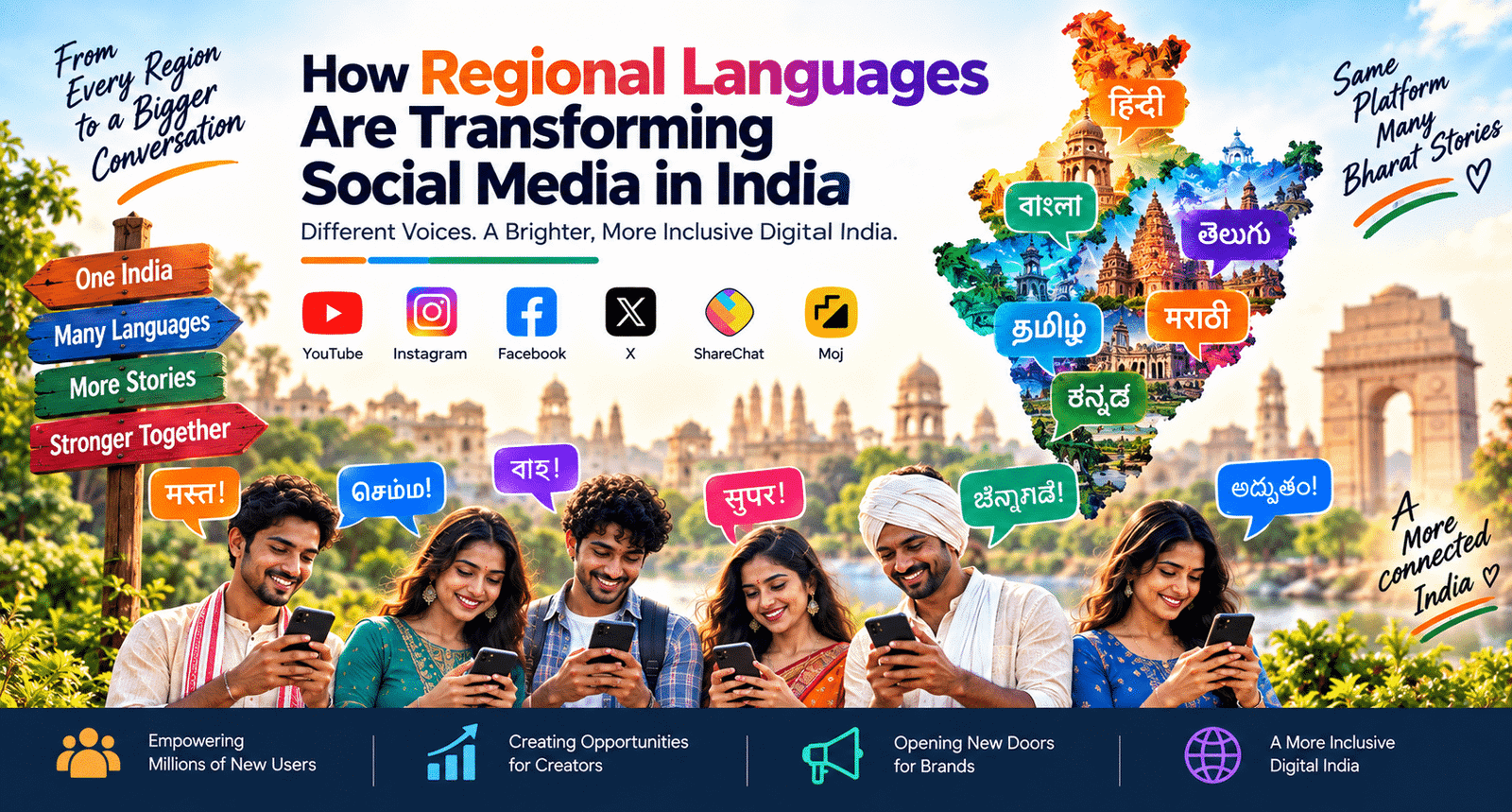
Regional languages are transforming social media in India by unlocking a massive, previously underserved audience of over 600 million vernacular internet users. Platforms like YouTube, Instagram, ShareChat, and Moj are seeing explosive growth in Hindi, Tamil, Telugu, Bengali, Kannada, and Marathi content. This shift is reshaping how brands market their products, how creators build communities, and how platforms design their user experiences — making regional language content one of the most powerful forces in India's digital economy today.
Introduction
Imagine scrolling through your social media feed and finding content that speaks to you — not just in words, but in the language your mother sang lullabies in. That is exactly what hundreds of millions of Indians are experiencing today.
For a long time, the internet in India was essentially an English-speaking club. Platforms were built in English, algorithms favored English content, and digital marketing strategies were designed with urban, English-literate audiences in mind. But that era is rapidly coming to an end.
Today, a farmer in Bihar records his agricultural tips in Bhojpuri and gets 2 million views. A homemaker in Coimbatore shares her cooking videos in Tamil and builds a thriving community of followers. A stand-up comedian from Kolkata cracks jokes in Bengali and lands brand deals with national companies. This is not a trend anymore — this is the new mainstream of Indian social media.
Regional languages social media India has become one of the most searched and talked-about phenomena in the country's digital marketing ecosystem. And for good reason. India is not one market — it is 22 officially recognized languages, hundreds of dialects, and billions of cultural stories waiting to be told.
In this blog, we will explore how regional languages are fundamentally transforming social media in India, why this shift matters for users, creators, and brands alike, and what the future holds for vernacular content in one of the world's largest digital markets.
The Rise of Vernacular Internet Users in India
The Numbers Tell the Story
India currently has approximately 850 million internet users, making it the second-largest online population in the world. But here is what makes India truly unique: the majority of these users are not comfortable consuming content in English.
According to a KPMG-Google report, Indian language internet users are expected to account for 75% of India's total internet user base. That translates to over 600 million people who prefer to search, watch, read, and engage in their native languages.
Key statistics driving this transformation:
- Hindi content consumption grew by over 94% in the last five years
- Tamil and Telugu YouTube channels collectively have billions of subscribers
- ShareChat, India's regional language social platform, crossed 180 million monthly active users
- Regional language searches on Google India grew by 5x compared to English searches
- Over 60% of new internet users in India come from Tier 2, Tier 3 cities, and rural areas
Who Are These New Users?
The new wave of Indian internet users does not look like the early adopters of the 2000s. They are:
- First-generation smartphone owners from small towns and villages
- Women homemakers who found their voice through regional content
- Elderly users connecting with family and entertainment in familiar languages
- Young students from non-English-medium backgrounds
- Small business owners learning to promote their products digitally
These users did not wait for the internet to adapt to them — they pushed platforms to adapt through sheer volume and engagement.
Why Regional Languages Are Dominating Social Media
Emotional Connection and Authenticity
Language is not just a communication tool — it is an emotional anchor. When someone watches a video in their mother tongue, they do not just understand the words; they feel the content at a deeper level. Regional language content creates a sense of belonging, trust, and authenticity that English content often cannot replicate for these audiences.
Research consistently shows that consumers are 3x more likely to trust and act on content presented in their native language. This psychological truth is at the heart of the regional language revolution on social media.
Affordable Smartphones and Cheap Data
Two game-changers accelerated the vernacular social media boom:
- Jio's 2016 disruption — When Reliance Jio entered the market with ultra-cheap data plans, it brought millions of first-time internet users online. These users were largely non-English speakers from Tier 2 and Tier 3 cities.
- Budget Android smartphones — With phones available for under ₹5,000, internet access became democratized across economic classes and geographies.
When these two forces combined, the internet stopped being an elite English club and became a truly democratic space — and regional languages rushed in to fill the content vacuum.
Content Relatability
Regional content creators understand something global platforms often miss: hyperlocal content wins. A video about a traditional festival in Rajasthan, a cooking show featuring authentic Odia recipes, or a comedy sketch based on Punjabi village life — these pieces of content generate massive engagement because they speak to lived experiences that mainstream media has long ignored.
Top Platforms Embracing Regional Language Content
YouTube — The King of Regional Content
YouTube is arguably the most significant platform for regional language content in India. Several YouTube channels in Hindi, Tamil, Telugu, and Bengali have crossed 10 million to 50 million subscribers.
Key developments:
- YouTube launched multilingual audio tracks, allowing creators to dub content into multiple Indian languages
- YouTube Shorts became a massive driver for regional language creators in smaller cities
- YouTube India introduced regional language creator programs to support vernacular content makers
Top regional language YouTube categories include entertainment, news, cooking, devotional content, and educational channels.
Instagram — Reels Fuel the Regional Revolution
Instagram Reels has become a powerhouse for regional language short-form content. With over 200 million users in India, Instagram saw a dramatic shift when it started optimizing its algorithm to promote regional content to relevant local audiences.
Regional language creators in Tamil, Telugu, Malayalam, Kannada, Gujarati, and Marathi are growing at double the rate of English creators.
Instagram's "Suggested Content" algorithm now actively recommends regional content based on location and language preferences.
Branded Reels in regional languages see higher engagement rates than their English counterparts
ShareChat and Moj — Built for Bharat
ShareChat is perhaps the most important platform in this story because it was built specifically for non-English Indian users. Available in 15 Indian languages, ShareChat allows users to create, share, and discover content entirely in their regional language.
ShareChat highlights:
- 180+ million monthly active users
- Content in languages including Bhojpuri, Odia, Punjabi, Haryanvi, Rajasthani, and more
- Acquired Moj (India's answer to TikTok after the ban) with 160+ million users
These platforms proved that there is massive commercial and community value in building for vernacular audiences from the ground up.
WhatsApp — The Silent Regional Language Powerhouse
While not traditionally seen as a "social media platform," WhatsApp is the digital heartbeat of regional India. With over 500 million users in India, WhatsApp groups in local languages drive content discovery, news sharing, business promotion, and community building at a scale that no other platform matches.
Regional language content routinely goes viral first on WhatsApp before reaching Instagram or YouTube — making it a critical but often underestimated player in the vernacular content ecosystem.
Twitter/X, Koo, and LinkedIn
- Koo (India's Twitter alternative) was built with regional language support at its core, allowing users to post in Hindi, Tamil, Telugu, and more
- Twitter/X India sees significant activity in regional languages, especially during political events, cricket matches, and regional elections
- LinkedIn is slowly but steadily seeing more regional language professional content, especially in Hindi
How Creators Are Capitalizing on Vernacular Content
The Rise of the Micro-Creator Economy
One of the most exciting consequences of the regional language boom is the emergence of a vernacular creator economy. Unlike the traditional influencer model dominated by English-speaking, metro-based creators, regional language creators come from diverse backgrounds and geographies.
What makes vernacular creators unique:
- Hyperlocal authority — They are trusted voices within their linguistic communities
- Higher engagement rates — Regional creators often see 5-10x higher engagement than national English influencers
- Lower competition — The vernacular content space is still less crowded, making it easier to build an audience
- Authentic storytelling — Their content feels genuine and unscripted
Monetization Paths for Regional Creators
Regional language creators are building sustainable careers through multiple revenue streams:
- YouTube AdSense revenue from regional content (CPM rates are improving)
- Brand collaborations with local and national brands targeting specific regions
- Affiliate marketing in regional languages
- Paid communities and subscription models on platforms like Patreon and Fanbase
- Live streaming gifts and donations on YouTube, Instagram, and Moj
Impact on Brand Marketing and Digital Advertising
Brands Can No Longer Ignore Regional Languages
For decades, Indian advertising was primarily conducted in Hindi and English — with the assumption that these two languages could reach "enough" consumers. That assumption is now dangerously outdated.
Brands that continue to market only in English and Hindi are essentially ignoring over 400 million potential customers who speak Tamil, Telugu, Bengali, Marathi, Gujarati, Kannada, and dozens of other languages.
The Shift to Vernacular Marketing
Forward-thinking brands are now:
- Creating dedicated regional language social media accounts (e.g., separate Instagram handles for Tamil, Telugu, Bengali audiences)
- Partnering with regional language influencers for authentic community marketing
- Running regional language ad campaigns on YouTube, Instagram, and ShareChat
- Producing regional language video content that resonates with local culture and values
- Investing in regional SEO to capture vernacular search traffic
Real-World Brand Examples
Amazon India runs extensive regional language campaigns during festivals like Pongal, Onam, Durga Puja, and Navratri — with dedicated content in Tamil, Malayalam, Bengali, and Gujarati.
Meesho, India's social commerce platform, built its entire brand strategy around regional language users, becoming one of India's most downloaded apps.
Fevicol (Pidilite) has long mastered regional language advertising, creating culturally rooted ads in multiple Indian languages that consistently go viral.
Flipkart's Big Billion Days campaigns now feature regional language content across all major social platforms.
ROI of Regional Language Marketing
Studies show that:
- Regional language digital ads have 50% lower cost-per-click than English ads
- Conversion rates for regional language e-commerce content are up to 2x higher
- Brand recall improves significantly when messaging is delivered in the audience's native language
Challenges of Regional Language Content on Social Media
While the opportunities are immense, the regional language social media space also faces significant challenges that creators, brands, and platforms must navigate.
Content Moderation at Scale
Moderating content in dozens of Indian languages and hundreds of dialects is an enormous technical and human challenge. Most platforms lack sufficient regional language content moderators, leading to:
- Misinformation spreading faster in regional languages
- Hate speech and harmful content going undetected
- Delayed responses to flagged regional language content
Monetization Gaps
Despite massive viewership numbers, regional language creators still earn significantly less than their English-speaking counterparts. This is largely because:
- Advertising CPM rates for regional languages remain lower than English
- Many brand deals still default to English creators, even when regional audiences are the target
- Limited native advertising tools exist for regional language platforms
Transliteration and Keyboard Challenges
Many regional language users type in Romanized versions of their language (e.g., typing Tamil words in English script). This creates challenges for:
- Searchability and discoverability of regional content
- Hashtag standardization
- SEO for vernacular content
Algorithmic Bias
Most global platform algorithms were originally designed with English content in mind. While improvements have been made, regional language content still sometimes struggles with:
- Lower algorithmic reach compared to English content
- Inconsistent content recommendations across languages
- Limited multilingual search optimization tools
Digital Literacy Gaps
While smartphone penetration has increased dramatically, digital literacy remains uneven across regional language user bases. This means some users may struggle with platform navigation, privacy settings, and distinguishing between credible and fake information.
The Role of AI and Technology in Regional Language Growth
AI-Powered Language Tools Are Breaking Barriers Social Media Platforms Investing in Indic AI
Technology is playing a transformative role in accelerating the regional language social media revolution.
Key technological developments:
- Google Translate and Indic NLP tools — Enabling real-time translation between Indian languages
- AI-powered dubbing — YouTube's multilingual audio feature allows creators to AI-dub content into other Indian languages
- Voice search in regional languages — Google Assistant and Alexa now support multiple Indian languages, changing how users discover content
- Regional language keyboards — Tools like Google Indic Keyboard and SwiftKey have made typing in Indian scripts much easier
Social Media Platforms Investing in Indic AI
Meta (Facebook/Instagram) has invested heavily in No Language Left Behind (NLLB) — an AI project designed to improve translation quality for hundreds of languages, including many Indian regional languages.
Google's Project Navlekha helped convert millions of offline regional language documents into digital format, expanding the digital content base for regional languages.
Microsoft's AI for Cultural Heritage project is working to preserve and digitize regional Indian languages, indirectly supporting the growth of digital content in these languages.
Future of Regional Languages on Social Media in India
What the Next Five Years Look Like
The regional language social media revolution in India is still in its early chapters. Here is what we can expect in the coming years:
- Super Apps with Multilingual Interfaces: India's next generation of super apps will be built with regional language support as a core feature — not an afterthought.
- Voice-First Regional Content: With voice search and audio content growing rapidly, regional language podcasts, audio series, and voice-based social media will see explosive growth.
- Regional Language Social Commerce: The integration of regional language content with e-commerce (social commerce) will unlock billions in rural and semi-urban consumer spending. Platforms like Meesho, DealShare, and Bulbul are already pioneering this space.
- Regional Language Gaming and Esports: Gaming content in regional languages is emerging as a major category, with creators building massive communities around games like Free Fire, BGMI, and mobile cricket games.
- Government and Public Sector Adoption: Government initiatives like Digital India are increasingly pushing for multilingual digital interfaces, which will further mainstream regional language internet usage.
- Hyperlocal Regional News on Social Media: Independent regional language news creators on YouTube and Instagram are already challenging traditional media houses. This trend will accelerate as advertising revenue follows vernacular audiences.
The 2030 Vision
By 2030, industry experts predict that:
- 90% of India's internet users will consume content primarily in regional languages
- The vernacular digital advertising market will be worth over $5 billion
- Regional language social media platforms will rival global platforms in active user numbers
Conclusion
The transformation of Indian social media through regional languages is not a passing trend — it is a structural, permanent shift in how one of the world's largest digital populations communicates, connects, creates, and consumes content.
From a grandmother in Gujarat sharing her recipes on WhatsApp, to a tech-savvy entrepreneur in Hyderabad building a Telugu-language YouTube empire, to global brands rethinking their marketing strategies to include Kannada-speaking consumers in Karnataka — regional languages are rewriting every rule of social media in India.
For creators, this is an unprecedented opportunity to build authentic communities and sustainable careers without needing to speak or create in English. For brands, it represents billions of untapped consumer relationships waiting to be built through culturally resonant, linguistically appropriate communication. For platforms, it is both a technical challenge and a massive growth opportunity. And for India as a nation, it is a celebration of linguistic diversity finding its rightful place in the digital age.
The internet in India was once a door that only English speakers could easily open. Regional languages have not just opened that door wider — they have rebuilt the entire building.
If you are a marketer, content creator, entrepreneur, or simply a curious observer of digital culture, the message is clear: the future of social media in India speaks in many voices, many scripts, and many beautifully diverse languages. The brands and creators who listen — and speak back — will be the ones who win.
FAQs
Which regional languages are most popular on social media in India?
The most popular regional languages on Indian social media are Hindi, Tamil, Telugu, Bengali, Kannada, Marathi, Malayalam, Gujarati, Punjabi, and Odia. Hindi dominates in terms of sheer volume, but Tamil and Telugu punch above their weight in terms of content quality and engagement, particularly on YouTube. Bengali has a massive social media presence on Facebook and YouTube, while Marathi and Gujarati communities are highly active on Instagram and WhatsApp. The fastest-growing regional languages on social media include Bhojpuri, Rajasthani, and Haryanvi, driven largely by short-video content.
What platforms are best for regional language content in India?
The best platforms for regional language content in India are:
- YouTube — Best for long-form regional language videos and Shorts
- Instagram — Excellent for regional Reels and community building
- ShareChat — Purpose-built for regional language content in 15 Indian languages
- Moj — Short-video platform focused on vernacular content
- WhatsApp — Unparalleled for regional language community engagement
- Facebook — Still very strong for regional language content in smaller cities and rural areas
- Koo — Designed for regional language microblogging
The best platform depends on your target language, audience demographics, and content format.
How can brands effectively use regional languages in their social media strategy?
Brands can effectively use regional languages in their social media strategy by following these steps:
- Research your target audience — Identify which languages your key customer segments speak
- Create dedicated regional language accounts — Don't just translate your English content; create culturally specific regional content
- Partner with regional influencers — Work with trusted voices within specific language communities
- Use regional language hashtags — Optimize your content for regional language discovery
- Invest in regional language video ads — Platforms like YouTube and Facebook allow you to target by language
- Localize, don't just translate — Cultural nuance matters more than linguistic accuracy alone
- Run regional language campaigns around local festivals and events relevant to specific communities
Is regional language content more effective than English content in India?
For reaching the majority of Indian internet users — yes, regional language content is significantly more effective than English content. Studies show that users spend 3x more time on content in their native language, have higher trust levels, and are more likely to take action (purchase, share, or engage). For brands targeting Tier 2 and Tier 3 cities, rural areas, and non-English-educated demographics, regional language content is not just more effective — it is essential. However, for B2B brands, premium segments, and urban professionals, English content still holds strong relevance. The ideal strategy for most brands is a bilingual or multilingual approach that serves both audiences.
How are regional language creators monetizing their social media content in India?
Regional language creators in India are monetizing their social media content through multiple avenues:
- YouTube Ad Revenue — Though CPM rates are lower for regional languages, high view volumes can still generate significant income
- Brand Collaborations — National and regional brands pay regional creators for sponsored content
- Affiliate Marketing — Promoting products through referral links in regional language captions and videos
- Live Streaming Gifts — On platforms like YouTube, Instagram Live, and Moj, followers can send virtual gifts
- Paid Communities — Exclusive groups on Telegram or WhatsApp with premium content
- Merchandise — Language-specific branded merchandise for dedicated fan bases
- Speaking and Workshop Fees — Established regional creators earn from training others in content creation
The monetization landscape is improving rapidly as brands realize the commercial value of regional audiences.
What is the future of regional languages on social media in India?
The future of regional languages on Indian social media is exceptionally bright and transformative. Key trends shaping this future include:
- AI and machine learning will make real-time regional language translation and dubbing seamless, allowing content to cross language boundaries
- Voice-first social media will give regional language users new ways to create and consume content without typing barriers
- Social commerce in regional languages will drive e-commerce growth in rural and semi-urban India
- More purpose-built vernacular platforms will emerge to serve specific language communities
- Brand investment in vernacular marketing will grow exponentially as more companies realize they cannot afford to ignore these audiences
- By 2030, regional language content is expected to represent the majority of all digital content consumed in India
Regional languages will not just participate in India's social media future — they will define it.