

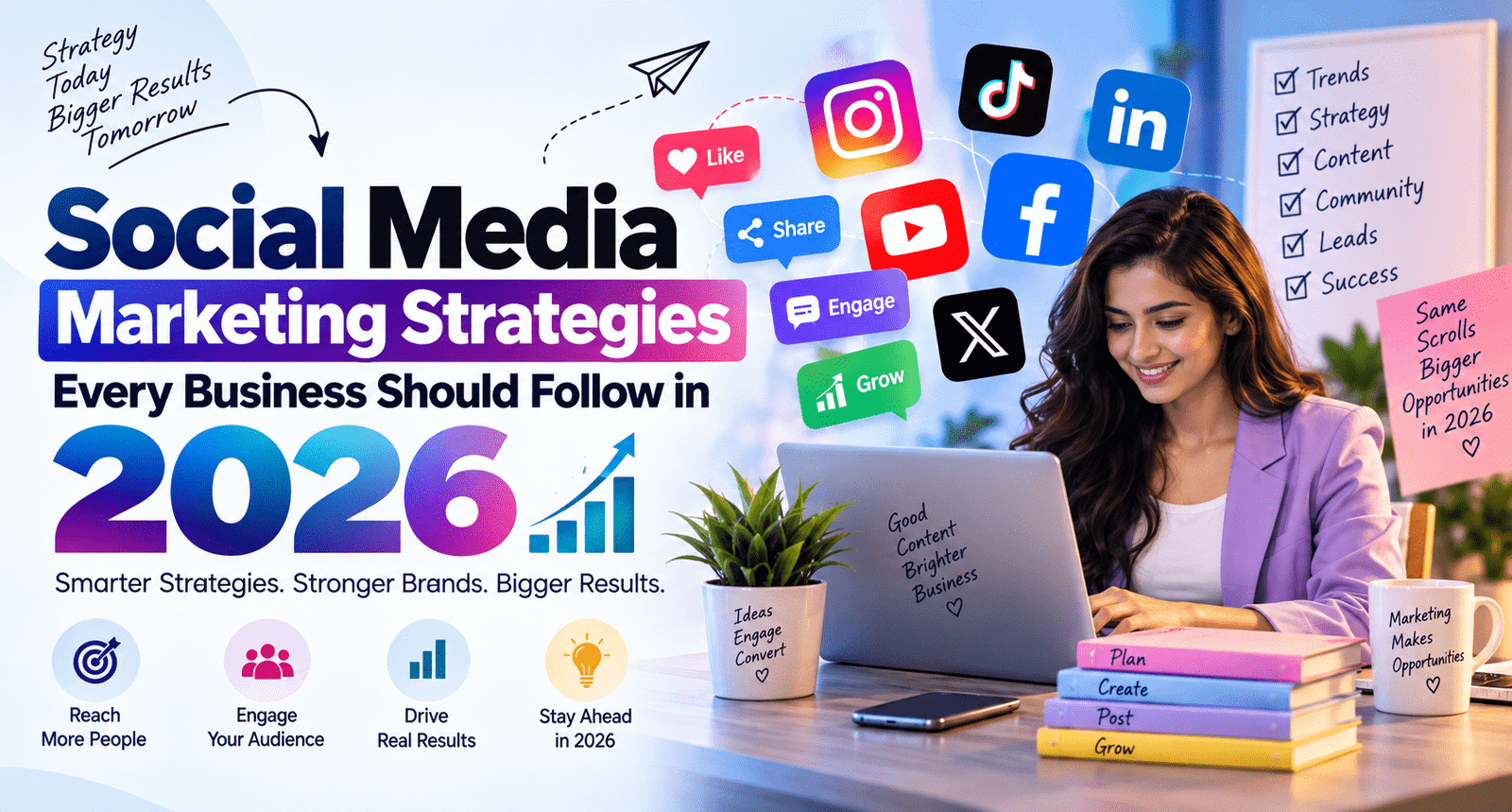
Quick Answer:
The article presents the most effective Social Media Marketing Strategies for 2026, focusing on deep audience research, platform-specific content, AI-powered tools, short-form video, social commerce, influencer partnerships, community building, UGC, social SEO, privacy, and paid advertising. It emphasizes consistency, authenticity, and data-driven decision-making. Businesses should focus on meaningful metrics such as engagement, shares, leads, conversions, traffic, and revenue rather than vanity metrics.
Introduction
If you think social media marketing is the same game it was five years ago, think again.
In 2026, social media has evolved into one of the most sophisticated, data-driven, and hyper-personalized marketing ecosystems ever built. Algorithms are smarter. Audiences are savvier. Competition is fiercer. And the brands winning the game are not the ones posting the most — they are the ones posting the smartest.
Whether you are a startup trying to make your first impression, a mid-sized business looking to scale, or an established enterprise defending market share, your social media strategy needs a serious upgrade.
This guide is your comprehensive playbook. We break down every strategy, tactic, and tool you need to dominate social media marketing in 2026 — backed by data, real-world insights, and actionable steps you can implement today.
Let us get into it.
Why Social Media Marketing Still Matters in 2026
Before diving into strategy, it is worth asking: is social media marketing still worth the investment?
The answer is a resounding yes — and the numbers prove it.
- There are now over 5.5 billion active social media users globally as of 2026.
- The average person spends approximately 2 hours and 45 minutes per day on social media platforms.
- Over 78% of consumers report that social media posts influence their purchasing decisions.
- Social commerce revenue is projected to exceed $1.3 trillion globally in 2026.
- 91% of B2B marketers now use LinkedIn as part of their primary content distribution strategy.
Social media is no longer just a brand awareness tool. It is a full-funnel marketing engine that drives discovery, consideration, conversion, and loyalty — all in one place.
Businesses that treat social media as an afterthought in 2026 are leaving enormous revenue on the table.
Know Your Audience Deeper Than Ever Before
Every great social media strategy starts with one non-negotiable foundation: knowing exactly who you are talking to.
In 2026, surface-level audience insights are not enough. Demographics like age and location are just the beginning. The brands winning on social media are building psychographic profiles — understanding what their audience values, fears, dreams about, laughs at, and scrolls past.
How to Build Deep Audience Intelligence
- Use First-Party Data Aggressively: With third-party cookies largely phased out, first-party data — information your audience willingly gives you — is gold. Use social media polls, quizzes, lead magnets, and surveys to collect meaningful insights directly from your followers.
- Analyze Behavioral Patterns: Go beyond vanity metrics. Study what content your audience saves, shares, comments on, and returns to. These behaviors reveal genuine interest far more accurately than simple likes.
- Create Micro-Personas: Instead of targeting one broad persona, develop micro-personas for each segment of your audience. A fitness brand, for example, might have separate personas for beginners, competitive athletes, and health-conscious seniors — each requiring a completely different content approach.
- Monitor Conversations, Not Just Mentions: Use social listening tools like Brandwatch, Sprout Social, or Mention to track conversations happening around your niche — even when your brand is not tagged. This tells you what your audience is really talking about, what problems they need solved, and what language they use.
- Practical Tip: Revisit and update your audience personas every quarter. Social behaviors, preferences, and platforms shift constantly in 2026. Your understanding of your audience should never be static.
Build a Platform-Specific Content Strategy
One of the biggest mistakes businesses make in 2026 is copy-pasting the same content across every social media platform and wondering why results are mediocre.
Each platform has its own culture, algorithm, content format preferences, and audience expectations. Treating them all the same is like wearing a swimsuit to a business meeting — technically, you showed up, but the execution was completely wrong.
Platform-by-Platform Breakdown for 2026
- Instagram: Instagram in 2026 remains a powerhouse for visual storytelling. Reels continue to dominate organic reach, while Stories drive engagement and direct message conversations. The algorithm heavily rewards content that generates saves and shares over passive likes. Focus on aspirational yet relatable content, strong visual branding, and a mix of educational carousels and entertaining Reels.
- LinkedIn: LinkedIn has exploded beyond its B2B roots. In 2026, it is a full content platform where thought leadership, behind-the-scenes stories, and even entertainment content perform well. Long-form newsletters, video content, and personal stories from founders and employees generate exceptional organic reach. If you are in the B2B space, LinkedIn is non-negotiable.
- YouTube: YouTube remains the undisputed king of long-form video and is now deeply integrated with Google search results. YouTube Shorts have carved out a strong position alongside TikTok. A dual YouTube strategy — combining Shorts for discovery and long-form videos for depth — is the winning formula for 2026.
- Facebook: While younger demographics have largely migrated elsewhere, Facebook remains dominant among audiences aged 35 and above and is exceptionally powerful for community building through Groups. Facebook advertising also continues to offer some of the most sophisticated targeting options available.
- Pinterest: Pinterest has quietly become one of the highest purchase-intent platforms available. Users come to Pinterest actively looking for ideas and products to buy. If your business sells visually appealing products or services, Pinterest deserves serious attention in your 2026 strategy.
- X (Formerly Twitter): X has transformed into a real-time conversation and news platform. It works best for brands that can engage in trending conversations, provide fast customer support, and establish thought leadership through sharp, insightful commentary.
- Threads: Meta's Threads continues to grow as a conversational platform. Businesses using Threads effectively in 2026 are treating it as a casual, community-focused extension of their Instagram presence.
Key Rule to Remember
Create natively for each platform. A vertical Reel, a horizontal YouTube video, a text-heavy LinkedIn post, and a visually pinned Pinterest graphic all require different approaches — even if they communicate the same core message.
Leverage AI-Powered Tools for Smarter Marketing
Artificial intelligence is no longer a futuristic concept for social media marketers — it is an everyday operational reality in 2026.
Brands that embrace AI tools are producing more content, with better personalization, at a fraction of the time and cost it took just three years ago.
How AI Is Transforming Social Media Marketing
- AI-Powered Content Creation: Tools like Jasper, Copy.ai, and ChatGPT-powered platforms help marketing teams generate caption drafts, blog outlines, ad copy variations, and content calendars in minutes. This does not replace human creativity — it accelerates it.
- Predictive Analytics: AI analyzes historical engagement data to predict which types of content will perform best, which posting times will maximize reach, and which audience segments are most likely to convert. Platforms like Hootsuite and Sprout Social now have built-in AI prediction features.
- Personalized Ad Targeting: Social media ad platforms have integrated AI deeply into their targeting systems. Machine learning algorithms optimize ad delivery in real time, showing your content to people most likely to take specific actions — without manual bidding adjustments.
- Chatbots and AI Customer Service: AI-powered chatbots on social media platforms handle customer inquiries 24/7, qualify leads, and even complete simple transactions. This keeps response times instant and customer satisfaction high without requiring round-the-clock human staffing.
- Sentiment Analysis: AI tools analyze comments, reviews, and mentions to gauge audience sentiment in real time. If a post is generating unexpectedly negative reactions, you know before it becomes a PR crisis.
- Content Moderation: For businesses managing active communities, AI moderation tools automatically flag and filter harmful or inappropriate comments, keeping brand spaces safe without constant manual monitoring.
Important Caveat
AI is a tool, not a replacement for strategy. The brands failing with AI in 2026 are those using it to churn out generic, soulless content. Use AI to enhance your human creativity — never to replace it.
Short-Form Video Is Still King — But With a Twist
Short-form video has dominated social media since the rise of TikTok, and in 2026, it is still the most powerful content format available.
But here is the twist: the definition of "short" has gotten smarter, not just shorter.
In 2026, successful short-form video is not about racing to squeeze your message into 15 seconds. It is about capturing and holding attention with maximum efficiency — whether that is 30 seconds or 3 minutes.
Short-Form Video Strategies That Work in 2026
- Hook Within the First 1.5 Seconds: With attention spans shorter than ever, your video must deliver a compelling hook — a surprising statement, a bold visual, a question, or a pattern interrupt — within the very first moment. If you do not grab attention immediately, users scroll past.
- Prioritize Value Over Production Quality: Authentic, slightly rough-around-the-edges videos consistently outperform over-produced, corporate-looking content on most platforms. Audiences have learned to associate high production value with advertising — and they skip advertising.
- Optimize for Silent Viewing: A significant percentage of social media video is watched without sound. Use captions, on-screen text, and strong visual storytelling to ensure your video communicates even on mute.
- Repurpose Strategically: Create once, distribute everywhere. One well-made short-form video can be repurposed as a TikTok, an Instagram Reel, a YouTube Short, a Facebook video, and even embedded into a blog post. This maximizes return on every piece of content created.
- Series Content Drives Return Viewers: Instead of standalone videos, create episodic content — a weekly tip series, an ongoing story, a recurring format. This gives audiences a reason to come back and trains the algorithm to deliver your content to loyal viewers.
- Use Trending Audio Strategically: On TikTok and Instagram, using trending audio can dramatically amplify organic reach. But choose audio that fits your brand naturally. Forced trend-chasing looks awkward and can damage brand credibility.
Social Commerce: Turn Scrolling Into Selling
Social commerce — the ability to discover and purchase products entirely within a social media platform — has gone from experimental feature to mainstream retail channel in 2026.
Consumers no longer need to leave Instagram, TikTok, or Pinterest to complete a purchase. And businesses that have built seamless social shopping experiences are seeing dramatic increases in conversion rates.
Social Commerce Strategies for 2026
- Set Up Native Storefronts: Every major platform — Instagram, TikTok, Facebook, and Pinterest — offers native shopping features. Set up your storefront on each relevant platform with complete product catalogs, compelling imagery, and accurate pricing. Reduce every possible friction point between discovery and purchase.
- Make Your Content Shoppable: Tag products directly in your posts, Reels, Stories, and TikTok videos. When users see a product they love in your content, they should be able to tap and purchase in seconds.
- Live Shopping Events: Live commerce — where brands sell products in real-time via live video streams — is an exploding trend in 2026. Live shopping events create urgency, entertainment, and community simultaneously. Brands report significantly higher conversion rates from live commerce compared to traditional social ads.
- Leverage Customer Reviews and Social Proof: Integrate customer reviews, star ratings, and UGC (user-generated content) directly into your social commerce storefronts. Social proof is the most powerful conversion trigger in e-commerce.
- Streamline the Checkout Experience: Every extra tap or page load between "I want this" and "I bought this" costs you a sale. Optimize your social checkout experience ruthlessly. Offer multiple payment options, including buy-now-pay-later services, which continue to grow in popularity.
Influencer Marketing Has Evolved — Here's How to Use It
Influencer marketing has undergone a complete transformation. The era of paying a celebrity with millions of followers to post a single endorsement photo and calling it a campaign is over.
In 2026, influencer marketing is about authentic partnerships, long-term relationships, and measurable results.
The Evolution of Influencer Marketing
- Micro and Nano Influencers Are Winning: Influencers with 1,000 to 100,000 followers — often called micro and nano influencers — consistently deliver higher engagement rates, more authentic audience connections, and better ROI than mega-influencers. Their audiences trust them deeply because they feel like real people rather than celebrities.
- Long-Term Brand Ambassadorships Over One-Off Posts: Single sponsored posts generate awareness but not trust. The most effective influencer campaigns in 2026 involve long-term partnerships where influencers genuinely integrate your brand into their ongoing content. Audiences notice the difference between a paid plug and a genuine recommendation.
- Creator-Led Content Direction: Smart brands in 2026 give influencers significant creative freedom. Influencers know their audience better than you do. Provide clear brand guidelines and campaign goals, then step back and let creators execute in their authentic voice.
- Performance-Based Partnerships: Many brands now structure influencer deals around performance metrics — affiliate commissions, trackable discount codes, UTM-linked landing pages. This aligns incentives and ensures both parties are invested in real results.
- Employee Influencers: One of the fastest-growing influencer trends in 2026 is the rise of employee advocacy — turning your own team into brand advocates on social media. Employee content generates enormous trust because it provides an authentic inside look at your brand.
Community Building Over Follower Counting
Here is the uncomfortable truth that most businesses resist: a highly engaged community of 5,000 followers is worth exponentially more than a disengaged audience of 500,000.
In 2026, the smartest brands on social media have shifted their entire mindset from chasing follower counts to building genuine communities.
How to Build a Thriving Social Media Community
- Create Dedicated Community Spaces: Facebook Groups, Discord servers, LinkedIn Groups, and Reddit communities allow brands to create owned spaces where their most loyal audience members gather, connect, and engage. These spaces generate organic conversations that no algorithm can replicate.
- Engage Actively and Authentically: Community building requires showing up — consistently. Respond to comments. Ask questions. Acknowledge your most loyal members by name. Make real people feel seen and valued. Automation has its place, but community engagement should always feel human.
- Host Regular Events: Weekly live Q&As, monthly challenges, virtual meetups, and exclusive webinars give community members reasons to stay engaged and look forward to something. Events transform passive followers into active participants.
- Celebrate Your Community: Feature member success stories, spotlight loyal followers, and acknowledge contributions publicly. When people feel celebrated, they become your most powerful brand advocates.
- Give Before You Take: The most successful brand communities are built on genuine value exchange. Before asking your community to buy anything, give them education, entertainment, inspiration, and connection. Build trust first — revenue follows naturally.
Data Privacy and Ethical Marketing Practices
In 2026, data privacy is not just a legal compliance issue — it is a competitive advantage.
Consumers are more privacy-conscious than ever. They choose brands they trust. And trust is built through transparent, ethical data practices and marketing that respects personal boundaries.
Privacy-First Social Media Marketing in 2026
- Be Transparent About Data Collection: Clearly communicate what data you collect, how you use it, and how you protect it. Make privacy policies readable by actual humans — not just legal teams.
- Seek Consent Explicitly: With global privacy regulations tightening — GDPR, CCPA, and newer regulations introduced in 2025 — explicit consent for marketing communications is non-negotiable. Make opting in easy and opting out even easier.
- Prioritize First-Party Data: Build your marketing strategy around data your audience shares with you directly — email lists, loyalty programs, social media interactions, and survey responses. This data is more reliable, more ethical, and more future-proof than third-party data ever was.
- Avoid Manipulative Marketing Tactics: Dark patterns, misleading claims, manufactured urgency, and pressure tactics erode trust at a time when trust is the most valuable currency in marketing. Ethical marketing is not just the right thing to do — it is the smart business strategy.
Paid Social Advertising Strategies for 2026
Organic reach alone will not scale most businesses. Paid social advertising remains one of the highest-ROI marketing channels available — but only when executed with precision and intelligence.
Paid Social Strategies That Deliver in 2026
- Use the Full Funnel: Many businesses make the mistake of only running bottom-funnel conversion ads. A complete paid social strategy includes awareness ads to introduce cold audiences to your brand, consideration ads to build interest and trust, and conversion ads to close sales from warm audiences.
- Creative Is Your Most Important Variable: In 2026, ad creative — the visual and copy combination — is the single most important factor in paid social performance. Algorithm optimization is largely automated. Your competitive advantage comes from producing better, more compelling, more relevant creative than your competitors.
- Test Relentlessly: Run structured creative tests with clear hypotheses. Test hooks, visuals, CTAs, formats, and messaging angles systematically. The brands winning at paid social in 2026 have robust testing frameworks, not just gut feelings.
- Retargeting With Precision: Use retargeting audiences strategically — targeting website visitors, video viewers, post engagers, and existing customers with tailored messages relevant to exactly where they are in the buyer journey.
- Leverage Lookalike Audiences: Feed your best customer data into lookalike audience tools. Social platforms use this to find new audiences who share characteristics with your existing customers — dramatically improving cold audience targeting efficiency.
User-Generated Content (UGC) as a Trust-Builder
Nothing builds trust faster than real customers sharing real experiences with your brand.
User-generated content — photos, videos, reviews, testimonials, and unboxing videos created by customers — is the most credible marketing content you can ever distribute. And in 2026, UGC is more powerful than ever.
How to Build a UGC Engine for Your Brand
- Ask for It Explicitly: Most customers who have positive experiences simply do not think to share them unless prompted. After a purchase, ask customers to share their experience on social media. A gentle email nudge, packaging insert, or follow-up message can dramatically increase UGC volume.
- Create Branded Hashtags: A memorable, specific branded hashtag makes UGC discoverable and organizes a community around shared experiences. Promote your hashtag consistently across all marketing touchpoints.
- Feature UGC Prominently: Re-share customer content on your official channels — with permission and credit. This rewards customers for creating content, encourages others to do the same, and provides your brand with authentic social proof at zero content creation cost.
- Run UGC Campaigns and Contests: Challenge your community to create content around a specific theme, experience, or product. Offer incentives like prizes, features, or discounts. UGC campaigns consistently generate significant content volume and organic reach.
- Use UGC in Paid Ads: Customer-created content often outperforms professionally produced content in paid advertising — because it looks authentic and trustworthy rather than promotional. Test UGC creative in your paid social campaigns aggressively.
Social SEO: How to Get Found on Social Platforms
Here is one of the biggest shifts in social media marketing in 2026: social platforms are now search engines.
Millions of people — particularly Gen Z and Millennials — search TikTok, Instagram, and YouTube before Google when looking for recommendations, how-to guides, product reviews, and local businesses.
If your content is not optimized for social search, you are invisible to this enormous and growing search behavior.
Social SEO Best Practices for 2026
- Use Keywords in Your Captions: Write captions that naturally include the words and phrases your target audience is searching for. Think about what questions your ideal customer is typing into TikTok or Instagram search, and answer those questions in your content.
- Optimize Your Profile and Bio: Your username, profile name, bio, and even your profile photo all contribute to how you appear in social search. Include relevant keywords in your profile name and bio where appropriate.
- Add Alt Text to Images: Instagram, Facebook, and LinkedIn allow you to add alt text to images. This improves accessibility and signals to platform algorithms what your content is about — boosting discoverability.
- Use Relevant Hashtags Strategically: Hashtags are still valuable for discoverability in 2026, particularly on Instagram and TikTok. Focus on a combination of broad, niche, and branded hashtags rather than stuffing posts with dozens of irrelevant tags.
- Optimize Video Titles and Descriptions: On YouTube and TikTok, your video title and description function like SEO metadata. Include target keywords naturally, write descriptive captions, and use closed captions to make your content indexable.
- Post Consistently to Build Platform Authority: Algorithms on social platforms reward consistent creators with broader reach. Consistent posting signals relevance and reliability, which improves your content's performance in both feed algorithms and search results.
Consistency, Authenticity, and Brand Voice
Amid all the strategies, tools, and tactics, two qualities continue to separate brands that build lasting social media presence from those that chase short-term spikes: consistency and authenticity.
Building Consistent Brand Presence
- Create a Content Calendar: Plan your content weeks — ideally months — in advance. A content calendar eliminates last-minute scrambling, ensures balanced topic coverage, and maintains posting consistency across all platforms.
- Define Your Brand Voice: Your brand voice should be distinctive, recognizable, and consistent across every platform and piece of content. Document your voice guidelines — the words you use, the tone you take, the topics you engage with, and the lines you never cross.
- Show Up Even When Engagement Is Low: Every brand has slow periods. The brands that maintain consistent presence through quiet periods are the ones that dominate when momentum returns. Social media rewards persistence above almost all other qualities.
The Authenticity Imperative
In 2026, audiences have highly sophisticated BS detectors. They can identify performative authenticity almost immediately.
True authenticity means:
- Sharing your real opinions, even when they are not universally popular
- Acknowledging mistakes and handling them publicly with grace
- Showing the human beings behind your brand — not just polished marketing
- Aligning your content with your actual values — not just values that test well with audiences
- Being willing to have real conversations rather than broadcasting marketing messages
Brands that genuinely show up as their authentic selves — even when that is imperfect — build the kind of loyalty that no advertising budget can buy.
How to Measure Social Media Success in 2026
You cannot improve what you do not measure. But in 2026, the metrics worth measuring are different from what many businesses are still tracking.
Stop obsessing over vanity metrics. Follower counts, total impressions, and raw like counts tell you very little about actual business impact. Focus on metrics that connect to real outcomes.
Metrics That Actually Matter in 2026
- Engagement Rate: Engagement rate (total engagements divided by reach or followers) tells you how resonant your content is with your audience. A smaller, highly engaged audience is more valuable than a large, passive one.
- Saves and Shares: These are the highest-value engagement signals on most platforms. When someone saves or shares your content, they are declaring it genuinely valuable. Track these obsessively.
- Reach vs. Impressions: Reach measures unique accounts who saw your content. Impressions measure total views, including repeat views. Both matter, but reach growth indicates you are expanding into new audiences.
- Social Commerce Conversion Rate: If you are running social commerce, track the percentage of product page viewers who complete a purchase. Optimize relentlessly for this number.
- Link Clicks and Traffic Generated: Track how much website traffic your social media presence generates using UTM parameters and platform analytics. This connects social activity to business outcomes.
- Leads and Revenue Attributed: The ultimate measure of social media success. Use attribution models to understand how social media touchpoints contribute to lead generation and revenue — even when they are not the direct last-touch conversion source.
- Response Rate and Time: For customer service interactions, track how quickly and consistently your team responds. Fast, helpful responses build trust and prevent public complaints from escalating.
- Community Growth Rate: Track not just the size of your community but how quickly it is growing — and how much of that growth is organic versus paid.
Build a Regular Reporting Rhythm
Review your social media analytics weekly for tactical decisions, monthly for strategic adjustments, and quarterly for comprehensive strategy reviews. Data-driven social media marketing is an ongoing practice, not a periodic audit.
Conclusion
Social media marketing in 2026 is simultaneously more complex and more opportunity-rich than it has ever been.
The businesses winning on social media are not necessarily the ones with the biggest budgets or the most followers. They are the ones who truly understand their audience, show up with consistency and authenticity, create content that serves people rather than just promotes products, and use data intelligently to keep improving.
The strategies outlined in this guide — from AI-powered marketing tools and short-form video mastery to social commerce, community building, and social SEO — represent a comprehensive framework for building a social media presence that drives real business results in 2026 and beyond.
The most important step is always the next one: take what you have learned here and put it into action.
Start with your audience. Choose your platforms. Create your content calendar. Show up consistently. Measure what matters. Optimize relentlessly.
Your strongest social media presence is not behind you. It is ahead of you — and it starts today.
FAQs
What is the most important social media marketing strategy for businesses in 2026?
There is no single "most important" strategy because success depends on your industry, audience, and goals. However, if you had to prioritize, building a platform-specific content strategy driven by deep audience understanding would deliver the highest return. Knowing exactly who you are speaking to, creating content native to each platform they use, and showing up with consistency and authenticity outperforms any individual tactic or trend. Everything else — AI tools, paid ads, influencer partnerships — amplifies this foundation, but cannot replace it.
How many social media platforms should a business be active on in 2026?
Quality always beats quantity. Most businesses are better served by executing brilliantly on two or three platforms than spreading resources thin across six or seven. Choose platforms based on where your target audience is most active and where your content format strengths align best. A visual product brand might focus on Instagram, Pinterest, and TikTok. A B2B service company might prioritize LinkedIn and YouTube. Start focused, prove what works, then expand strategically.
How often should a business post on social media in 2026?
Posting frequency varies by platform. General 2026 guidelines suggest: Instagram — 4 to 7 Reels per week plus daily Stories; TikTok — 1 to 3 posts per day for maximum algorithm favor; LinkedIn — 3 to 5 times per week; YouTube — 1 to 2 long-form videos per week plus several Shorts; Facebook — 3 to 5 times per week. However, consistency matters more than volume. Posting 3 times per week without fail beats posting 10 times this week and disappearing for two weeks.
Is organic social media marketing still effective in 2026, or do you need paid advertising?
Both are valuable and work best together. Organic social media builds genuine community, brand authority, and long-term audience loyalty. Paid social advertising accelerates reach, drives measurable conversions, and fills your pipeline faster. In 2026, organic reach has declined on most platforms due to algorithm changes, meaning paid amplification is often necessary to reach beyond your existing audience. The most effective strategy is an integrated approach: use organic content to build trust and community, and use paid advertising to amplify your best-performing content and reach new audiences.
How can small businesses with limited budgets compete on social media in 2026?
Small businesses have a significant advantage that large corporations struggle to replicate: authenticity and genuine human connection. You can show faces, share real stories, engage personally with every comment, and build a community that feels like family — something a Fortune 500 brand's marketing department finds nearly impossible to fake. Focus on one or two platforms. Create content consistently. Engage deeply with every follower. Leverage free AI tools to streamline content creation. Partner with micro-influencers through product exchanges rather than expensive paid deals. Encourage and feature UGC. And invest even modest ad budgets into boosting your top-performing organic content to expand reach efficiently.
How do you create a social media strategy from scratch in 2026?
Building a social media strategy from scratch involves six essential steps. First, define your business goals and what social media success specifically looks like for your business — brand awareness, lead generation, direct sales, or customer retention. Second, research your target audience deeply to understand who they are, where they spend time online, and what content resonates with them. Third, choose the two or three platforms most aligned with your audience and content strengths. Fourth, develop a content strategy specific to each platform, planning content pillars, formats, and posting cadence. Fifth, create a 30-day content calendar and begin executing consistently. Sixth, monitor your analytics weekly, identify what is performing, and optimize your approach monthly. Strategy is not set once and forgotten — it evolves continuously based on data and changing platform dynamics.