

Quick Answer:
What are the best Indian foods you must try at least once?
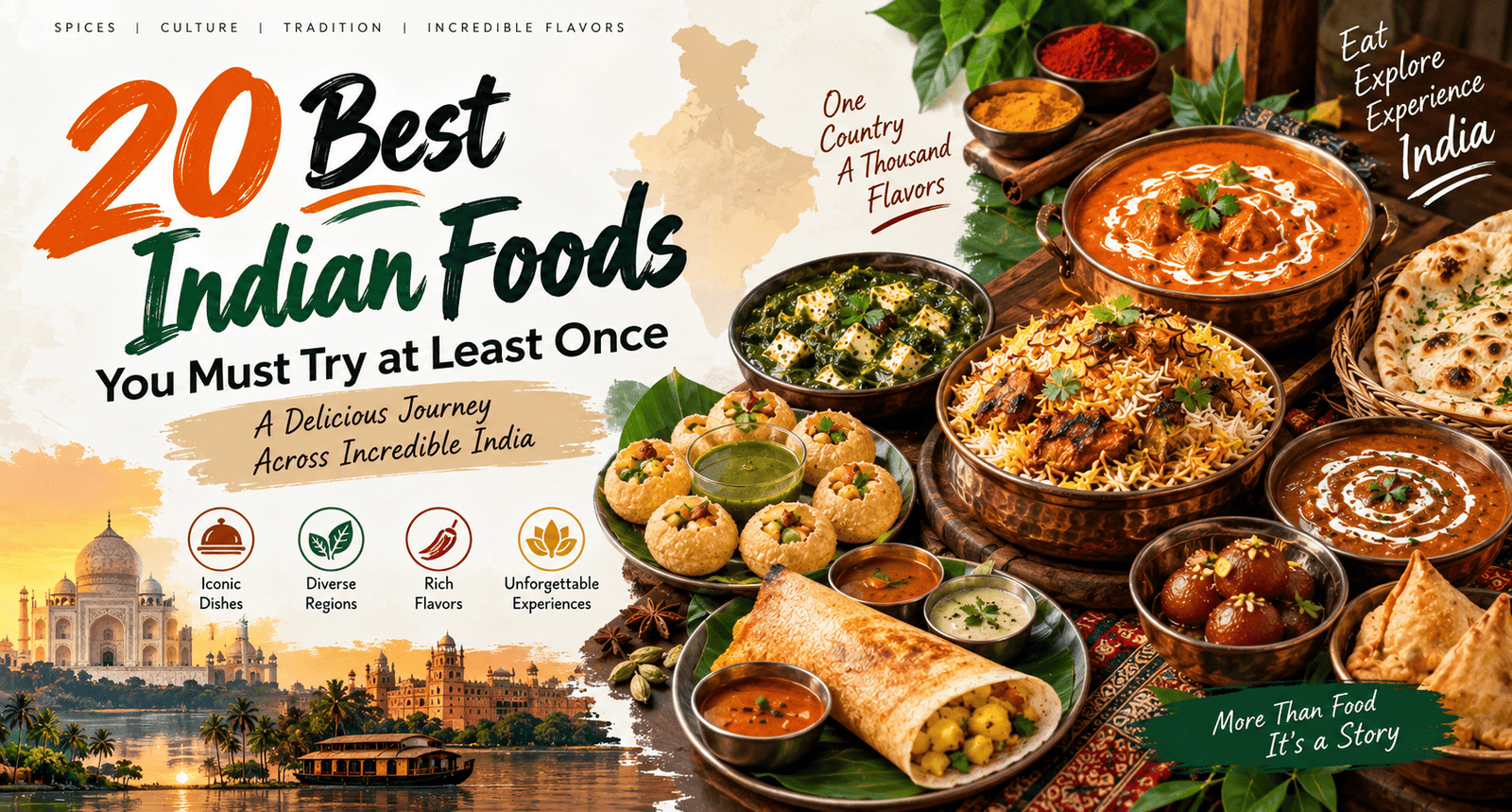
The best Indian foods you must try include Butter Chicken, Biryani, Masala Dosa, Rogan Josh, Palak Paneer, Chole Bhature, Pani Puri, Dal Makhani, Tandoori Chicken, Samosa, Hyderabadi Biryani, Pav Bhaji, Gulab Jamun, Rajma Chawal, Aloo Paratha, Goan Fish Curry, Khichdi, Jalebi, Seekh & Galouti Kebab, and Rasmalai. Each dish represents the extraordinary diversity, depth of flavor, and centuries-old culinary traditions that make Indian cuisine one of the most beloved in the world. These dishes span vegetarian, non-vegetarian, and vegan profiles across multiple regions — from the creamy, tandoor-heavy kitchens of North India to the coconut-laced coastal curries of the South and the mustard-oil-rich preparations of the East.
Introduction
Imagine a cuisine so vast, so complex, and so irresistibly delicious that it has conquered taste buds across every continent on Earth. A cuisine that can be fiery and bold in one state, delicate and aromatic in another, and sweet and comforting in yet another. A cuisine where a single spice — turmeric, cardamom, or cumin — can completely transform a dish into something extraordinary.
Welcome to Indian food — arguably the world's greatest culinary adventure.
With over 1.4 billion people, 28 states, 8 union territories, and thousands of years of history, India doesn't just have one cuisine. It has hundreds. Each region, each community, and each household carries its own secret recipes, cooking techniques, and food philosophies passed down through generations. From the snow-capped mountains of Kashmir to the sun-drenched beaches of Kerala, from the royal kitchens of Rajasthan to the street food stalls of Mumbai — Indian food tells a story that no history book can fully capture.
Whether you're a seasoned foodie traveling to India for the first time, a curious home cook looking to expand your culinary horizons, or someone who simply wants to know what all the fuss is about — this guide to the 20 best Indian foods you must try at least once is your definitive starting point.
We're not just listing dishes here. We're taking you on a full sensory journey — the sizzle of a tawa, the fragrance of freshly ground spices, the burst of chutney on your tongue, and the warm, satisfied feeling that only a great Indian meal can deliver.
Each dish in this guide comes with its Region of Origin, Flavor Profile, and Dietary Type so you can instantly identify what suits your palate, your dietary preferences, and your culinary curiosity.
Buckle up. Your taste buds are about to experience something life-changing.
Why Indian Food Is Unlike Anything Else in the World
Before we dive into the 20 best Indian foods, it's worth understanding what makes Indian cuisine so extraordinary from a culinary standpoint.
🌶️ The Spice Factor
India is the world's largest producer and consumer of spices. Indian cooking uses over 200 different spices, often layering multiple spices together in precise combinations to create flavor profiles that are impossibly complex yet perfectly balanced.
🕌 A History Written in Recipes
Indian cuisine has been shaped by Mughal emperors, Portuguese traders, British colonizers, Persian merchants, and ancient Vedic traditions. Every foreign influence left a mark on Indian food, creating a culinary tapestry unlike anything else in the world.
🥗 Vegetarian Paradise
India has the world's largest vegetarian population, which means Indian vegetarian food isn't an afterthought — it's a masterpiece. Dishes like Palak Paneer, Dal Makhani, and Chole Bhature are proof that vegetarian food can be deeply satisfying and unbelievably flavorful.
🗺️ Regional Diversity
Indian food changes dramatically every few hundred kilometers. North Indian food tends to be rich, creamy, and tandoor-heavy. South Indian food is lighter, rice-based, and often fermented. West Indian food mixes sweet and spicy, while East Indian food uses mustard oil and fish generously. This regional diversity means there is always something new to discover.
Now, let's get to the main event.
The 20 Best Indian Foods You Must Try at Least Once
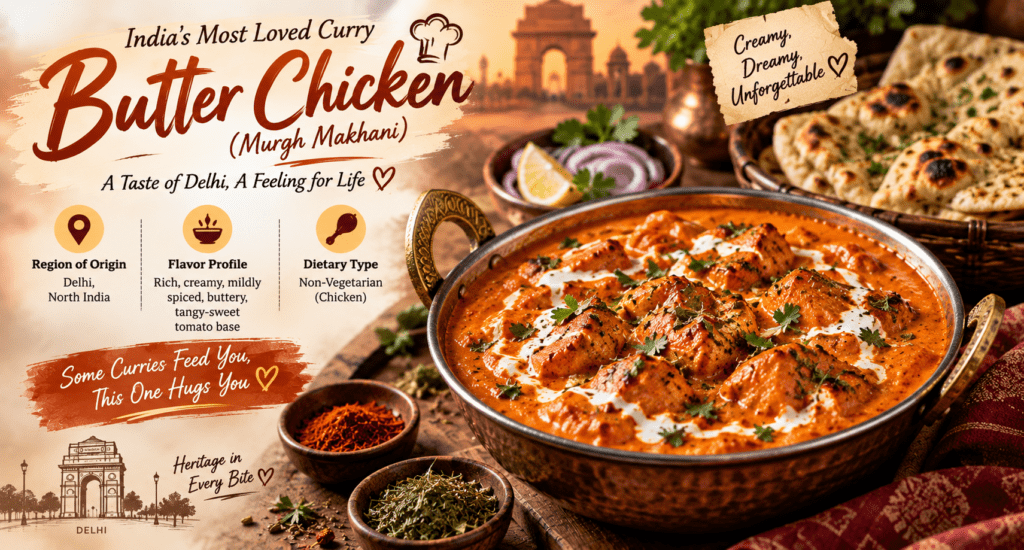
1. Butter Chicken (Murgh Makhani)
- Region of Origin: Delhi, North India
- Flavor Profile: Rich, creamy, mildly spiced, buttery, tangy-sweet tomato base
- Dietary Type: Non-Vegetarian (Chicken)
- Best Described As: Velvety, rich tomato-cream chicken curry that hugs your soul If Indian food had a global ambassador, it would be Butter Chicken. Created accidentally in the 1950s at the legendary Moti Mahal restaurant in Delhi, this iconic dish has become one of the most ordered Indian foods worldwide — and for very good reason. Tender pieces of tandoor-roasted chicken are simmered in a luxuriously smooth sauce made from tomatoes, butter, cream, and an aromatic blend of spices including garam masala, fenugreek leaves (kasuri methi), and cardamom. The result is a curry that is simultaneously rich and delicate, spiced but not overwhelming, and deeply comforting.
- Deep Dive — Flavor Profile: Butter Chicken sits at the gentler end of the Indian curry spectrum. The dominant flavor notes are:
- Sweetness from the tomatoes and a touch of sugar
- Richness from the butter and cream
- Warmth from garam masala and cardamom
- Subtle smokiness from the tandoor-roasted chicken
- Earthy bitterness from kasuri methi (dried fenugreek leaves) that balances the cream
- It is not a hot or aggressively spiced curry. Instead, it achieves a layered, velvety complexity that is deeply satisfying and universally approachable.
- Why you must try it: Butter Chicken is the perfect gateway Indian food for first-timers. Its mild, approachable flavor profile and velvety texture make it universally appealing. Once you try the real thing — not the watered-down, oversimplified versions found in some international restaurants — you will understand why people travel to Delhi specifically to eat it.
- Pro Tip: Pair it with freshly baked naan or tandoori roti for the full experience. The bread is not optional — it's essential for scooping up every last drop of that magnificent sauce.
- Fun Fact: The dish was reportedly invented when chef Kundan Lal Gujral repurposed leftover tandoori chicken by simmering it in a buttery tomato gravy. One happy accident. One billion fans.
2. Biryani
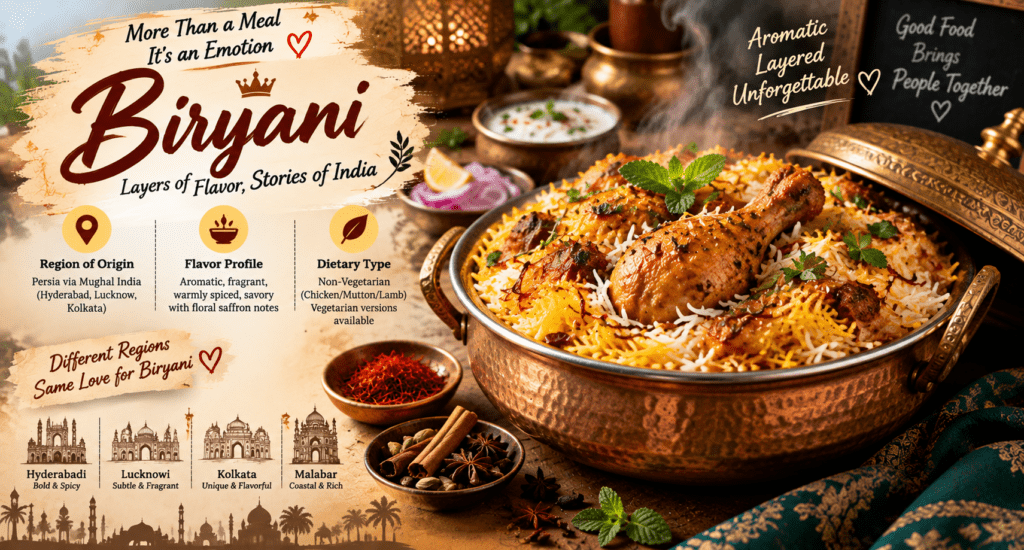
- Region of Origin: Persia via Mughal India (Hyderabad, Lucknow, Kolkata)
- Flavor Profile: Aromatic, fragrant, warmly spiced, savory with floral saffron notes
- Dietary Type: Non-Vegetarian (Chicken/Mutton/Lamb) — Vegetarian versions available
- Best Described As: Fragrant, layered rice dish with meat, spices, and soul Biryani is not just food. It is an emotion. Ask any Indian what their desert island meal would be and nine times out of ten, the answer is Biryani. This magnificent dish — made by slow-cooking marinated meat and parboiled rice together in a sealed pot (a technique called dum pukht) — is one of the most complex, labor-intensive, and rewarding dishes in world cuisine. The magic of biryani lies in its layers. Aromatic basmati rice is layered with spiced meat (usually chicken, mutton, or lamb), fried onions, saffron-infused milk, fresh mint, and ghee. The pot is then sealed with dough or foil and slow-cooked until the flavors meld into something otherworldly.
- Deep Dive — Flavor Profile: Biryani's flavor profile is a symphony of complementary notes:
- Floral and exotic — Saffron, rose water (in some versions), and kewra water
- Warm and spiced — Whole spices like bay leaf, star anise, cloves, and cinnamon
- Savory and meaty — The marinated meat juices perfume every grain of rice
- Caramelized sweetness — From slow-cooked fried onions (birista)
- Fresh and herby — From the mint and coriander layered between the rice
- Regional Flavor Variations to Know:
- Hyderabadi Biryani — Bold, spicy, and aromatic. The crown jewel of all biryanis
- Lucknowi (Awadhi) Biryani — More subtle and delicate, with a focus on fragrance over heat
- Kolkata Biryani — Uniquely contains potato and eggs alongside meat, with a sweeter flavor profile
- Malabar Biryani — South Indian style, using short-grain rice and coconut
- Why you must try it: Because no description can prepare you for the moment when the sealed pot is opened at the table and a cloud of saffron-spiced steam rises into the air. It is pure theater. Pure flavor. Pure joy.
3. Masala Dosa
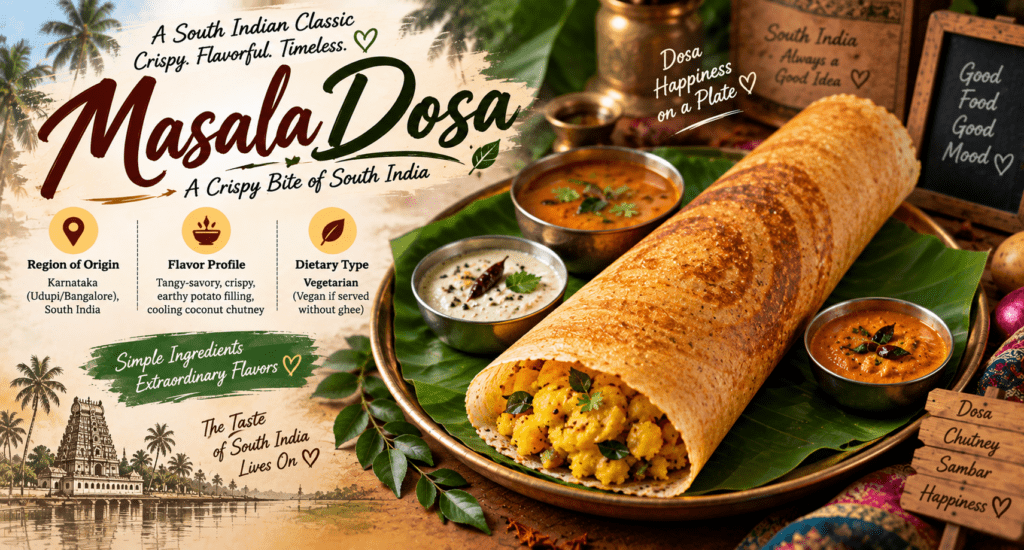
- Region of Origin: Karnataka (Udupi/Bangalore), South India
- Flavor Profile: Tangy-savory, crispy, earthy potato filling, cooling coconut chutney
- Dietary Type: Vegetarian (Vegan if served without ghee)
- Best Described As: Crispy, golden crepe stuffed with spiced potato filling Walk into any South Indian restaurant in the world and you'll immediately understand why Masala Dosa has become one of the most recognizable Indian dishes globally. This impossibly thin, crispy crepe — made from a fermented batter of rice and lentils — is folded around a perfectly spiced potato and onion filling and served with coconut chutney and sambar (a tangy lentil vegetable soup).
- Deep Dive — Flavor Profile: The genius of Masala Dosa is its multi-layered flavor and texture experience:
- Sour and tangy — The fermented rice-lentil batter has a natural, mild sourness
- Crispy and savory — The dosa crepe itself is lightly salted and deeply savory
- Earthy and spiced — The potato masala filling is flavored with mustard seeds, curry leaves, turmeric, green chilies, and onions
- Cool and creamy — Fresh coconut chutney provides cooling relief
- Tangy and umami — The sambar (lentil vegetable soup) adds a tart, complex dimension
- Why you must try it: Masala Dosa is the perfect introduction to South Indian cuisine. It is vegetarian, gluten-friendly (the batter is made from rice and lentils), incredibly flavorful, and unlike anything you've likely eaten before.
- Where to try it: The original MTR (Mavalli Tiffin Room) restaurant in Bangalore has been serving legendary Masala Dosas since 1924. If you're in South India, this is a pilgrimage worth making.
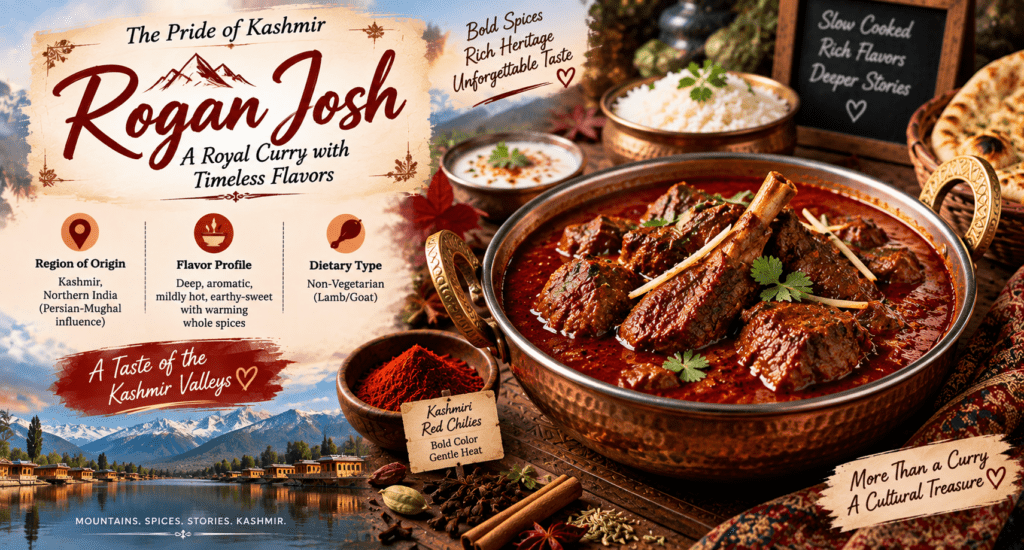
4. Rogan Josh
- Region of Origin: Kashmir, Northern India (Persian-Mughal influence)
- Flavor Profile: Deep, aromatic, mildly hot, earthy-sweet with warming whole spices
- Dietary Type: Non-Vegetarian (Lamb/Goat)
- Best Described As: Deep red, aromatic lamb curry with Kashmiri spices Rogan Josh is the culinary crown of Kashmir — a dish as breathtaking as the mountain valley it comes from. The name itself is poetic: "rogan" means fat or oil in Persian, and "josh" means heat or passion. This is a dish cooked with passion, in oil, with heat. And every bite proves it. Slow-cooked lamb (or sometimes goat) is braised in a rich, deeply red sauce made from Kashmiri red chilies — which give incredible color without excessive heat — along with yogurt, ginger, fennel, and a blend of aromatic whole spices.
- Deep Dive — Flavor Profile: Rogan Josh has a uniquely Kashmiri flavor identity that sets it apart from all other Indian curries:
- Vibrant and mildly hot — Kashmiri red chilies (Deghi Mirch) provide stunning red color with gentle heat
- Aromatic and warm — Whole spices including cloves, cardamom, cinnamon, and bay leaves create complexity
- Earthy and anise-like — Fennel seeds (saunf) are a distinctive Kashmiri signature flavor
- Tangy and tenderizing — Yogurt in the marinade and sauce adds tanginess and tenderizes the meat
- Rich and meaty — Long, slow braising develops deep, layered meat flavors
- Why you must try it: Rogan Josh represents Indian food at its most sophisticated. The Kashmiri red chili creates a vivid, beautiful sauce that looks as stunning as it tastes.
- Pair it with: Steamed rice or fresh naan bread and a cooling raita (yogurt condiment).
5. Palak Paneer
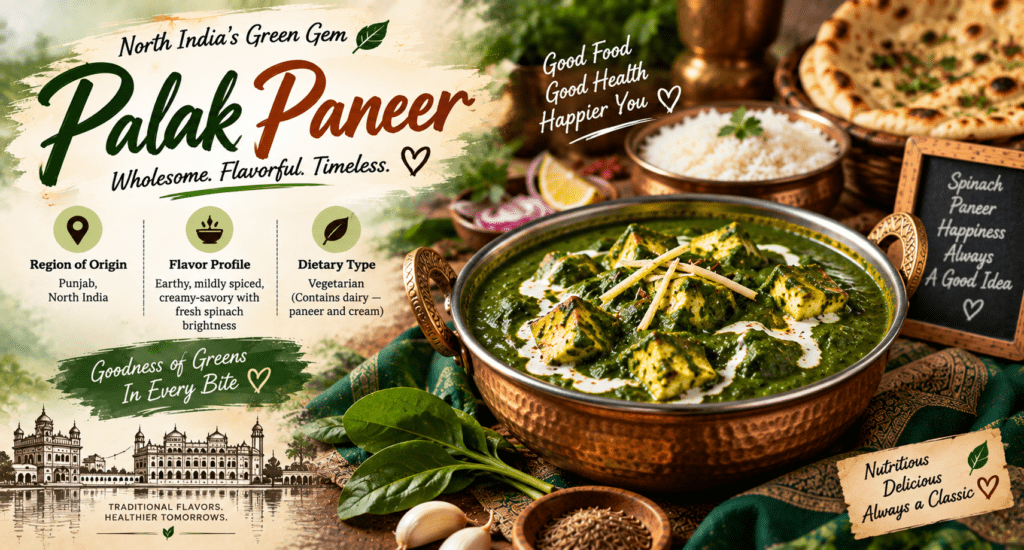
- Region of Origin: Punjab, North India
- Flavor Profile: Earthy, mildly spiced, creamy-savory with fresh spinach brightness
- Dietary Type: Vegetarian (Contains dairy — paneer and cream)
- Best Described As: Creamy spinach curry with soft, fresh Indian cheese Palak Paneer is the dish that converts spinach skeptics into spinach evangelists. This vibrant North Indian classic features cubes of fresh paneer (Indian cottage cheese) nestled in a silky, emerald-green sauce made from pureed spinach, aromatic spices, garlic, ginger, and cream.
- Deep Dive — Flavor Profile: Palak Paneer achieves a beautiful balance between the earthiness of spinach and the richness of cream and paneer:
- Fresh and earthy — Blanched and pureed spinach provides a vibrant, green, slightly bitter base
- Warming and gently spiced — Cumin, coriander, garam masala, and turmeric add warmth without heat
- Rich and creamy — Cream and butter add luxurious body to the sauce
- Mild and milky — The paneer is neutral and slightly chewy, absorbing the surrounding flavors
- Garlicky and aromatic — Fried garlic and ginger are the flavor backbone of the dish
- Why you must try it: This is proof that vegetarian food can be deeply satisfying, nutritious, and incredibly flavorful. Palak Paneer is beloved by vegetarians and meat-eaters alike.
- Nutritional Bonus: Spinach + paneer = iron + protein + calcium in one delicious bowl. Your body will thank you as much as your taste buds.
6. Chole Bhature
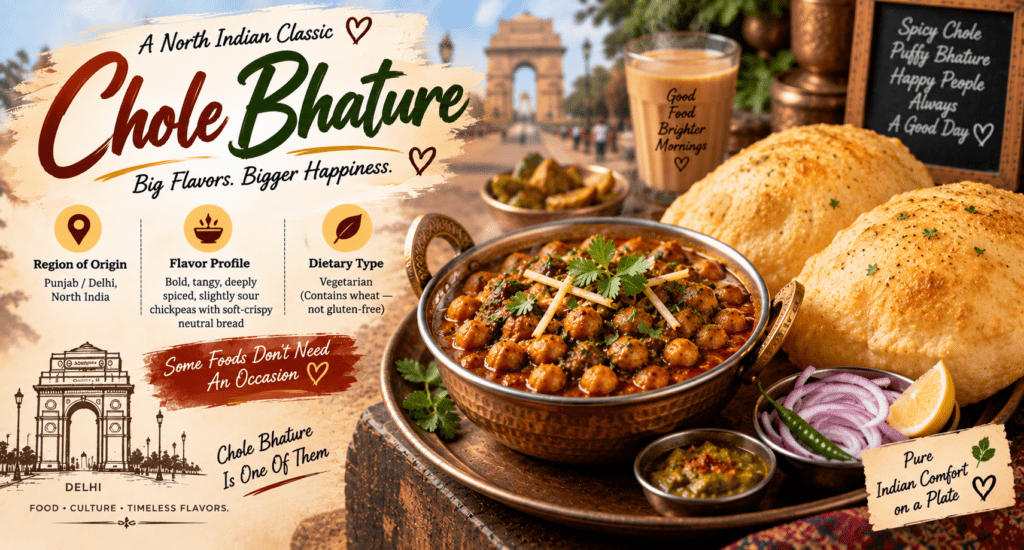
- Region of Origin: Punjab / Delhi, North India
- Flavor Profile: Bold, tangy, deeply spiced, slightly sour chickpeas with soft-crispy neutral bread
- Dietary Type: Vegetarian (Contains wheat — not gluten-free)
- Best Described As: Spicy chickpea curry served with puffed, fried bread Chole Bhature is the kind of breakfast that makes you rethink everything you thought you knew about morning meals. This bold, intensely spiced chickpea curry served alongside enormous, pillow-soft fried bread is a beloved morning institution across Punjab and Delhi.
- Deep Dive — Flavor Profile: The chole (spiced chickpeas) are a masterclass in layered spicing:
- Tangy and sour — Amchur (dried mango powder) and pomegranate seeds add distinctive tartness
- Deeply spiced — Chole masala, cumin, coriander, and black cardamom create complexity
- Earthy and robust — The slow-cooked chickpeas have an earthy, nutty base flavor
- Mildly smoky — Some recipes use charcoal or tea bags during cooking for subtle smokiness
- Neutral and pillowy — The bhatura provides a neutral, slightly crispy counterpoint to the intense chole
- Why you must try it: The contrast between the bold, tangy chickpeas and the soft, neutral bread is perfect in every way. This is Indian comfort food at its most indulgent and most unapologetic.
7. Pani Puri (Golgappa)
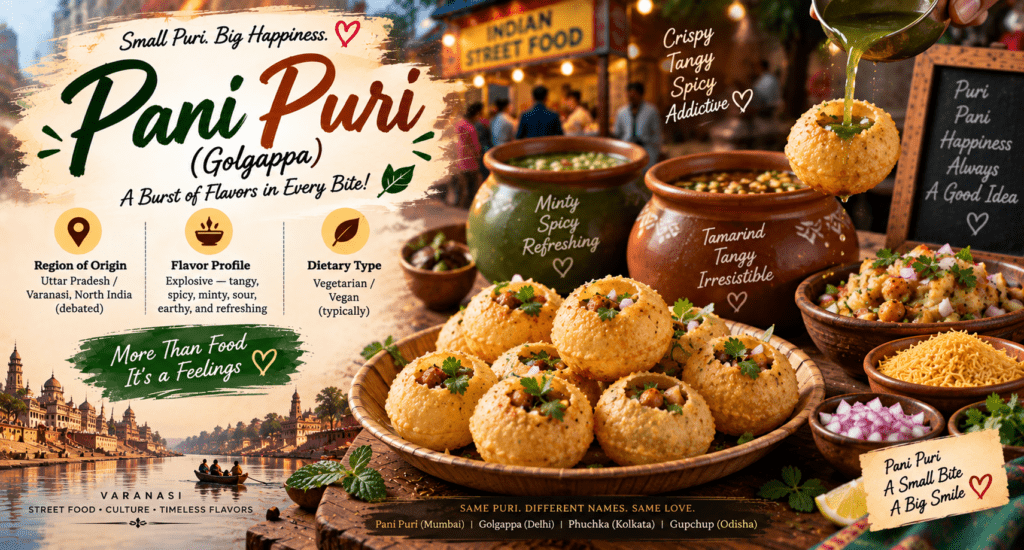
- Region of Origin: Uttar Pradesh / Varanasi, North India (debated)
- Flavor Profile: Explosive — simultaneously tangy, spicy, minty, sour, earthy, and refreshing
- Dietary Type: Vegetarian / Vegan (typically)
- Best Described As: Crispy hollow shells filled with spiced water, chickpeas, and chutneys
- Pani Puri is Indian street food in its purest, most joyful form. These small, round, hollow crispy shells (puris) are filled with a mixture of spiced mashed potatoes or chickpeas, then dunked into an intensely flavored, cold water (pani) made from tamarind, mint, green chili, cumin, and black salt.
- Deep Dive — Flavor Profile: Pani Puri delivers what food scientists call a "multisensory flavor bomb" — multiple flavors hitting simultaneously:
- Sour and tangy — Tamarind provides a bold, mouth-puckering tartness
- Spicy and sharp — Green chili and black pepper add heat
- Cooling and fresh — Fresh mint creates a counterintuitive cooling sensation against the spice
- Earthy and mineral — Black salt (kala namak) adds a distinctive sulfurous, mineral depth unlike regular salt
- Crunchy to soft — The crispy puri shell softens rapidly in the spiced water, creating a fleeting textural experience
- Savory and umami — The potato/chickpea filling adds body and earthiness
- Why you must try it: Pani Puri is not just food — it's a cultural experience. The street vendor, the lineup of eager customers, the rapid-fire rhythm of puri being filled and handed over — this is Indian street food at its most democratic and most delightful.
- Regional Name Variations:
- Pani Puri (Mumbai)
- Golgappa (Delhi, North India)
- Phuchka (Kolkata)
- Gupchup (Odisha, Chhattisgarh)
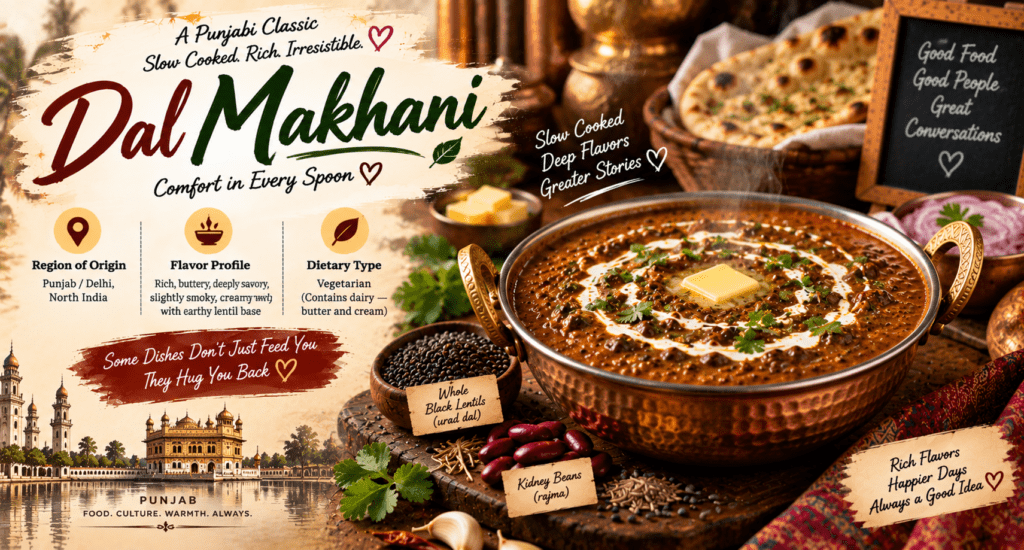
8. Dal Makhani
- Region of Origin: Punjab / Delhi, North India
- Flavor Profile: Rich, buttery, deeply savory, slightly smoky, creamy with earthy lentil base
- Dietary Type: Vegetarian (Contains dairy — butter and cream)
- Best Described As: Slow-cooked black lentils in a rich, buttery, cream-laced sauce Dal Makhani is the dish that proves patience is the greatest cooking ingredient of all. This iconic Punjabi preparation — made from whole black lentils (urad dal) and kidney beans (rajma) — is cooked low and slow, sometimes for 12-24 hours, in a rich sauce of tomatoes, butter, cream, and spices.
- Deep Dive — Flavor Profile: Dal Makhani's extraordinary flavor is a product of time, fat, and heat working together:
- Rich and buttery — Generous amounts of butter and cream create a luxuriously silky body
- Earthy and deep — Black lentils have a naturally earthy, slightly mineral flavor that intensifies with long cooking
- Mildly smoky — Traditional recipes use a charcoal smoking technique (dhungar method) for a subtle smokiness
- Gently spiced — Garam masala, ginger, and garlic are present but never overpowering
- Subtly tangy — Tomatoes add brightness that balances the richness of the butter and cream
- Why you must try it: Dal Makhani is the ultimate Indian comfort food for both vegetarians and non-vegetarians. Its depth of flavor rivals any meat-based dish, and the buttery richness makes it deeply satisfying.
9. Tandoori Chicken
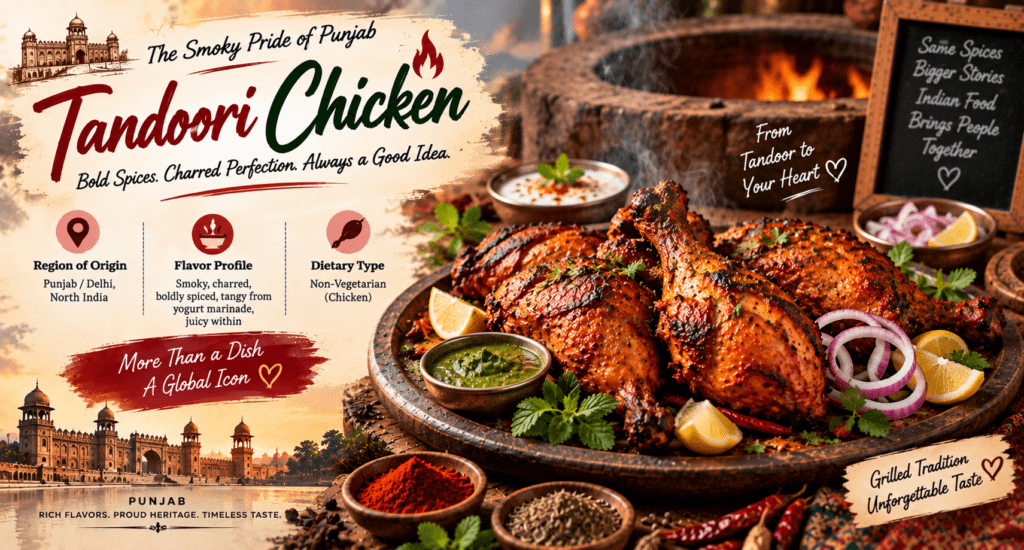
- Region of Origin: Punjab / Delhi, North India
- Flavor Profile: Smoky, charred, boldly spiced, tangy from yogurt marinade, juicy within
- Dietary Type: Non-Vegetarian (Chicken)
- Best Described As: Yogurt-marinated chicken, charred and smoky from the tandoor oven Tandoori Chicken changed the world of cooking forever. The concept of marinating meat in yogurt and spices before cooking it in a blazing hot clay oven (tandoor) at temperatures exceeding 480°C (900°F) creates a texture and flavor that no other cooking method can replicate.
- Deep Dive — Flavor Profile: Tandoori Chicken's flavor is the result of three distinct processes working in harmony:
- Smoky and charred — The tandoor's intense heat creates slightly blackened, smoky edges that are irreplaceable
- Tangy and bright — Yogurt in the marinade imparts a pleasant sour tang to the cooked chicken
- Boldly spiced — Red chili, turmeric, cumin, garam masala, and coriander create a robust spice crust
- Juicy and tender — The yogurt tenderizes the chicken while the high heat seals in the juices
- Garlicky and gingery — Ginger-garlic paste is a core component of the marinade and its flavor penetrates deeply
- Why you must try it: Tandoori Chicken is the foundation of so many beloved dishes (including Butter Chicken) and represents one of India's greatest contributions to world cooking technique.
10. Samosa
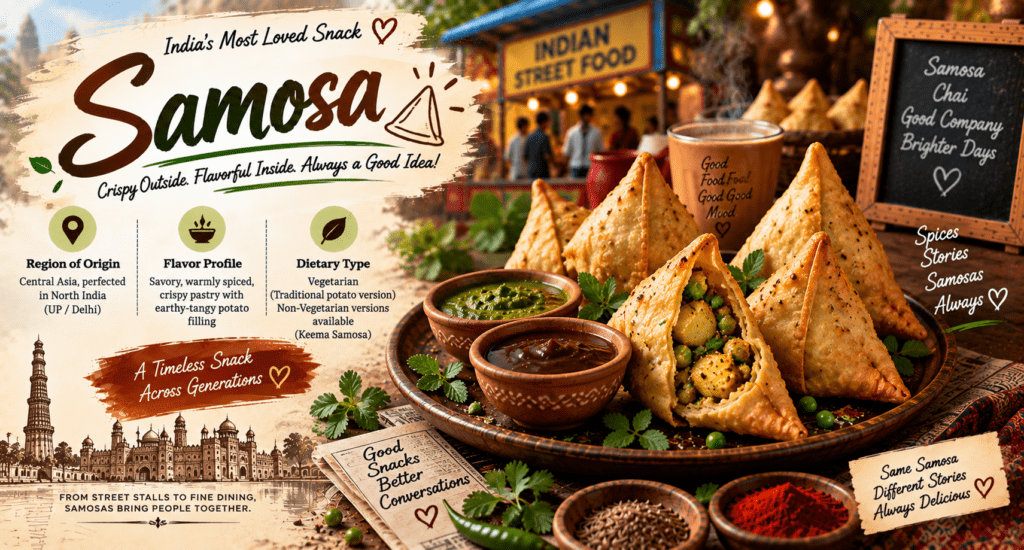
- Region of Origin: Central Asia, perfected in North India (UP / Delhi)
- Flavor Profile: Savory, warmly spiced, crispy pastry with earthy-tangy potato filling
- Dietary Type: Vegetarian (Traditional potato version) — Non-Vegetarian versions available (Keema Samosa)
- Best Described As: Crispy, triangular pastry filled with spiced potatoes and peas The Samosa is one of the most widely recognized Indian foods in the world. This crispy, golden, triangular pastry filled with a perfectly spiced mixture of potatoes, peas, and sometimes minced meat is the perfect snack: portable, satisfying, and irresistibly delicious.
- Deep Dive — Flavor Profile: A perfect Samosa is a study in contrasts:
- Crispy and flaky — The pastry shell (made from maida flour and ajwain/carom seeds) provides a satisfying crunch
- Earthy and savory — The potato filling is deeply savory with a natural earthiness
- Warmly spiced — Cumin, coriander, garam masala, and green chili add layers of warm spice
- Tangy and bright — Amchur (dried mango powder) adds a distinctive tartness to the filling
- Condiment-enhanced — Mint chutney adds freshness and heat; tamarind chutney adds sweet-sour depth
- Why you must try it: Samosas are the perfect introduction to Indian flavors — available everywhere from street stalls to fine restaurants.
- Fun Fact: Samosas were introduced to India by traders from Central Asia and the Middle East. The original Persian version was called "sanbosag."
11. Hyderabadi Biryani
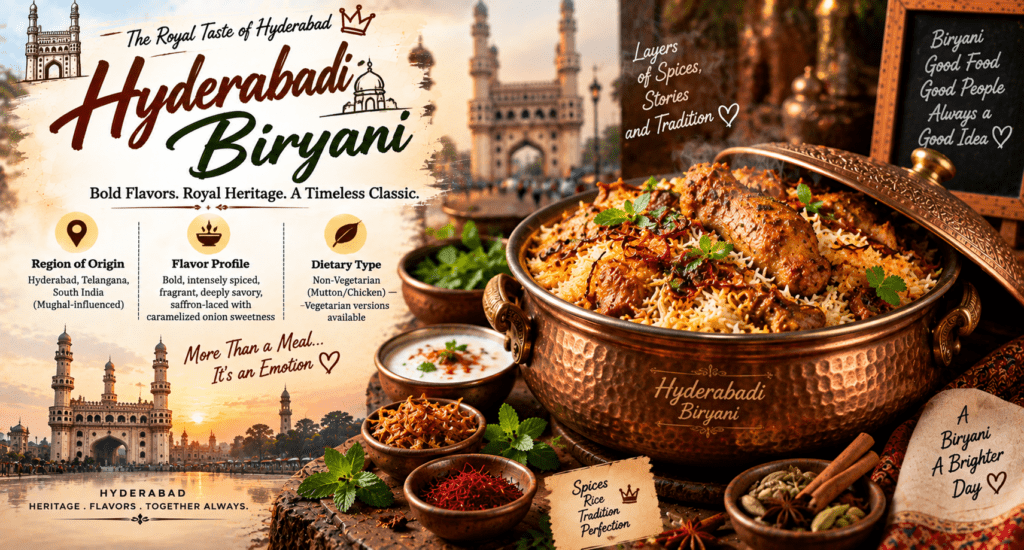
- Region of Origin: Hyderabad, Telangana, South India (Mughal-influenced)
- Flavor Profile: Bold, intensely spiced, fragrant, deeply savory, saffron-laced with caramelized onion sweetness
- Dietary Type: Non-Vegetarian (Mutton/Chicken) — Vegetarian versions available
- Best Described As: The king of all biryanis — bold, layered, and uncompromisingly flavorful We mentioned Biryani earlier, but Hyderabadi Biryani deserves its own spotlight because it is, by many accounts, the greatest expression of this dish. Born in the royal kitchens of the Nizam of Hyderabad, this biryani is characterized by its bold use of spices and the kacchi (raw meat) method of cooking.
- Deep Dive — Flavor Profile: Hyderabadi Biryani has a distinctly bolder, more assertive flavor profile than other biryanis:
- Intensely aromatic — Whole spices (star anise, mace, kewra water) create an almost intoxicating fragrance
- Deeply spiced and hot — Green chilies, red chili powder, and biryani masala create significant heat
- Floral and exotic — Saffron-infused milk and rose water add delicate floral notes
- Caramelized and sweet — Deeply fried onions (birista) contribute sweetness and texture
- Rich and fatty — The meat juices, ghee, and caramelized onions create a richness that coats every grain of rice
- Why you must try it: Hyderabadi Biryani is the benchmark against which all biryanis are judged. Eating it is not just a meal — it's an event.
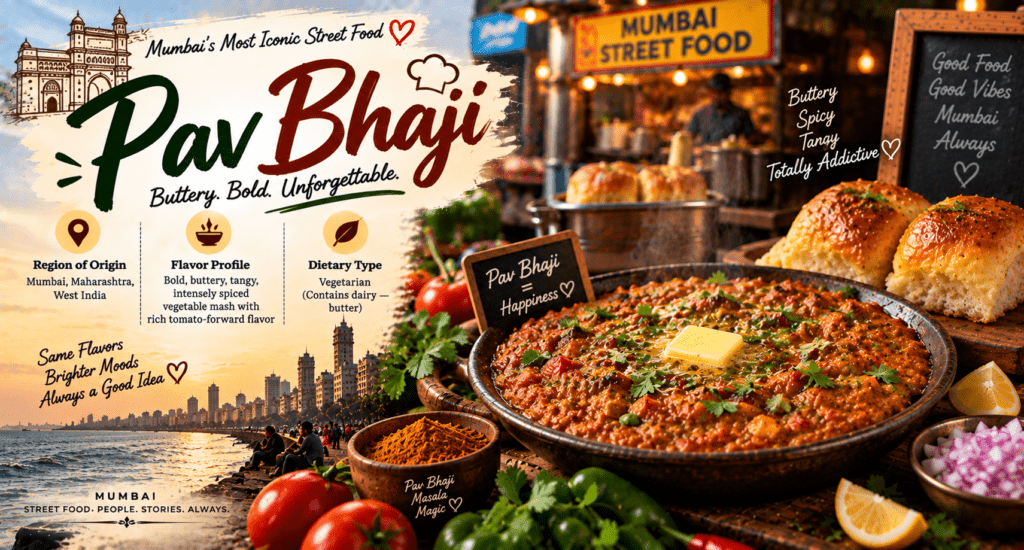
12. Pav Bhaji
- Region of Origin: Mumbai, Maharashtra, West India
- Flavor Profile: Bold, buttery, tangy, intensely spiced vegetable mash with rich tomato-forward flavor
- Dietary Type: Vegetarian (Contains dairy — butter)
- Best Described As: Buttery mashed vegetable curry with toasted bread rolls Pav Bhaji is Mumbai on a plate — chaotic, vibrant, delicious, and unapologetically bold. Created in the 1850s as a quick, filling meal for Mumbai's textile mill workers, this beloved street food has grown into one of India's most iconic dishes.
- Deep Dive — Flavor Profile: Pav Bhaji's flavor profile is deliberately bold and maximalist:
- Buttery and rich — An almost excessive amount of butter is key; it adds richness and helps the vegetables caramelize
- Intensely tomato-forward — Tomatoes form the foundation of the bhaji and provide vibrant acidity
- Boldly spiced — Pav Bhaji masala (a unique spice blend) includes coriander, cumin, dried mango, and more
- Slightly sweet — Bell peppers and naturally sweet vegetables add subtle sweetness
- Tangy from lemon — Fresh lemon juice is squeezed on top at serving for brightness
- Why you must try it: Pav Bhaji is the kind of food that makes you close your eyes involuntarily with pleasure. The combination of buttery, intensely spiced vegetables and soft, toasted bread is perfect in its simplicity.
13. Gulab Jamun
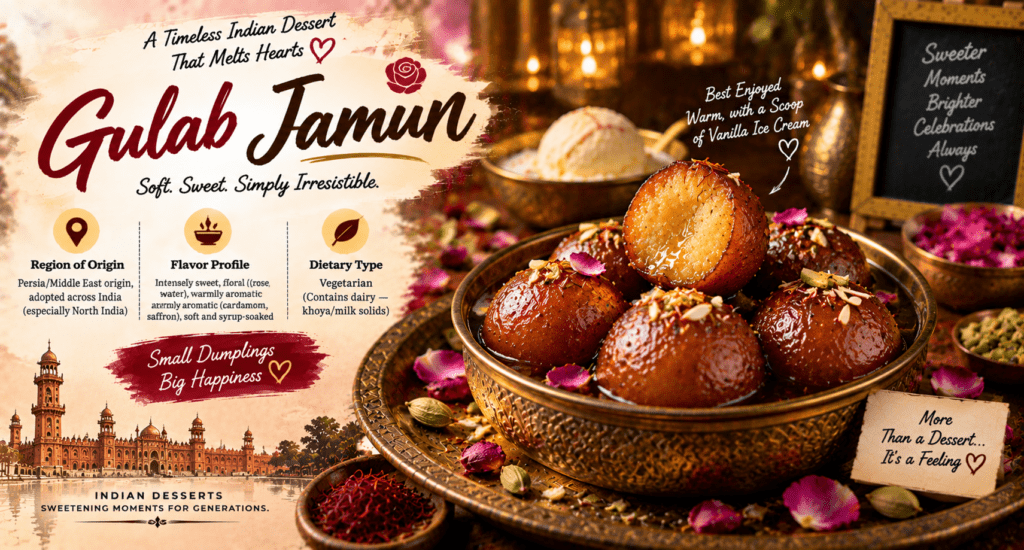
- Region of Origin: Persia/Middle East origin, adopted across India (especially North India)
- Flavor Profile: Intensely sweet, floral (rose water), warmly aromatic (cardamom, saffron), soft and syrup-soaked
- Dietary Type: Vegetarian (Contains dairy — khoya/milk solids)
- Best Described As: Soft, melt-in-your-mouth milk dumplings soaked in rose-flavored syrup If there is one Indian dessert that has achieved universal love, it is Gulab Jamun. These small, round dumplings — made from khoya (reduced milk solids) or milk powder — are deep-fried to a deep golden brown and then soaked in a fragrant sugar syrup flavored with rose water, cardamom, and saffron.
- Deep Dive — Flavor Profile: Gulab Jamun is a study in sweet, aromatic indulgence:
- Intensely sweet — The sugar syrup is heavily concentrated and the dumplings absorb it completely
- Floral and perfumed — Rose water (gulab = rose in Urdu/Persian) is the defining aromatic element
- Warmly spiced — Green cardamom adds a distinctive warm, floral spice note
- Exotic and golden — Saffron-infused syrup adds a subtle earthy-floral complexity
- Rich and milky — The khoya base gives the dumpling a rich, caramelized dairy flavor
- Texturally unique — Slightly firm exterior gives way to a completely syrup-saturated, almost custard-like interior
- Why you must try it: Gulab Jamun is served at every Indian celebration and eating it feels like being welcomed into something special.
- Best eaten: Warm, with a scoop of vanilla ice cream. Trust us.
14. Rajma Chawal
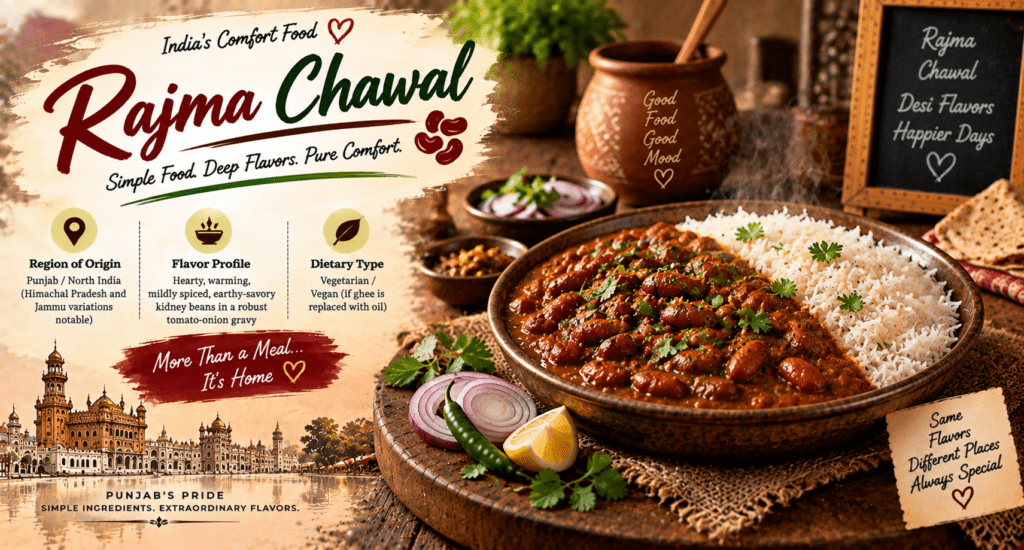
- Region of Origin: Punjab / North India (Himachal Pradesh and Jammu variations notable)
- Flavor Profile: Hearty, warming, mildly spiced, earthy-savory kidney beans in a robust tomato-onion gravy
- Dietary Type: Vegetarian / Vegan (if ghee is replaced with oil)
- Best Described As: Hearty red kidney bean curry served over steamed rice Rajma Chawal (kidney beans with rice) is the ultimate Indian home-cooked meal — the dish that every North Indian grew up eating, and the dish that every North Indian misses most when they're far from home.
- Deep Dive — Flavor Profile: Rajma Chawal's beauty is in its honest, wholesome flavor:
- Earthy and hearty — Kidney beans have a naturally robust, earthy flavor that anchors the dish
- Savory and umami-rich — The slow-cooked onion-tomato gravy develops deep savory depth
- Warmly spiced — Cumin, coriander, garam masala, and amchur provide warmth without heat
- Slightly tangy — Tomatoes and amchur add brightness that prevents the dish from feeling heavy
- Nutty and rich — A finishing drizzle of ghee adds nuttiness and richness to the final dish
- Why you must try it: Rajma Chawal is Indian soul food — honest, humble, nourishing, and utterly delicious. If you want to understand everyday Indian home cooking, this is where you start.
15. Aloo Paratha
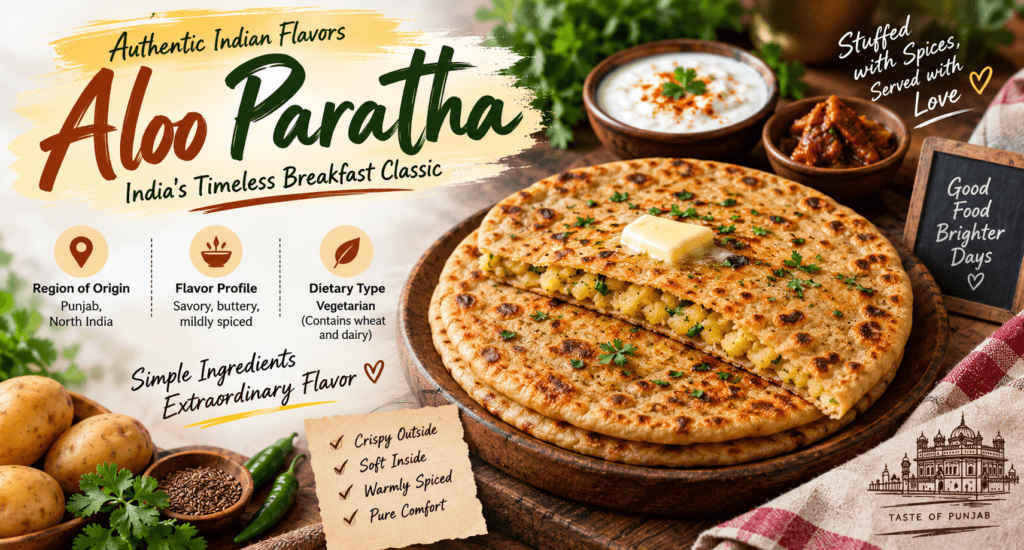
- Region of Origin: Punjab, North India
- Flavor Profile: Savory, buttery, mildly spiced with a crispy exterior and soft, earthy potato interior
- Dietary Type: Vegetarian (Contains wheat and dairy — ghee/butter)
- Best Described As: Whole wheat flatbread stuffed with spiced mashed potato, cooked in butter Aloo Paratha is the breakfast of champions — at least, it is according to every Punjabi household in India. This thick, stuffed flatbread made from whole wheat flour (atta) filled with a well-spiced mashed potato mixture is cooked on a tawa (griddle) with generous amounts of ghee or butter.
- Deep Dive — Flavor Profile: Aloo Paratha delivers a beautiful interplay of flavors and textures:
- Buttery and nutty — The whole wheat exterior takes on a nutty, toasted butter flavor from cooking in ghee
- Crispy outside, soft inside — The textural contrast between the golden crust and the soft potato filling is central to its appeal
- Warmly spiced — The potato filling is seasoned with green chili, coriander, ajwain (carom seeds), and garam masala
- Savory and earthy — Potatoes provide a neutral, starchy base that carries the spices beautifully
- Contrast-enhanced — The yogurt accompaniment adds cool creaminess; the pickle adds sharp, vinegary tang
- Why you must try it: Aloo Paratha is Indian comfort food at its most fundamental — the kind of breakfast that energizes you for the entire day.
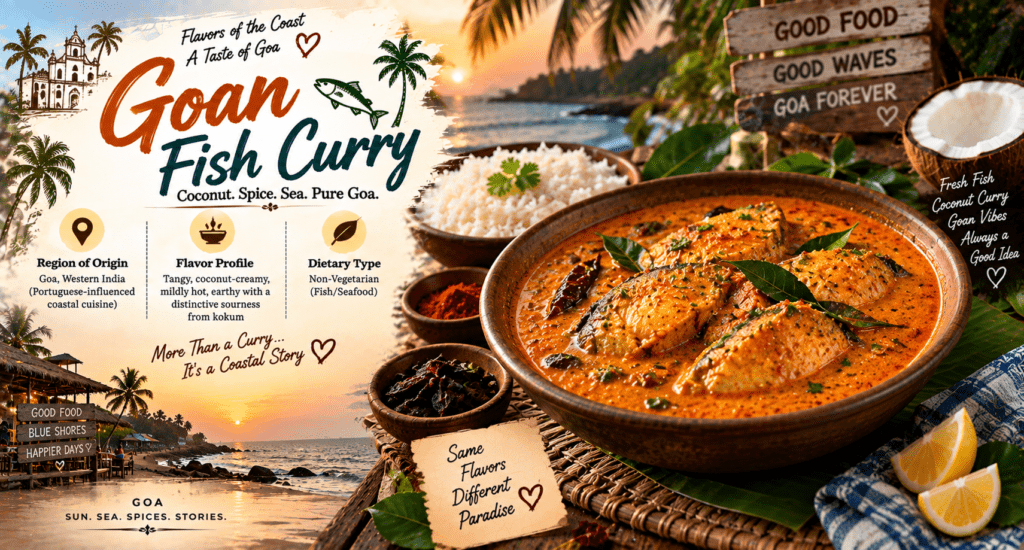
16. Fish Curry (Goan Style)
- Region of Origin: Goa, Western India (Portuguese-influenced coastal cuisine)
- Flavor Profile: Tangy, coconut-creamy, mildly hot, earthy with a distinctive sourness from kokum
- Dietary Type: Non-Vegetarian (Fish/Seafood)
- Best Described As: Coconut-based fish curry with tangy kokum and warming spices The Goan Fish Curry represents a completely different side of Indian cuisine — one that is lighter, coconut-based, and deeply influenced by the region's Portuguese colonial history and its coastal geography.
- Deep Dive — Flavor Profile: Goan Fish Curry has a flavor profile that is dramatically different from North Indian curries:
- Tangy and sour — Kokum (Garcinia indica), a sour fruit native to the Konkan coast, provides a uniquely fruity, grape-like tartness
- Creamy and coconut-forward — Freshly ground coconut paste and coconut milk create a rich, tropical base
- Mildly hot and vibrant — Kashmiri red chilies provide color and gentle heat without overwhelming
- Fresh and oceanic — The fresh fish (kingfish, pomfret, or mackerel) contributes a clean, oceanic freshness
- Earthy and warm — Turmeric, cumin, and coriander add warmth and ground the coconut sweetness
- Why you must try it: Goan Fish Curry shows you that Indian cuisine extends far beyond butter-and-cream North Indian dishes. Best eaten with steamed rice in Goa itself, ideally at a shack overlooking the Arabian Sea.
17. Khichdi
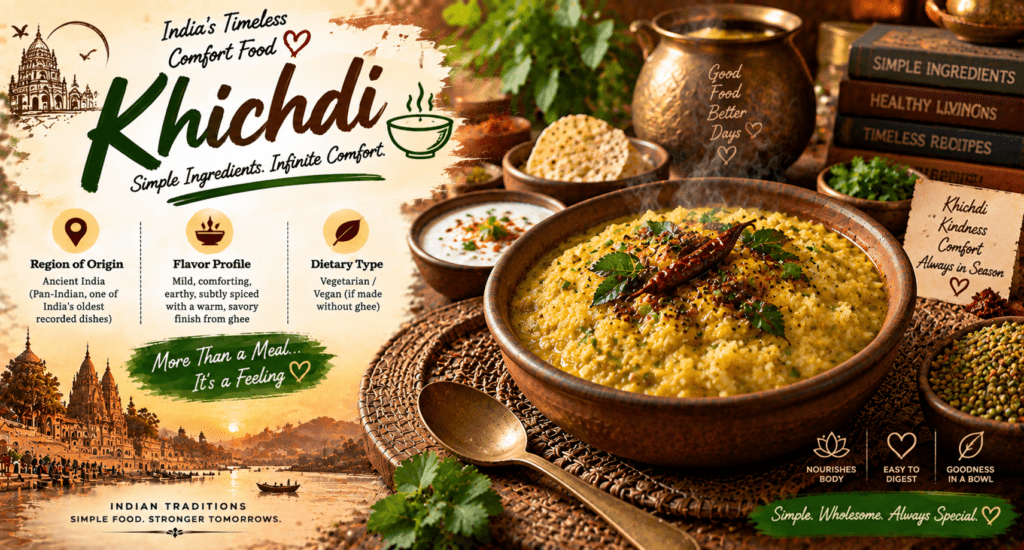
- Region of Origin: Ancient India (pan-Indian, one of India's oldest recorded dishes)
- Flavor Profile: Mild, comforting, earthy, subtly spiced with a warm, savory finish from ghee
- Dietary Type: Vegetarian / Vegan (if made without ghee)
- Best Described As: Simple, nourishing porridge of rice and lentils cooked together Khichdi is often described as India's original comfort food, and its history stretches back thousands of years. This simple, one-pot dish made from rice and lentils (usually moong dal) cooked together with turmeric, cumin, and ghee is the ultimate Indian restorative meal.
- Deep Dive — Flavor Profile: Khichdi's beauty lies in its deliberate mildness and comfort:
- Mild and soothing — The combined rice and moong dal create a neutral, gentle flavor base
- Warmly earthy — Turmeric adds an earthy, slightly bitter warmth and a beautiful golden color
- Aromatic and savory — The tadka (tempering) of cumin, mustard seeds, dried red chilies, and asafoetida in ghee adds layers of savory, aromatic complexity
- Rich and nutty — Ghee provides a buttery, nutty richness that elevates the simple base
- Digestive and clean — The combination of moong dal and rice is considered one of the most easily digestible meals in Indian nutritional tradition
- Why you must try it: Khichdi is the foundation of Indian home cooking and the dish that has fed this civilization for millennia.
- Fun Fact: The British colonial dish "Kedgeree" (smoked fish and rice) is directly derived from Khichdi.
18. Jalebi
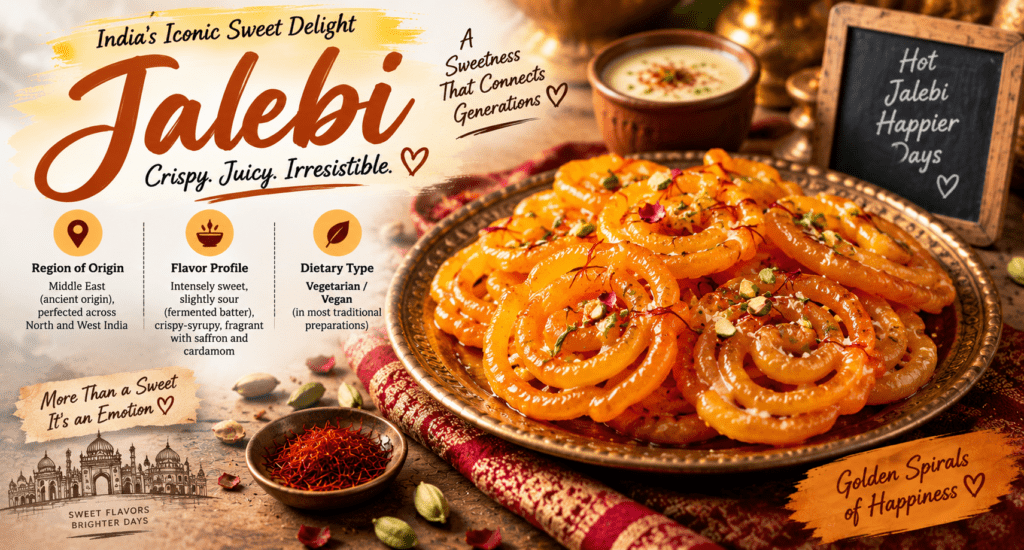
- Region of Origin: Middle East (ancient origin), perfected across North and West India
- Flavor Profile: Intensely sweet, slightly sour (fermented batter), crispy-syrupy, fragrant with saffron and cardamom
- Dietary Type: Vegetarian / Vegan (in most traditional preparations)
- Best Described As: Crispy, syrup-soaked spiral of deep-fried fermented batter Jalebi is one of India's most beloved and most distinctive sweets — a spiral-shaped, deep-fried confection made from fermented batter that is immediately soaked in hot sugar syrup.
- Deep Dive — Flavor Profile: Jalebi is one of the world's most unique sweet flavor experiences:
- Intensely sweet — Hot sugar syrup saturates the entire jalebi, creating concentrated sweetness
- Subtly sour — The fermented batter introduces a gentle, yeast-like sourness that cuts through the sweetness brilliantly
- Saffron-golden — Saffron in the syrup adds an earthy, floral, exotic note and the signature golden-orange color
- Warmly spiced — Cardamom in the syrup adds aromatic warmth
- Texturally extraordinary — The outer edges remain shatteringly crispy while the center is completely syrup-logged, creating a simultaneously crunchy and juicy experience
- Why you must try it: Jalebi is unlike any other sweet in world cuisine — the texture contrast alone makes it a must-try experience.
19. Kebabs (Seekh & Galouti)
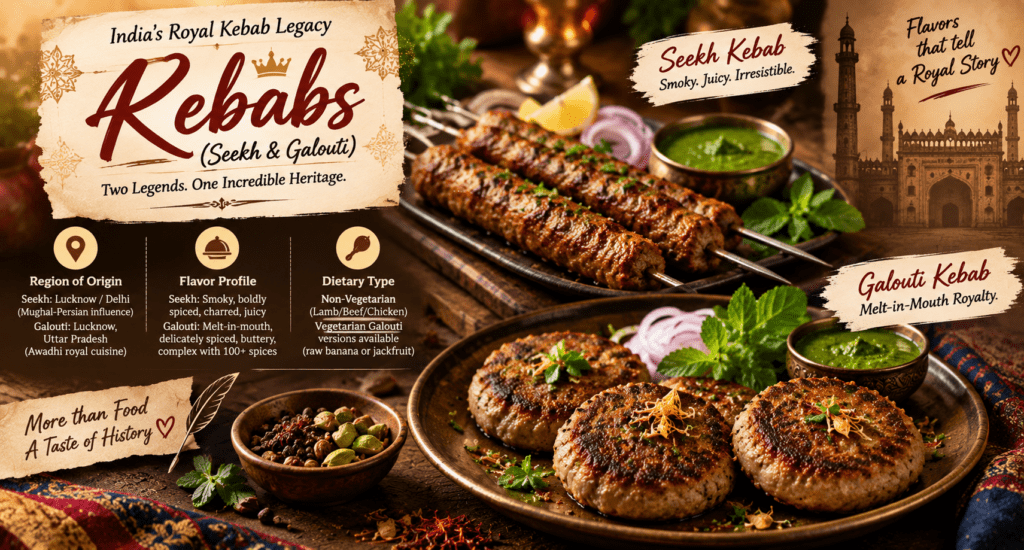
- Region of Origin:
- Seekh Kebab: Lucknow / Delhi, North India (Mughal-Persian influence)
- Galouti Kebab: Lucknow, Uttar Pradesh (Awadhi royal cuisine)
- Flavor Profile:
- Seekh: Smoky, boldly spiced, charred, juicy
- Galouti: Melt-in-mouth, delicately spiced, buttery, complex with 100+ spice blend
- Dietary Type: Non-Vegetarian (Lamb/Beef/Chicken) — Vegetarian Galouti versions available (made with raw banana or jackfruit)
- Best Described As: Minced meat kebabs — one grilled and smoky, one impossibly tender and melt-in-the-mouth India's kebab tradition, inherited and perfected from Persian and Mughal cooking, is one of the most refined and sophisticated in the world.
- Deep Dive — Flavor Profiles:
- Seekh Kebab:
- Smoky and charred — The tandoor or grill imparts irreplaceable smokiness with slightly blackened edges
- Boldly spiced — Red chili, cumin, coriander, garam masala, and raw papaya (tenderizer) create a robust spice profile
- Juicy and meaty — Properly made seekh kebab is always moist within despite the char outside
- Herby and fresh — Fresh mint, coriander, and green chili are mixed into the minced meat
- Galouti Kebab:
- Impossibly tender — So finely minced and tenderized that it dissolves on contact with the tongue
- Delicately and deeply spiced — Over 100 spices are used, but none dominates; the total is greater than the sum of its parts
- Buttery and rich — Generous ghee content makes this kebab feel luxuriously rich
- Subtly floral — Kewra water (pandanus extract) adds a uniquely Indian floral note
- Seekh Kebab:
- Why you must try them: Indian kebabs represent centuries of culinary refinement. The Galouti Kebab in particular is one of the most technically impressive preparations in world cuisine.
20. Rasmalai
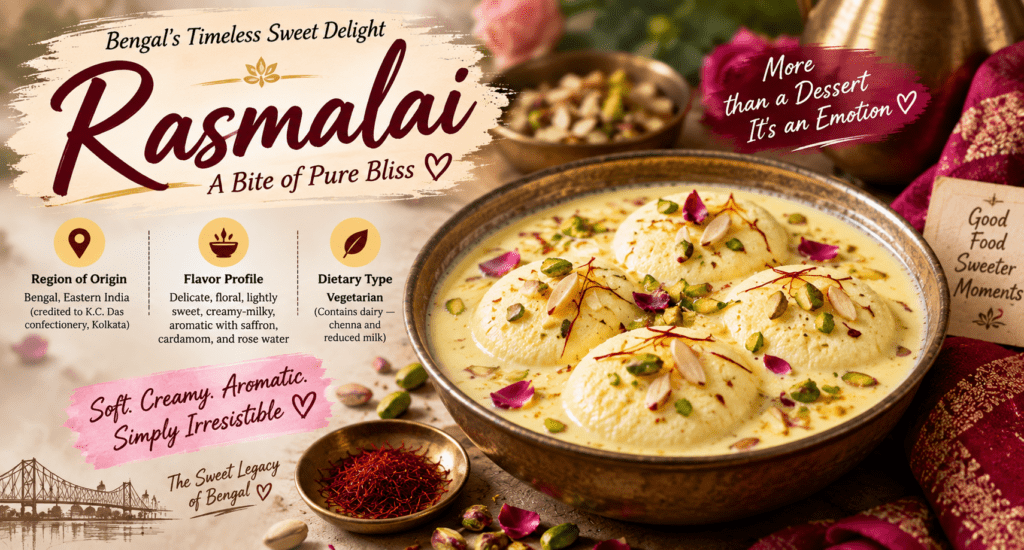
- Region of Origin: Bengal, Eastern India (credited to K.C. Das confectionery, Kolkata)
- Flavor Profile: Delicate, floral, lightly sweet, creamy-milky, aromatic with saffron, cardamom, and rose water
- Dietary Type: Vegetarian (Contains dairy — chenna/fresh cheese and reduced milk)
- Best Described As: Soft, spongy cheese dumplings in fragrant sweetened milk We end our culinary journey with perhaps India's most elegant dessert — Rasmalai. These soft, spongy discs made from fresh chenna (Indian cottage cheese) are cooked in sugar syrup and then immersed in thick, sweetened, reduced milk (ras) flavored with saffron, cardamom, and rose water.
- Deep Dive — Flavor Profile: Rasmalai is Indian dessert-making at its most refined and delicate:
- Lightly sweet and milky — Unlike Gulab Jamun's intense sweetness, Rasmalai is gentler and more delicate in its sweetness
- Floral and perfumed — Rose water and kewra water add layers of floral complexity
- Saffron-golden — Saffron contributes an earthy, slightly honeyed, exotic note to the rich milk base
- Warmly aromatic — Green cardamom is the spice backbone, adding warmth and brightness
- Texturally ethereal — The rasmalai disc trembles with softness; it has the consistency of a perfectly set, very tender pudding
- Nutty and garnished — Crushed pistachios and almonds add a final nutty crunch contrast
- Why you must try it: Rasmalai demonstrates the extraordinary things Indian confectioners can do with simple ingredients — milk, sugar, spices — and represents the best of Bengal's world-famous sweets tradition.
Complete Quick Reference Table
| Dish | 📍 Region of Origin | 🎨 Flavor Profile | 🥗 Dietary Type |
| Butter Chicken | Delhi, North India | Rich, creamy, mildly spiced, buttery, tangy-sweet | Non-Vegetarian 🍗 |
| Biryani | Mughal India (Hyderabad, Lucknow, Kolkata) | Aromatic, fragrant, warmly spiced, saffron-floral | Non-Veg 🍗 / Veg option |
| Masala Dosa | Karnataka, South India | Tangy-savory, crispy, earthy potato, cooling coconut | Vegetarian 🌿 / Vegan option |
| Rogan Josh | Kashmir, North India | Deep, aromatic, mildly hot, earthy-sweet, warm spices | Non-Vegetarian 🍖 |
| Palak Paneer | Punjab, North India | Earthy, mildly spiced, creamy-savory, fresh spinach | Vegetarian 🌿 |
| Chole Bhature | Punjab / Delhi, North India | Bold, tangy, deeply spiced, slightly sour | Vegetarian 🌿 |
| Pani Puri | Uttar Pradesh, North India | Tangy, spicy, minty, sour, earthy, refreshing | Vegetarian 🌿 / Vegan |
| Dal Makhani | Punjab / Delhi, North India | Rich, buttery, deeply savory, slightly smoky, creamy | Vegetarian 🌿 |
| Tandoori Chicken | Punjab / Delhi, North India | Smoky, charred, boldly spiced, tangy, juicy | Non-Vegetarian 🍗 |
| Samosa | Central Asia → North India | Savory, warmly spiced, crispy pastry, tangy potato filling | Vegetarian 🌿 / Non-Veg option |
| Hyderabadi Biryani | Hyderabad, Telangana | Bold, intensely spiced, fragrant, saffron-laced, caramelized | Non-Veg 🍗 / Veg option |
| Pav Bhaji | Mumbai, Maharashtra | Bold, buttery, tangy, intensely spiced, tomato-forward | Vegetarian 🌿 |
| Gulab Jamun | Persia → North India | Intensely sweet, floral (rose), warm cardamom, syrup-soaked | Vegetarian 🌿 |
| Rajma Chawal | Punjab, North India | Hearty, warming, mildly spiced, earthy-savory | Vegetarian 🌿 / Vegan option |
| Aloo Paratha | Punjab, North India | Savory, buttery, mildly spiced, crispy-soft contrast | Vegetarian 🌿 |
| Goan Fish Curry | Goa, West India | Tangy (kokum), coconut-creamy, mildly hot, fresh, oceanic | Non-Vegetarian 🍗 |
| Khichdi | Ancient / Pan-India | Mild, comforting, earthy, subtly spiced, warm ghee finish | Vegetarian 🌿 / Vegan option |
| Jalebi | Middle East → North/West India | Intensely sweet, slightly sour, crispy-syrupy, saffron-cardamom | Vegetarian 🌿 / Vegan |
| Seekh & Galouti Kebab | Lucknow / Delhi, North India | Smoky-charred (Seekh) / Melt-in-mouth-delicate (Galouti) | Non-Veg 🍖 / Veg Galouti option |
| Rasmalai | Bengal, East India | Delicate, floral, lightly sweet, creamy-milky, saffron-cardamom | Vegetarian 🌿 |
How to Experience Authentic Indian Food Like a Pro
Now that you know what to eat, where it comes from, how it tastes, and what dietary type it is, here's how to eat it properly:
🏠 Seek Out Home-Style Cooking
The best Indian food is often not found in fancy restaurants. Dhabas (roadside eateries), home-style restaurants, and community kitchens often produce the most authentic, soulful Indian food you'll ever taste.
🌍 Explore Regional Cuisines
Don't limit yourself to North Indian food. South Indian, East Indian, West Indian, and Northeast Indian cuisines are equally extraordinary and dramatically different from each other.
🕐 Eat at Local Meal Times
- Breakfast: 7:00 AM – 9:00 AM (Idli, Dosa, Paratha, Poha)
- Lunch: 12:00 PM – 2:00 PM (Full thali — the greatest Indian meal experience)
- Dinner: 7:30 PM – 9:30 PM (Curries, dal, bread, rice)
Try a Thali
A thali (meaning "plate") is the ultimate Indian meal experience — a large round plate containing small portions of multiple dishes: dal, sabzi (vegetable curry), roti, rice, pickle, papad, and dessert. It showcases a region's entire culinary identity in a single sitting.
🌶️ Be Honest About Your Spice Tolerance
Indian food ranges from very mild to extremely hot. Be honest with your server about your spice tolerance. "Medium" in India can mean "very spicy" by international standards.
🥗 Use This Guide's Dietary Filters
Now that every dish in this guide is tagged with its Dietary Type, vegetarians, vegans, and non-vegetarians can instantly identify what suits them. Remember: India has the world's richest vegetarian cuisine — vegetarians are never at a disadvantage here.
Indian Food by Region: A Quick Guide
| Region | Characteristic Flavors | Must-Try Dishes | Dietary Lean |
| North India | Rich, creamy, tandoor-heavy | Butter Chicken, Biryani, Dal Makhani, Naan | Both Veg & Non-Veg |
| South India | Light, tangy, coconut and rice-based | Masala Dosa, Idli, Sambar, Rasam | Predominantly Vegetarian |
| West India (Goa/Maharashtra/Gujarat) | Sweet-sour, coastal, diverse | Goan Fish Curry, Pav Bhaji, Dhokla, Thepla | Mixed — Goa: seafood-heavy; Gujarat: vegetarian |
| East India (Bengal/Odisha) | Mustard oil, fish, subtle spices | Fish Curry, Mishti Doi, Rasgulla, Rasmalai | Both Veg & Non-Veg, seafood-forward |
| Central India (Rajasthan/MP) | Robust, spicy, vegetarian-heavy | Dal Baati Churma, Laal Maas, Kachori | Predominantly Vegetarian (Rajasthan) |
| Northeast India | Minimal spices, fermented foods, unique local ingredients | Smoked meats, bamboo shoot curries, Jadoh | Non-Vegetarian heavy, unique ingredients |
Final Thoughts
Indian food is not just a cuisine — it is a living, breathing cultural encyclopedia. Every dish tells a story of migration, conquest, trade, and innovation. Every spice blend carries within it centuries of culinary wisdom. Every Region of Origin reflects a civilization shaped by geography, history, and human creativity. Every Flavor Profile is a window into a different way of understanding pleasure, sustenance, and community. Every Dietary Type reflects India's extraordinary commitment to feeding everyone — regardless of religion, philosophy, or preference.
The 20 best Indian foods on this list are not just delicious dishes — they are entry points into one of humanity's greatest cultural achievements. Whether you're drawn to the approachable richness of a Non-Vegetarian Butter Chicken from Delhi, the vibrant Vegetarian crispiness of a South Indian Masala Dosa, or the explosively tangy Vegan joy of Pani Puri from the streets of Varanasi — every meal is a journey through one of the world's most extraordinary culinary traditions.
At TechTalksToday, we believe discovering food is also a way to discover the culture, history, and traditions behind it. Use this guide as your map, but don't stop at 20. Once you start exploring Indian cuisine — armed now with the knowledge of where each dish comes from, how it tastes, and whether it suits your diet — you'll quickly realize that 20 dishes barely scratches the surface of a culinary universe so vast, so varied, and so extraordinarily delicious that a lifetime of eating might not be enough to fully explore it.
But starting with these 20? That's the perfect first step.
FAQs About Indian Food
What is the most popular Indian food in the world?
The most popular Indian food in the world is widely considered to be Butter Chicken (Murgh Makhani). A 2023 global food survey by TasteAtlas and similar platforms consistently ranks Butter Chicken as one of the top dishes in the world, with massive popularity in the UK, USA, Australia, Canada, and across Europe.
📍 Region: Delhi, North India
🎨 Flavor Profile: Rich, creamy, mildly spiced tomato-butter sauce
🥗 Dietary Type: Non-Vegetarian
Biryani runs a very close second and is arguably the most popular Indian dish within India itself. Other globally popular Indian dishes include Chicken Tikka Masala (hugely popular in the UK), Samosa, Palak Paneer, and Masala Dosa. India's cuisine is now ranked among the top 3 most popular world cuisines in multiple countries.
Is Indian food healthy?
Yes, Indian food can be extremely healthy — and in many cases, it is among the healthiest cuisines in the world.
The healthy aspects:
- Spices as medicine: Turmeric (anti-inflammatory), ginger (digestive health), cumin (metabolism), and garlic (immune support) are used daily
- Lentil-heavy diet: Dishes like Dal Makhani, Khichdi, and Rajma Chawal are high in protein and fiber
- Vegetable diversity: Indian cuisine uses an extraordinary variety of vegetables
- Fermented foods: South Indian staples like Dosa and Idli contain beneficial probiotics
- Antioxidant-rich spices: Cinnamon, cardamom, and cloves are powerful antioxidants
From a Dietary Type perspective:
- Vegetarian and Vegan dishes like Khichdi, Rajma Chawal, and Masala Dosa are genuinely nutritious
- Non-Vegetarian dishes like Tandoori Chicken and Rogan Josh are high-protein and rich in essential nutrients
- Restaurant Indian food is often richer than home-cooked Indian food — adjust expectations accordingly
What Indian food should a first-timer try?
If you're trying Indian food for the first time, here is the perfect beginner's Indian food roadmap organized by Dietary Type:
For Non-Vegetarians — Start Here:
- Butter Chicken (North India — Rich, mild, creamy)
- Tandoori Chicken (North India — Smoky, bold, accessible)
- Samosa (North India — Crispy, savory, perfect street snack)
For Vegetarians — Start Here:
- Palak Paneer (North India — Creamy, mildly spiced, approachable)
- Masala Dosa (South India — Crispy, tangy, exciting textures)
- Dal Makhani (North India — Buttery, comforting, universally loved)
For Vegans — Start Here:
- Pani Puri (North India — Explosive, tangy, unique)
- Rajma Chawal (North India — Hearty, warming, satisfying)
- Khichdi (Pan-India — Gentle, comforting, nourishing)
Golden Rule: Always order Mango Lassi or Raita alongside spicier dishes. Dairy neutralizes capsaicin far more effectively than water.
What makes Indian food different from other Asian cuisines?
Indian food is fundamentally different from other Asian cuisines in several key ways:
- Spice Philosophy and Flavor Profiles:- Indian cooking uses spices not just for heat but as the primary flavor architecture of every dish. The flavor profiles in Indian cuisine range from the buttery-sweet richness of Butter Chicken to the explosive tangy-spicy complexity of Pani Puri to the delicate floral mildness of Rasmalai — all within the same national cuisine.
- The Tandoor:- The clay tandoor oven creates a signature charred, smoky flavor — evident in dishes like Tandoori Chicken and Seekh Kebab — that doesn't exist in other Asian cooking traditions.
- Extraordinary Dietary Range:- Indian cuisine simultaneously offers some of the world's best Non-Vegetarian dishes (Rogan Josh, Hyderabadi Biryani), Vegetarian dishes (Palak Paneer, Chole Bhature), and Vegan dishes (Pani Puri, Khichdi) — a range that no other Asian cuisine matches.
Regional Diversity:- The difference between Goan Fish Curry (West India) and Masala Dosa (South India) and Rogan Josh (North India) is as dramatic as the difference between French and Greek and Turkish cuisine — yet all three are "Indian."