

Quick Answer:
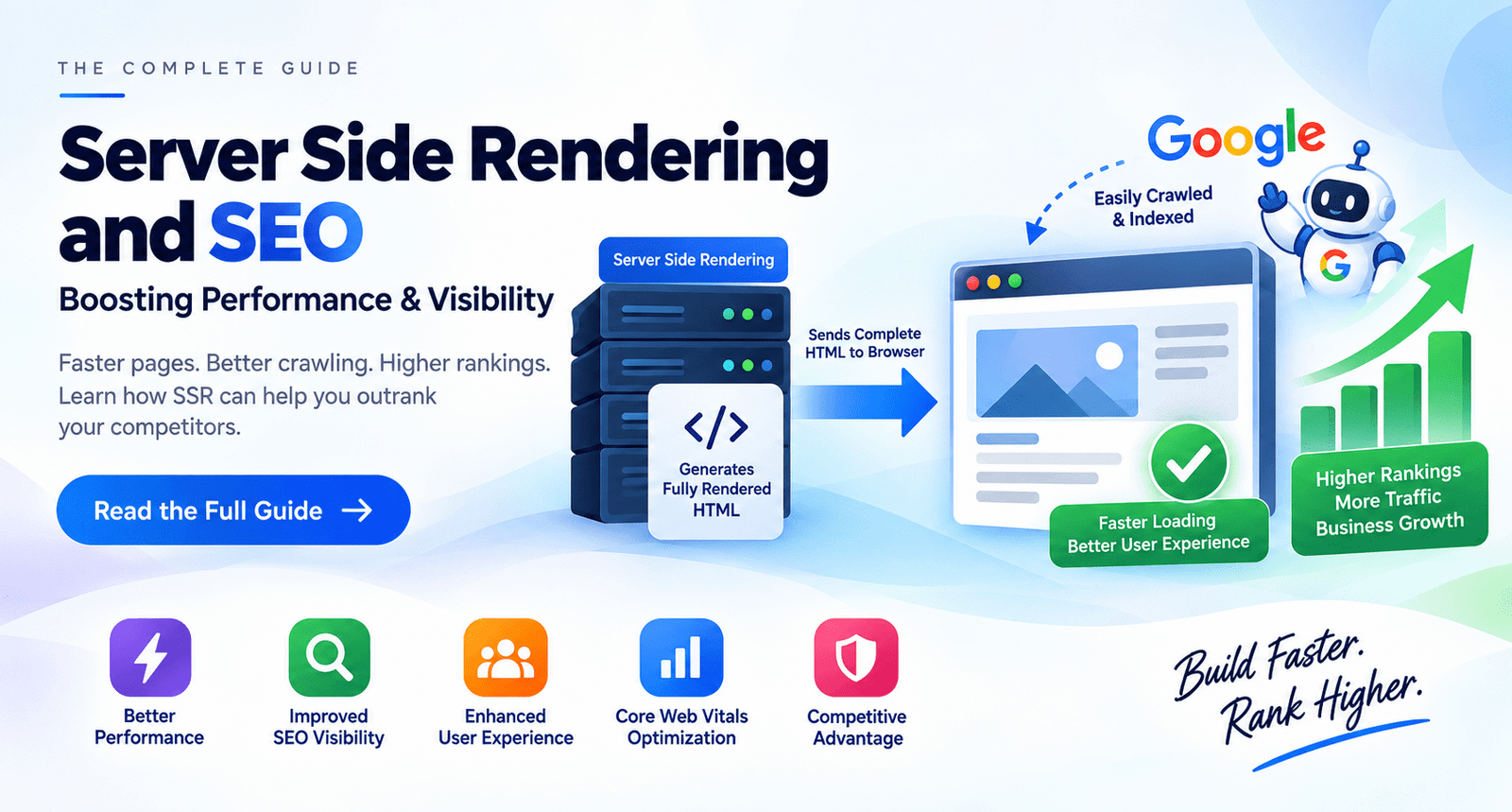
Server Side Rendering (SSR) improves SEO by delivering fully rendered HTML that search engines can crawl and index immediately. It supports faster indexing, reliable metadata, better crawlability, and improved Core Web Vitals such as LCP and CLS. However, SSR adds server load, caching, and development complexity. For SEO-focused websites, a hybrid approach using SSR, SSG, ISR, and CSR can provide the right balance.
Introduction
Imagine spending months crafting the perfect website — beautiful design, compelling content, seamless user experience — only to discover that search engines can barely read it. Your rankings remain stubbornly low, your organic traffic is a trickle, and your competitors are dominating the search results page despite seemingly offering less value.
This scenario plays out for thousands of websites every single day, and the culprit is often something developers and marketers overlook: how web pages are rendered.
In the modern digital landscape, where JavaScript-heavy applications have become the norm, rendering methodology has emerged as one of the most critical yet underappreciated factors affecting both website performance and SEO visibility. Server Side Rendering (SSR) has stepped into the spotlight as a powerful solution — one that bridges the gap between dynamic, feature-rich web applications and the technical requirements that search engines demand.
Whether you are a business owner trying to understand why your website is not ranking, a developer looking to make technically informed architectural decisions, or a digital marketer aiming to squeeze every last drop of organic performance from your web presence, this guide is your comprehensive resource.
In this blog post, we will explore everything you need to know about Server Side Rendering and SEO — from the foundational concepts to advanced implementation strategies — so you can make informed decisions that genuinely move the needle on your search performance.
What Is Server Side Rendering (SSR)?
Before we can appreciate why Server Side Rendering matters for SEO, it is essential to understand what it actually means and how it works at a fundamental level.
The Basic Concept
Server Side Rendering (SSR) is a web rendering technique where a web page's HTML is fully generated on the server before it is sent to the user's browser. When a user requests a page, the server processes the request, compiles all the necessary data, runs the application code, generates a complete HTML document, and then delivers that fully formed page to the browser.
In simpler terms, think of it like ordering food at a restaurant where the chef fully prepares your meal in the kitchen before it arrives at your table — ready to eat the moment it lands in front of you.
A Brief History
Server Side Rendering is not actually a new concept — it is the original way the web worked. In the early days of the internet, virtually every website used SSR by default. PHP, Ruby on Rails, ASP.NET, and similar server-side technologies dominated the landscape, generating and serving complete HTML pages for every user request.
The shift away from traditional SSR began with the rise of JavaScript frameworks like Angular, React, and Vue.js in the 2010s. These frameworks introduced Client Side Rendering (CSR), where much of the page generation work moved from the server to the user's browser. While CSR enabled richer, more dynamic web experiences, it also introduced significant SEO and performance challenges.
Modern SSR represents a sophisticated evolution of the original concept — combining the SEO and performance benefits of traditional server rendering with the interactivity and component-based architecture of modern JavaScript frameworks.
How SSR Works: Step by Step
Understanding the SSR process helps clarify why it offers specific SEO advantages:
- User Request: A user types a URL or clicks a link, sending an HTTP request to the web server
- Server Processing: The server receives the request and begins processing it
- Data Fetching: The server fetches any necessary data from databases, APIs, or other data sources
- HTML Generation: The server runs the application code (React, Vue, Angular, etc.) and generates a complete HTML document with all content populated
- Response Delivery: The fully rendered HTML is sent back to the browser
- Browser Rendering: The browser displays the complete page almost immediately since the HTML is already fully formed
- Hydration: JavaScript loads in the background and "hydrates" the static HTML, attaching event listeners to make the page interactive
This process ensures that when the page arrives in a user's browser — or a search engine crawler's indexer — it is fully formed and content-rich from the very first moment.
How Search Engines Crawl and Index Web Pages
To fully appreciate the impact of Server Side Rendering on SEO, you need to understand how search engines like Google actually discover, crawl, and index web content. This is where many website owners and developers have significant knowledge gaps.
The Crawling Process
Search engines use automated programs called crawlers or spiders (Googlebot is Google's primary crawler) that systematically browse the web by following links from page to page. When Googlebot discovers a new URL, it sends an HTTP request to that URL and processes what it receives in response.
Here is where rendering methodology becomes critically important.
The Two-Wave Indexing Problem
Google's indexing process for JavaScript-heavy websites traditionally operated in two distinct waves:
- Wave 1 — Initial Crawl: Googlebot fetches the raw HTML of a page and indexes any content that is immediately visible in that HTML. If the page uses Client Side Rendering and returns minimal HTML (just a basic shell with JavaScript references), very little content gets indexed in this first wave.
- Wave 2 — JavaScript Rendering: At some later point, Google's indexing system goes back to render the JavaScript, process the dynamic content, and update the index. This second wave can be delayed by days or even weeks, meaning your content may not appear in search results for an extended period.
This two-wave process creates several problems:
- Delayed indexing of new content and updates
- Inconsistent content discovery, since not all crawlers are as capable as Googlebot at rendering JavaScript
- Risk of missing content if JavaScript errors occur during rendering
- Resource-intensive rendering that may not always be completed for all pages
What Google Actually Says
Google has stated that while Googlebot can render JavaScript, the rendering process is resource-intensive and may not happen immediately or consistently for all pages. Furthermore, other important search engines like Bing, Yahoo, Yandex, and Baidu have significantly less capability when it comes to JavaScript rendering, meaning CSR sites may have substantial indexing problems across multiple search platforms.
The SSR Advantage in Crawling
When a search engine crawler visits an SSR website, it receives a complete, fully populated HTML page in response to its initial request — no JavaScript execution required, no second rendering wave needed. Every piece of content, every metadata tag, every heading, and every link is immediately visible and indexable.
This is the fundamental reason why Server Side Rendering and SEO are so deeply intertwined.
The Connection Between Server Side Rendering and SEO
Now that we understand both SSR and how search engines work, let us explore the specific, tangible ways that Server Side Rendering directly influences your SEO performance.
Immediate Content Availability
The most direct connection between Server Side Rendering and SEO is the immediate availability of fully rendered content for search engine crawlers. When Googlebot or any other crawler fetches an SSR page, it receives complete HTML containing:
- All body content and text
- Properly structured headings (H1, H2, H3, etc.)
- Meta titles and descriptions
- Open Graph tags and other metadata
- Internal and external links
- Image alt text and attributes
- Schema markup and structured data
This means everything that matters for on-page SEO is immediately discoverable without the need for JavaScript execution. There is no guesswork, no waiting period, and no risk of content being missed.
Faster Indexing Cycles
With SSR, search engines can crawl and index your content much faster. Since there is no need for the two-wave indexing process that JavaScript-dependent pages require, new content and updates can appear in search results significantly sooner. This matters enormously for:
- News websites that need real-time indexing of breaking stories
- E-commerce sites with frequently updated product listings
- Blogs and content platforms publishing time-sensitive information
- Any website that regularly refreshes or adds content
Metadata and Technical SEO Elements
One of the most critical aspects of technical SEO is ensuring that all metadata elements are properly rendered and accessible to crawlers. Server Side Rendering guarantees that these elements are present in the initial HTML response:
- Title tags — properly rendered for every unique page
- Meta descriptions — dynamically generated and present from the first request
- Canonical tags — correctly implemented to prevent duplicate content issues
- Open Graph tags — important for social media sharing and indirect SEO benefits
- Robots meta tags — properly controlling crawler behavior
- Hreflang tags — essential for international SEO
With Client Side Rendering, these elements may not be present in the initial HTML or may be dynamically inserted in ways that certain crawlers cannot read, leading to significant technical SEO vulnerabilities.
Crawl Budget Optimization
Crawl budget refers to the number of pages that Google will crawl on your website within a given timeframe. For large websites with thousands of pages, crawl budget management is a significant SEO concern.
SSR can positively impact crawl budget utilization in several ways:
- Pages are served more efficiently, allowing crawlers to process more pages in the same amount of time
- Clean HTML responses reduce the processing work required by crawlers
- Faster page loading means crawlers can move through your site more quickly
- Consistent, predictable rendering reduces the chance of crawlers abandoning pages due to timeout issues
SSR vs. Client Side Rendering: Which Is Better for SEO?
The SSR versus CSR debate is one of the most important architectural decisions affecting modern website SEO. Understanding both approaches and their specific SEO implications is crucial for making the right choice for your project.
Client Side Rendering (CSR) Explained
Despite its popularity and developer experience benefits, pure CSR creates significant SEO challenges:
| Challenge | Impact on SEO |
| Empty initial HTML | Crawlers see little to no content on first fetch |
| JavaScript dependency | Non-JS crawlers cannot index content at all |
| Slow Time to First Byte | Negative impact on Core Web Vitals |
| Two-wave indexing | Delays in content appearing in search results |
| Dynamic metadata issues | Title tags and meta descriptions may not render correctly |
| Inconsistent rendering | Different crawlers see different versions of your page |
The SEO Advantages of SSR Over CSR
| Factor | SSR | CSR |
| Initial HTML content | Complete and full | Minimal shell |
| Crawler accessibility | Excellent | Poor to moderate |
| Indexing speed | Fast | Slow (two-wave process) |
| Metadata reliability | High | Variable |
| JavaScript dependency for SEO | None | Critical |
| Cross-crawler compatibility | Excellent | Poor |
| Core Web Vitals performance | Generally better | Generally worse |
When CSR Might Still Make Sense
Despite its SEO disadvantages, CSR can still be appropriate in certain scenarios:
- Private, authenticated applications where pages are behind login walls and do not need to be indexed
- Internal tools and dashboards used exclusively by team members
- Highly interactive applications where every feature is gated and SEO is genuinely irrelevant
- Progressive Web Apps with minimal SEO requirements
For any publicly accessible content that needs to rank in search engines, SSR almost universally provides better SEO outcomes than pure CSR.
SSR vs. Static Site Generation (SSG): Key Differences
While SSR is often positioned against CSR, there is another rendering approach worth considering from an SEO perspective: Static Site Generation (SSG). Understanding the differences helps you choose the right approach for different use cases.
What Is Static Site Generation?
Static Site Generation involves pre-building all pages at build time, generating complete HTML files that are then served directly from a CDN or file server. Unlike SSR (which generates pages on each request), SSG generates pages once and serves the same pre-built HTML to every user.
Popular SSG tools include Gatsby, Hugo, Jekyll, Eleventy, and Next.js (which supports both SSR and SSG).
SSR vs. SSG: SEO Comparison
| Factor | SSR | SSG |
| Content freshness | Always current | Only as fresh as last build |
| Dynamic content handling | Excellent | Limited without client-side fetching |
| Crawlability | Excellent | Excellent |
| Server load | Higher | Minimal |
| TTFB (Time to First Byte) | Moderate | Very fast (CDN-served) |
| Personalization | Full support | Limited |
| Build time for large sites | Not applicable | Can be very long |
| Best for | Dynamic, frequently updated sites | Content-heavy sites with stable data |
When to Choose SSR vs. SSG for SEO
Choose SSR when:
- Content changes frequently and real-time accuracy matters
- Pages are personalized based on user data, location, or behavior
- You have a large e-commerce catalog that constantly updates
- News and media content needs immediate indexing
Choose SSG when:
- Content is relatively stable and does not change frequently
- Maximum page speed (especially TTFB) is the priority
- The site can tolerate a rebuild cycle when content updates
- Blog or documentation content fits a predictable update schedule
Many modern frameworks support Incremental Static Regeneration (ISR) — a hybrid approach offered by Next.js that combines the speed of SSG with the freshness of SSR by revalidating and rebuilding individual pages on a configurable schedule.
Core Web Vitals and SSR: Why Performance Matters
Google's Core Web Vitals have become a confirmed ranking factor, making page performance metrics directly relevant to SEO outcomes. SSR has a significant positive impact on several Core Web Vitals, which is why the relationship between Server Side Rendering and SEO extends far beyond just content crawlability.
The Three Core Web Vitals
1. Largest Contentful Paint (LCP)
LCP measures how long it takes for the largest visible content element on a page to load and become visible to the user. Google considers a good LCP score to be 2.5 seconds or less.
- How SSR Improves LCP: Since SSR delivers fully formed HTML, the browser can begin rendering the largest content elements almost immediately upon receiving the server response. There is no need to wait for JavaScript to download, parse, execute, and then fetch data before rendering visible content. CSR applications typically suffer from poor LCP because the browser must complete multiple steps (download JS bundle, execute code, fetch data, render content) before the largest content element becomes visible.
- Typical improvement: SSR applications can improve LCP scores by 1-3 seconds compared to equivalent CSR implementations.
2. First Input Delay (FID) / Interaction to Next Paint (INP)
FID measures the time from when a user first interacts with a page to when the browser can actually respond to that interaction. Google replaced FID with Interaction to Next Paint (INP) in 2024, which measures responsiveness more comprehensively throughout the entire page session.
- How SSR Influences FID/INP: SSR's impact on interactivity metrics is more nuanced. While SSR delivers visible content faster, the hydration process (attaching JavaScript event listeners to the server-rendered HTML) can temporarily delay interactivity. However, modern SSR implementations have optimized hydration techniques that minimize this impact.
- For most sites, SSR results in equal or better FID/INP scores compared to CSR because:
- Initial content is visible faster, providing immediate user feedback
- JavaScript bundles can be optimized and loaded progressively
- Server responses are typically faster than waiting for client-side rendering
3. Cumulative Layout Shift (CLS)
CLS measures visual stability — how much page elements move around as the page loads. A good CLS score is less than 0.1.
- How SSR Improves CLS: SSR dramatically reduces layout shifts because the complete page structure is defined in the initial HTML. There are no placeholder elements that get replaced by dynamically loaded content, no elements that suddenly appear and push other elements down, and no late-loading fonts or images that cause content to jump. CSR applications frequently suffer from poor CLS because placeholders, loading spinners, and skeleton screens are replaced by actual content, causing significant layout shifts that Google penalizes.
Additional Performance Metrics
Beyond Core Web Vitals, SSR also positively affects several other performance metrics that influence user experience and indirectly impact SEO:
- Time to First Byte (TTFB): TTFB measures how quickly the server begins sending data in response to a request. SSR can have a slightly higher TTFB than static files (because the server must process and generate the HTML), but when optimized with caching and CDN delivery, SSR TTFB can be excellent.
- First Contentful Paint (FCP): SSR consistently delivers better FCP scores than CSR since the browser can begin painting content from the initial HTML response.
- Total Blocking Time (TBT): With proper code splitting and optimized hydration, SSR applications can achieve lower TBT scores than equivalent CSR implementations.
Top Benefits of Server Side Rendering for SEO
Let us consolidate the specific, measurable benefits that Server Side Rendering provides from an SEO perspective:
Benefit 1: Immediate and Reliable Content Indexing
SSR ensures that 100% of your page content is immediately available in the initial HTML response. There is no risk of content being missed during indexing, no delays from JavaScript rendering queues, and no inconsistency between what different crawlers see.
This reliability is enormously valuable. In competitive niches where content freshness and indexing speed matter, the ability to get new pages into the index quickly and completely can be the difference between capturing first-mover advantage and watching competitors rank for content you published first.
Benefit 2: Consistent Technical SEO Implementation
Every technical SEO element — title tags, meta descriptions, canonical URLs, structured data, hreflang tags — is reliably present in the server response. This eliminates the technical inconsistencies that plague CSR sites and ensures your technical SEO work actually produces results.
Benefit 3: Superior Performance Scores
Better Core Web Vitals scores resulting from SSR implementation translate directly into improved rankings in Google's search algorithm, which explicitly uses page experience signals as ranking factors.
Benefit 4: Enhanced User Experience Driving Indirect SEO Signals
Faster page loads reduce bounce rates and increase engagement metrics like pages per session and time on site. While Google has been cautious about confirming the direct use of engagement metrics as ranking signals, the indirect benefits of better user experience are well-documented:
- Lower bounce rates signal content quality and relevance
- Longer session durations indicate user satisfaction
- More pages visited per session increases internal link equity distribution
- Better mobile experience improves mobile search rankings specifically
Benefit 5: Broader Search Engine Compatibility
While Googlebot is increasingly capable of rendering JavaScript, other major search engines are not. SSR ensures compatibility with:
- Bing — Microsoft's search engine with significant market share
- Yandex — Dominant in Russian-speaking markets
- Baidu — Essential for Chinese market penetration
- DuckDuckGo — Privacy-focused search growing in popularity
- Social media crawlers — Facebook, Twitter, LinkedIn crawlers for proper Open Graph rendering
Benefit 6: Improved Social Sharing and Indirect SEO Benefits
Social media crawlers (used by Facebook, Twitter, LinkedIn) when generating link previews often do not execute JavaScript. SSR ensures that proper Open Graph tags and social metadata are available in the initial HTML, resulting in rich, attractive link previews whenever content is shared.
While social shares are not direct ranking factors, the increased visibility and potential for natural backlink acquisition that comes from better social sharing does indirectly support SEO goals.
Benefit 7: Better Mobile SEO Performance
Google uses mobile-first indexing, meaning it primarily uses the mobile version of content for ranking purposes. SSR applications typically perform better on mobile devices because they require less client-side processing power, which is particularly relevant for users on lower-end devices or slower mobile connections.
Challenges of Server Side Rendering
While the SEO benefits of SSR are substantial, it is important to approach this technology with a clear understanding of its challenges. A well-informed decision requires honest assessment of the trade-offs.
Challenge 1: Increased Server Load
Since SSR generates HTML on every page request (unless caching is implemented), it places significantly more load on your server infrastructure compared to serving static files or relying on client-side rendering. High-traffic websites can face:
- Increased server costs
- Scalability challenges during traffic spikes
- Need for more sophisticated infrastructure planning
Solution: Implement robust caching strategies at multiple levels — page-level caching, fragment caching, CDN caching — and use horizontal scaling to handle traffic increases.
Challenge 2: Time to First Byte (TTFB) Variability
The server processing time required to generate SSR responses can increase TTFB compared to serving static files. If the server needs to make multiple database queries or API calls before rendering the page, TTFB can become a performance bottleneck.
Solution: Optimize server-side data fetching with efficient database queries, implement API response caching, use CDN-level caching for frequently accessed pages, and consider edge rendering solutions.
Challenge 3: Hydration Complexity and Time to Interactive (TTI)
The hydration process — where JavaScript attaches to server-rendered HTML to make it interactive — can temporarily block user interactions. If the JavaScript bundle is large and takes time to download and execute, users may see a fully rendered page that appears responsive but does not actually respond to interactions.
This "uncanny valley" of visible but non-interactive content can be frustrating for users and can negatively impact FID/INP scores.
Solution: Implement code splitting, lazy loading, progressive hydration, and consider selective hydration approaches (like React 18's streaming SSR) that prioritize critical interactive elements.
Challenge 4: Development Complexity
SSR introduces additional complexity to the development process:
- Code must work in both server and browser environments
- Certain browser-specific APIs (window, document, localStorage) cannot be used during server rendering
- Debugging becomes more complex across two environments
- Build and deployment pipelines become more sophisticated
Solution: Use established SSR frameworks (Next.js, Nuxt.js, SvelteKit) that handle much of this complexity automatically, and invest in developer training and documentation.
Challenge 5: Caching Complexity for Dynamic Content
While SSR caching is possible and highly recommended, caching personalized or user-specific content correctly is complex. Serving a cached version of a page intended for one user to another user can create significant problems.
Solution: Implement granular cache key strategies, use cache-control headers appropriately, and consider edge computing solutions that can handle personalization while still benefiting from geographic distribution.
Best Practices for Implementing SSR for Maximum SEO Gains
If you have decided that SSR is right for your project, implementing it correctly is crucial to actually capturing the SEO benefits. Here are the key best practices that separate successful SSR implementations from problematic ones.
Practice 1: Implement Comprehensive Caching Strategies
Caching is the single most important factor in making SSR both performant and scalable. Without effective caching, SSR can actually perform worse than CSR in certain scenarios.
Recommended caching layers:
- CDN-level caching: Cache full page responses at CDN edge nodes geographically close to users. This is ideal for non-personalized content and can make SSR pages as fast as static files.
- Server-level caching: Cache rendered HTML in memory (Redis, Memcached) at the application server level for pages that change infrequently.
- Fragment caching: Cache individual page sections separately, allowing you to cache static parts of a page while dynamically rendering personalized sections.
- API and data caching: Cache the data fetched from databases and APIs to reduce the time spent in data fetching during SSR.
Practice 2: Optimize Critical Rendering Path
Ensure that the HTML generated by SSR is optimized for maximum rendering performance:
- Inline critical CSS to eliminate render-blocking stylesheet loading
- Preload important resources (fonts, critical images) using link preload hints
- Defer non-critical JavaScript to prevent blocking the initial page render
- Use HTTP/2 or HTTP/3 for multiplexed resource delivery
Practice 3: Implement Proper Meta Tag Management
Take full advantage of SSR's ability to reliably deliver metadata by ensuring every page has:
- Unique, keyword-optimized title tags dynamically generated per page
- Compelling meta descriptions that encourage click-throughs from search results
- Canonical tags properly set to prevent duplicate content issues
- Open Graph tags for social sharing
- Structured data/schema markup appropriate for your content type
Libraries like Next.js's <Head> component or React Helmet make dynamic meta tag management straightforward in SSR frameworks.
Practice 4: Optimize for Core Web Vitals Specifically
Go beyond just implementing SSR — actively optimize for each Core Web Vital:
1. For LCP
- Identify and optimize the largest content element on each page template
- Ensure hero images are properly sized and include fetchpriority="high"
- Avoid loading the LCP element through CSS backgrounds
- Pre-connect to third-party domains hosting required resources
2. For INP
- Break up long tasks that block the main thread
- Use Web Workers for CPU-intensive operations
- Implement efficient event handlers
- Minimize unnecessary JavaScript execution
3. For CLS
- Always specify width and height attributes for images and videos
- Reserve space for ad slots and dynamic content
- Use font-display: optional or font-display: swap for web fonts
- Avoid inserting content above existing content dynamically
Practice 5: Implement Comprehensive Structured Data
SSR's reliable HTML delivery makes structured data implementation more dependable. Implement relevant schema types for your content:
- Article schema for blog posts and news content
- Product schema for e-commerce pages
- FAQ schema for question-and-answer content
- BreadcrumbList schema for improved SERP display
- Organization and LocalBusiness schema for brand representation
- Review and AggregateRating schema for product and service pages
Practice 6: Optimize Internal Linking
Server-rendered pages make internal link structures more reliable and crawl-friendly. Ensure:
- All internal links are standard HTML anchor tags with href attributes
- Links are present in the initial HTML (not dynamically added after page load)
- Breadcrumbs are implemented and included in server-rendered HTML
- Footer and navigation links are part of the server-rendered markup
Practice 7: Monitor Rendering and Indexing Health
Set up monitoring to ensure your SSR implementation continues to function correctly from a search engine perspective:
- Use Google Search Console to monitor coverage reports and identify indexing issues
- Regularly test pages with Google's Rich Results Test to verify structured data
- Use Google's URL Inspection Tool to verify how Googlebot sees your pages
- Monitor Core Web Vitals in Search Console and using tools like PageSpeed Insights
- Set up log file analysis to monitor how search engine bots interact with your site
- Use Screaming Frog or similar tools to regularly audit your SSR implementation
Practice 8: Handle JavaScript Errors Gracefully
SSR server-side code errors can result in incomplete or broken pages being served to both users and crawlers. Implement:
- Comprehensive error handling and fallback rendering
- Error monitoring and alerting (Sentry, Datadog)
- Graceful degradation strategies for when data fetching fails
- Health checks and automated alerting for SSR service issues
Popular SSR Frameworks and Tools
Choosing the right framework or tool for implementing SSR can significantly affect both the quality of your implementation and your development efficiency. Here are the leading options:
Real-World Examples of SSR Improving SEO Performance
Understanding the theoretical benefits of SSR is valuable, but seeing real-world impact helps solidify the business case.
E-commerce Case Study Pattern
Large e-commerce platforms that have migrated from CSR SPAs to SSR implementations consistently report:
- 30-50% improvement in organic search traffic within 3-6 months of migration
- Significant reduction in time-to-index for new product listings (from weeks to days or hours)
- Improved crawl coverage with more pages being successfully indexed
- Better rankings for long-tail keywords due to improved content discovery
The pattern is especially pronounced for product category pages and product detail pages, where CSR implementations often fail to reliably render content for non-JavaScript crawlers.
News and Media Platform Improvements
News websites migrating from traditional CMS setups or CSR implementations to SSR report:
- Faster inclusion in Google News for time-sensitive stories
- Better Core Web Vitals scores leading to improved rankings
- Increased visibility in Google Discover which has specific page experience requirements
- Higher click-through rates from improved meta description rendering
B2B SaaS Marketing Site Migrations
Technology companies rebuilding their marketing websites with SSR frameworks like Next.js consistently report:
- Dramatically improved PageSpeed Insights scores (often moving from 30-50 range to 70-90+ range)
- Faster indexing of new blog and resource content
- Improved ranking positions for target keywords within weeks of launching
- Reduced bounce rates due to faster perceived page loads
Is SSR Right for Your Website?
Not every website needs SSR, and implementing it unnecessarily adds complexity without proportional benefit. Use this decision framework to determine the right approach for your specific situation.
SSR Is Strongly Recommended When
- Your website depends on organic search traffic for business success
- You have a large content catalog that needs reliable, fast indexing
- Your content changes frequently and indexing freshness matters
- You serve personalized content that cannot be pre-generated statically
- You are building an e-commerce site with dynamic product data
- Your current Core Web Vitals scores are poor and affecting rankings
- You need to serve international audiences and require proper hreflang implementation
- Your existing CSR implementation is causing indexing issues in Search Console
Consider SSG Instead When
- Your content changes infrequently (weekly or less)
- You do not have personalized content requirements
- Maximum TTFB performance is the priority
- You want minimal server infrastructure and maintenance overhead
- Your site has a manageable number of pages (under tens of thousands)
CSR May Be Acceptable When
- Your content is behind authentication and does not need to be indexed
- The application is an internal tool or dashboard
- SEO is genuinely not a business requirement
- The interaction complexity makes SSR impractical
A Hybrid Approach Is Often Optimal
Most modern frameworks support mixing rendering strategies. A common and effective approach is:
- SSR for key landing pages, product pages, and SEO-critical content
- SSG for blog posts, documentation, and stable content pages
- CSR for authenticated user dashboards and highly interactive features
- ISR for pages that need freshness but can tolerate slight staleness
Conclusion
The relationship between Server Side Rendering and SEO is not merely technical — it is fundamentally strategic. In a digital landscape where search engine visibility can make or break a business, the architectural decisions made during web development have direct, measurable consequences for organic search performance.
Throughout this guide, we have established that SSR provides significant advantages across the key pillars of SEO:
- Technical accessibility: Fully rendered HTML that every search engine crawler can immediately read and index without JavaScript dependencies
- Performance: Improved Core Web Vitals scores — particularly LCP and CLS — that directly contribute to Google's Page Experience ranking signals
- Indexing speed and reliability: Faster, more consistent content indexing that helps new content appear in search results sooner
- Metadata reliability: Consistent, dependable rendering of all technical SEO elements including title tags, meta descriptions, canonical tags, and structured data
- Cross-engine compatibility: Proper content delivery to all search engines, not just Googlebot
At the same time, we have been honest about the challenges SSR presents — increased server load, hydration complexity, development overhead, and caching requirements. These are real considerations that require thoughtful infrastructure planning and experienced development work.
The good news is that modern frameworks like Next.js, Nuxt.js, SvelteKit, and Remix have made implementing SSR dramatically more accessible than it was even a few years ago. The days when SSR required complex, custom server infrastructure are largely behind us — today, developers can implement production-quality SSR with excellent performance characteristics using well-supported, well-documented frameworks.
The bottom line for anyone serious about organic search performance is clear: if your website depends on search engine visibility for business success, Server Side Rendering should be a strong consideration in your architecture decisions. The technical investment pays dividends through better rankings, faster indexing, improved user experience, and the competitive advantage that comes from a technically excellent web presence.
Whether you are planning a new website, considering a migration from an existing CSR application, or simply trying to understand why your current site is underperforming in search, SSR represents one of the most impactful technical SEO investments available in the modern web development toolkit.
FAQs
Does Google require Server Side Rendering for good SEO rankings?
No, Google does not strictly require Server Side Rendering for good SEO rankings. Google's Googlebot is capable of rendering JavaScript and indexing content from Client Side Rendered pages. However, JavaScript rendering by Google happens in a second wave that can be delayed by days or weeks, meaning SSR provides a significant advantage in indexing speed and reliability.
For most websites targeting strong organic search performance, SSR provides meaningful advantages that translate into better rankings, especially for content freshness, crawl reliability, and performance metrics (Core Web Vitals). While you can rank with CSR, SSR consistently provides a more favorable environment for SEO success.
It is also worth noting that while Google can render JavaScript, other search engines (Bing, Yandex, Baidu) are significantly less capable in this regard. SSR ensures your content is accessible across all search engines, not just Google.
Will switching from Client Side Rendering to Server Side Rendering improve my website's rankings?
In most cases, yes — migrating from CSR to SSR will improve your SEO performance, though the extent and timeline of improvement varies. Websites that switch to SSR typically see:
- Faster and more comprehensive indexing of their content
- Improved Core Web Vitals scores, particularly LCP and CLS
- Better crawl coverage, meaning more pages appearing in the index
- Faster ranking of new content and pages
However, improvements are not instantaneous. After migration, allow 2-3 months for Google to fully re-crawl and reindex your site with the improved rendering. Some improvements, like better Core Web Vitals scores, may reflect in rankings faster — sometimes within weeks.
The magnitude of improvement depends heavily on how poorly your CSR implementation was performing before migration. Sites with serious indexing issues due to CSR can see dramatic improvements, while sites where Google was successfully rendering JavaScript may see more modest gains.
How does Server Side Rendering impact Core Web Vitals, and why does that matter for SEO?
Server Side Rendering has a generally positive impact on Core Web Vitals, which directly matters for SEO because Google uses Core Web Vitals as a ranking factor in its Page Experience signals.
The specific impacts are:
- Largest Contentful Paint (LCP): SSR delivers significant improvements by making content immediately available in the initial HTML response. Browsers can begin rendering the largest content element without waiting for JavaScript to execute, typically improving LCP scores by 1-3 seconds.
- Cumulative Layout Shift (CLS): SSR reduces layout shifts because the complete page structure is defined in the initial HTML, eliminating the dynamic content insertion that causes elements to jump around in CSR applications.
- Interaction to Next Paint (INP): The impact is more nuanced — SSR's hydration process can temporarily delay interactivity, but modern optimization techniques (progressive hydration, selective hydration) minimize this effect.
Google has explicitly stated that pages with good Core Web Vitals scores receive a ranking boost, though content quality and relevance remain the primary ranking factors. Better Core Web Vitals from SSR implementation can provide the competitive edge needed to rank above similarly authoritative competitors.