

Quick Summary
- Cloud ERP centralizes business operations by integrating finance, HR, inventory, sales, procurement, and customer management into a single, cloud-based platform.
- Organizations benefit from real-time data, automation, and improved collaboration, enabling faster decision-making and greater operational efficiency.
- Cloud ERP reduces IT infrastructure costs while providing scalability, flexibility, and secure remote access for hybrid and distributed teams.
- Advanced capabilities such as AI, machine learning, IoT, and analytics help businesses optimize workflows, predict trends, and improve overall performance.
- With proper implementation and the right ERP provider, businesses can accelerate digital transformation, enhance customer experiences, and achieve sustainable long-term growth.
Introduction
Modern enterprises run in an environment where speed, flexibility, and data-based choices really matter for success. As organizations get bigger, it gets hard to handle finance, human resources, inventory, supply chains, customer ties, and everyday operations when everything sits in separate systems. That whole situation usually ends up as hidden inefficiencies, slow cycles, and this kind of scattered reporting. This is also the part where cloud enterprise resource planning (ERP) starts to feel like a big game changer.
How Cloud ERP Is Transforming Different Business Functions
Unlike older on-premise ERP setups, cloud ERP solutions give companies a single, centralized place that can be reached securely pretty much anywhere. Plus, they help organizations smooth out daily workflows, support better cooperation across teams, and see business performance in real time, without having to babysit complicated IT infrastructure all the time.
Nowadays, firms of every size are leaning into cloud ERP as a piece of their digital transformation plans. Whether it’s about improving operational efficiency, backing remote teams, or enabling faster decision-making, cloud ERP keeps shifting how modern enterprises actually run. In this article, we look at how cloud ERP platforms reshape business processes, what benefits come along with them, and why this kind of solution is becoming a must-have investment for lasting growth.
What Is a Cloud ERP Solution?
Definition of Cloud ERP
A cloud ERP solution is sort of enterprise resource planning system that runs on cloud infrastructure, not installed on a company’s local servers. People access the software through a secure internet connection, so teams can work from different places at the same time, while still using the same centralized database, more or less.
Cloud ERP also bundles multiple business functions into one integrated platform, which helps shrink data silos and makes internal communication more seamless between departments.
How Cloud ERP Solutions Works?
Cloud ERP keeps business data on secure cloud servers that are run by the ERP provider, so employees can log in, mostly through a web browser or sometimes via a mobile app and then jump into the modules like finance, procurement, inventory, sales, customer management, and human resources.
The whole point is that it stays connected, and everything feels pretty fast even when different teams are using it at once. Because all departments depend on shared, real-time information, organizations usually can automate workflows, track business performance, and create reports without having to manually mash together details from several separate systems.
Cloud ERP Vs. Traditional On-Premise ERP
With a traditional on-premise ERP, companies typically need to buy servers, install software on-site, and then manage upkeep on their own. That means higher effort, more internal responsibilities, and a bit more time spent on maintenance rather than operations. Cloud ERP kind of removes that burden, since it provides automatic upgrades, reduces infrastructure needs, and uses subscription-based pricing instead.
So in practice, businesses get more flexibility, plus lower maintenance overhead, and generally better system accessibility, especially for teams that don’t all sit in the same place all the time.
Why Modern Enterprises Are Moving to Cloud ERP
Many organizations also work with experienced cloud development companies in India to implement, customize, and integrate cloud ERP platforms based on their unique business requirements. These technology partners help enterprises accelerate digital transformation while ensuring secure, scalable, and cost-effective deployments.
A Growing Push for Agility in Operations
Companies have to respond quickly to changing customer expectations and market shifts. Cloud ERP offers the kind of flexibility that helps introduce new procedures, extend operations, and meet ongoing business challenges in a smoother, more efficient way, basically.
Better Support for Remote and Hybrid Teams
Workplaces today are not just tied to a single place or physical office. With cloud ERP, people can securely reach business applications from different locations, so teamwork becomes easier for remote plus hybrid groups.
Digital Transformation Efforts Underway
A lot of organizations are moving away from older legacy platforms toward cloud-based systems, mainly to boost productivity and stay competitive. Cloud ERP often becomes the backbone, the starting point, for these digital transformation projects.
Higher Expectation for Real-Time Information
Leaders want trustworthy, real-time insight for better decisions. Cloud ERP delivers near-immediate access to operational data, so organizations can track progress and spot chances more effectively, without delay.
Key Features of Cloud ERP Solutions
Cloud ERP platforms give enterprises quite a few things that, uh, support efficiency and make day-to-day operations feel less messy.
Centralized Data Management
They keep all business info essentially in one single database, so departments stay aligned, fewer duplicate records happen, and the whole system looks more consistent.
Real-Time Reporting and Analytics
You get dashboards that you can interact with, plus automated reports. Decision-makers can watch financial results, inventory levels, sales patterns, and other operational signals right as they shift.
Automation of Business Processes
A lot of the usual grind, like invoice handling, purchase approvals, payroll management, and inventory updates, can be set up to run automatically. This cuts manual work, and it also helps accuracy.
Multi-Department Integration
Finance, sales, procurement, inventory, manufacturing, and HR modules tend to mesh together smoothly. That coordination improves across the organization, not only within one team.
Mobile Accessibility
Many cloud ERP systems come with mobile apps. Employees and managers can approve requests, check what’s going on, and pull business information even when they’re away from the office.
AI and Machine Learning Capabilities
More and more modern platforms fold in artificial intelligence and machine learning. This helps automate repeated tasks, produce forecasts, and spot business patterns you might not notice otherwise.
Built-in Security and Compliance
Top ERP providers typically include encryption, user authentication, backup routines, and compliance-related tools. Together, they help protect sensitive business data, so it isn’t just sitting there exposed.
Major Benefits of Cloud ERP for Modern Enterprises
Cloud ERP really does bring measurable benefits that trickle into everyday work, but also help with the bigger, long-range business growth part, you know.
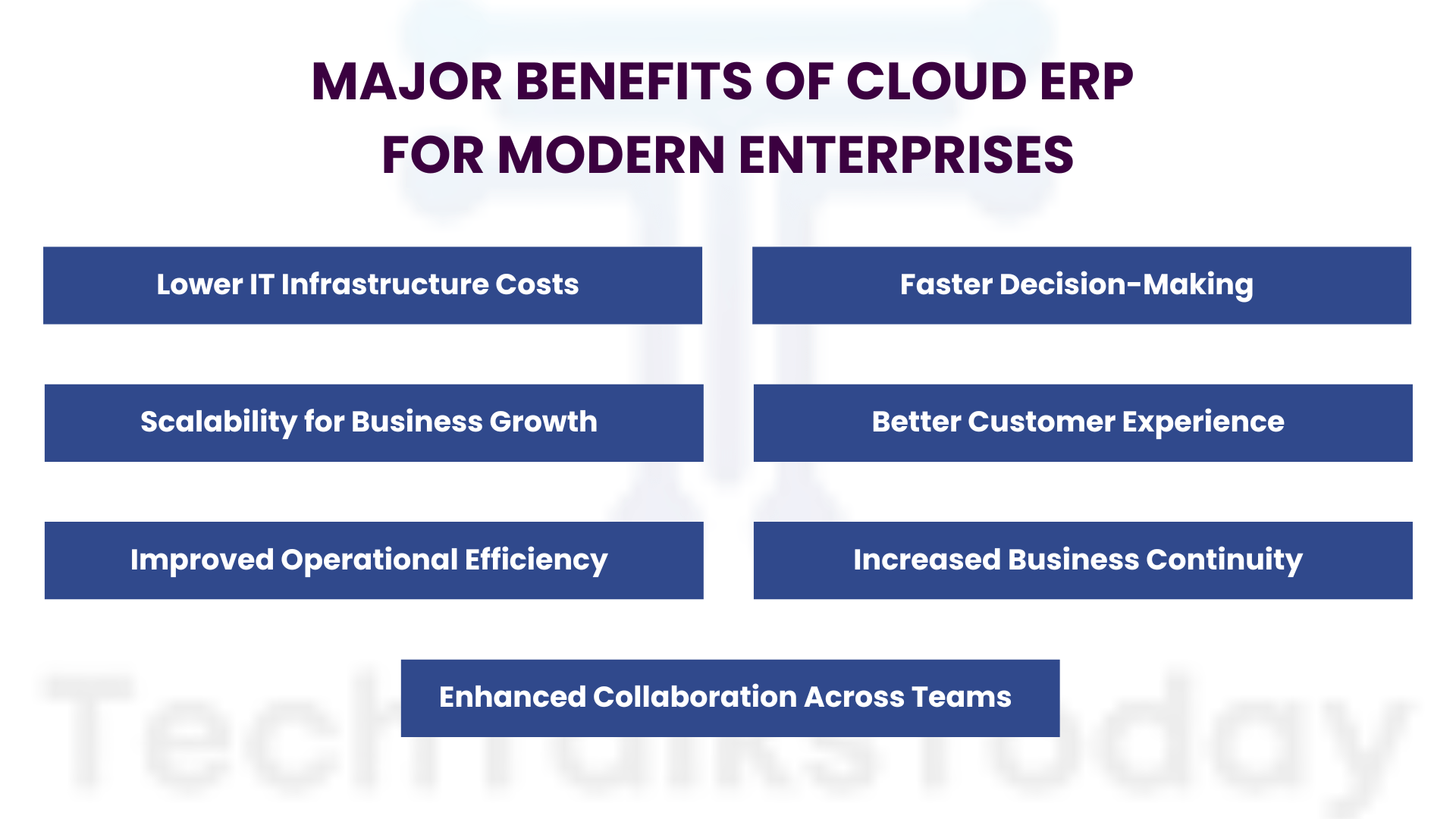
Lower IT Infrastructure Costs
Companies can often cut down on spend tied to buying hardware, keeping servers running, and handling the whole software update routine, without having to overthink it.
Scalability for Business Growth
As a business grows, Cloud ERP makes it easier to add more users, new locations, or extra functionalities. You don’t usually have to swap out the entire system just because things got bigger.
Improved Operational Efficiency
With automated workflows in place, a lot of the repeat stuff gets handled in the background. That way, staff can spend more time on higher-value tasks, and fewer operational delays show up.
Enhanced Collaboration Across Teams
Different departments are working off the same information set, which supports smoother communication and also lowers the chance of mistakes caused by mismatched or inconsistent data.
Faster Decision-Making
Since managers get access to real-time business insights, they can spot issues earlier and steer strategy faster, instead of waiting around.
Better Customer Experience
When customer information is integrated, teams can reply quicker to questions, process orders more efficiently, and deliver a steadier service overall.
Increased Business Continuity
Cloud-based infrastructure usually includes regular backups, disaster recovery options, and high system availability. So organizations can keep operations moving even when unexpected disruptions happen, and that matters a lot.
How Cloud ERP Is Transforming Different Business Functions
Cloud ERP somehow supports almost every department inside an enterprise, not just one or two. It kind of works across functions and keeps data flowing in a more consistent way.
Finance and Accounting
Finance and accounting teams get automated bookkeeping, quicker financial reports, budget monitoring, plus stronger regulatory compliance, which helps them keep things tidy and traceable.
Human Resources
HR groups can handle hiring pipelines, payroll, employee profiles, attendance monitoring, and performance checks all in one centralized place, with less jumping between systems.
Supply Chain Management
With cloud ERP, supply chain visibility goes up because businesses can keep an eye on suppliers, shipments, inventory figures, and procurement actions in near real time.
Inventory and Warehouse Management
Companies can sharpen inventory control, reduce the chances of stockouts, and also boost warehouse efficiency using automated inventory tracking that doesn’t get forgotten.
Procurement
Procurement teams get better oversight over vendor management, purchase approvals, and procurement workflows, so unnecessary spending tends to drop, more or less.
Sales and CRM
Integrated customer relationship features let sales teams handle leads, customer conversations, quotes, and order processing in a more organized manner, instead of patchwork spreadsheets.
For enterprises that also manage digital commerce operations, Salesforce Commerce Cloud can connect customer-facing commerce with broader business processes. Businesses evaluating implementation partners can review Salesforce Commerce Cloud development companies in India based on platform expertise and integration capabilities.
Manufacturing Operations
For manufacturing, cloud ERP supports production scheduling, tracks resource utilization, supports quality control, and improves day-to-day operational efficiency through connected workflows that actually align.
Emerging Technologies Enhancing Cloud ERP
Cloud ERP keeps changing, more or less, as new technologies roll in. Artificial intelligence helps handle repetitive tasks, and also pushes forecasting to be more accurate. Then machine learning digs up patterns inside the operational data, so teams get predictive insights sooner.
Internet of Things, or IoT devices, give real-time visibility into equipment and stock, while robotic process automation (RPA) takes away some of the grunt work from manual admin. On top of that, upgraded business intelligence dashboards make decisions easier since they turn tangled data into clear, visual summaries.
Challenges of Cloud ERP Adoption
Even though cloud ERP development does bring plenty of benefits, organizations still should be ready for some implementation headaches, not just the neat marketing part.
Moving data from legacy systems takes careful planning, so accuracy doesn’t slip, and nobody has to clean up a mess later. At the same time, employees might need proper training to get comfortable with the new workflows, and yes, integrating the cloud ERP with existing applications can turn into a technical puzzle that needs real expertise, rather than guesswork.
On top of that, companies should check the vendor the right way, meaning strong security practices, dependable customer support, and actual long-run scalability, not vague promises.
If you plan properly, and get stakeholders involved early enough, the chances of a successful rollout go way up.
Best Practices for Successful Cloud ERP Implementation
A successful cloud ERP project really starts with business objectives that are clear enough, and then with timelines that are realistic, not just “visionary”. Organizations need to look at ERP vendors with a bit of care, compare features, think about industry know-how, confirm security standards, and also check the level of support services they actually provide.
Then, there’s the data migration part, which can get messy if it’s not planned properly, so comprehensive migration planning really helps to cut down errors once you’re deploying. On top of that, employee training should be treated as a priority, since you want people to start using the system without friction, and in the end it boosts productivity. After go-live, businesses should keep an eye on system performance, collect user feedback as it comes in, and keep tweaking workflows so the long-term value from the ERP investment stays strong.
Future Trends in Cloud ERP Solutions
Cloud ERP is expected to get more, um, brainy and tailored to each industry in the next few years. Artificial intelligence will keep automating some thorny business workflows, while low-code and no-code tweaks will let organizations reshape their ERP environment with way less hassle.
At the same time, sector-bound ERP solutions will come with specialized features for healthcare, manufacturing, retail, and logistics, you know. There will also be stronger cybersecurity protections, predictive analytics added in more places, and sustainability reporting that almost feels built in by default as enterprises press forward with their digital transformation journey.
How to Choose the Right Cloud ERP Solution
Choosing the best cloud ERP platform kind of depends on how well you actually understand what the organization needs, you know. It’s not just “pick one” and done, because companies should look at scalability, how well it connects with existing systems, and whether data security is solid, plus pricing models, and yeah, even the vendor reputation before they decide.
For enterprises considering Oracle-based cloud infrastructure, it is also worth comparing Oracle Cloud development companies in India based on their integration experience, technical capabilities, and ability to support long-term requirements.
What seems most useful is a solution that fits the current way things operate but still leaves room for future growth. That usually brings the biggest long-term value. At the same time, organizations should think about the implementation support, training materials, and hands-on guidance, and also the ongoing customer service you’ll get when comparing different ERP providers.
Conclusion
Cloud ERP solutions have kind of transformed how modern enterprises handle operations and work together across departments, and also how they respond to business demands that keep changing. When data gets centralized, when processes get automated, and when teams can see real-time business insights, the whole thing tends to improve efficiency, lower operational costs a bit, and back sustainable growth.
And as digital transformation keeps speeding up in different industries, cloud ERP is going to stay a key technology for companies that want more agility and to be competitive. The enterprises that choose the right cloud ERP solution, then roll it out in a smart way, will usually be better positioned for what comes next. That means they can handle future challenges while still delivering long-term value to customers, employees, and stakeholders.