

Quick Answer
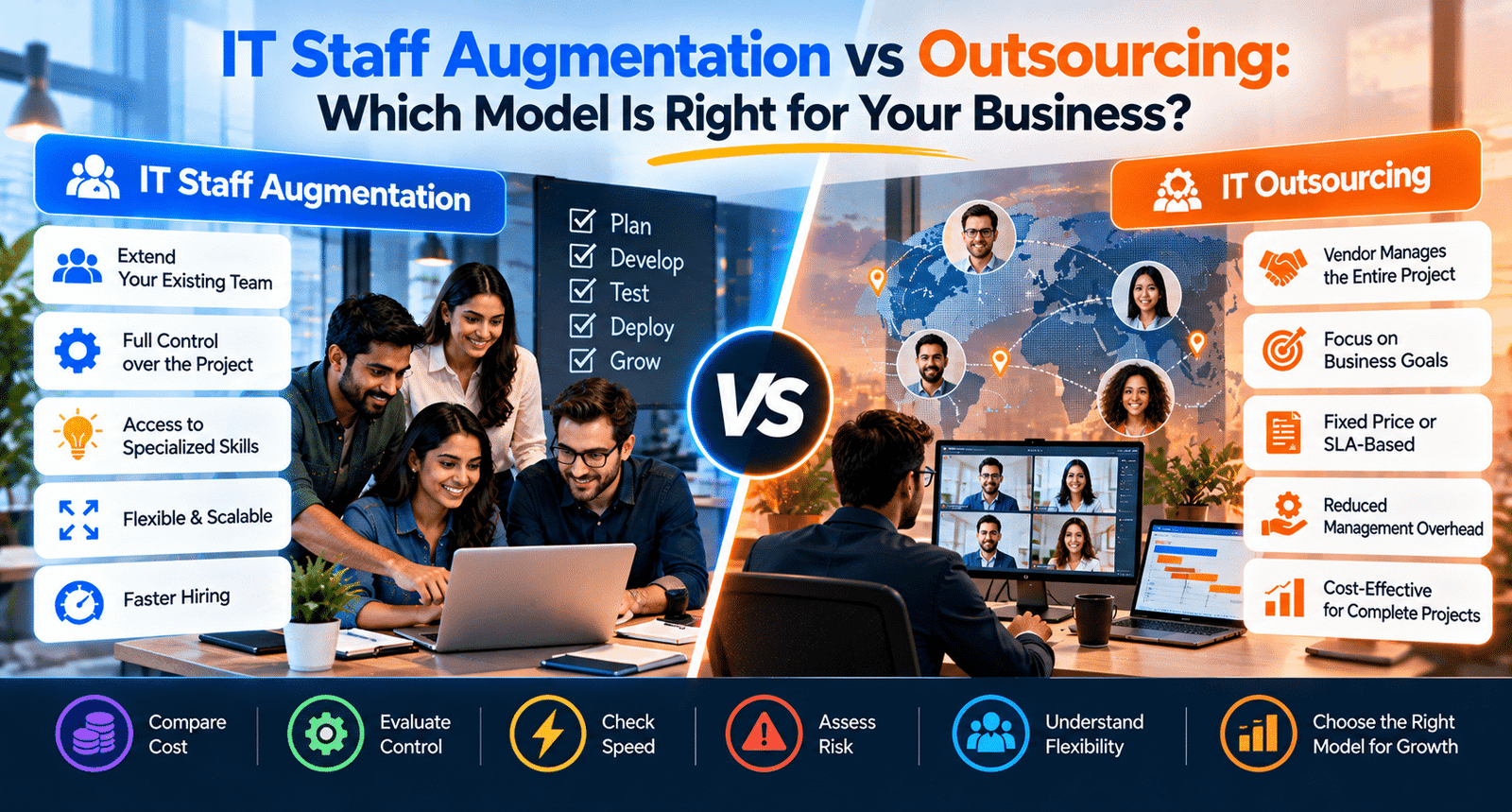
IT staff augmentation means adding external specialists to your in-house team while you keep full control over the project and daily management. IT outsourcing means handing an entire project or function to a third-party vendor who manages the delivery end to end.
Choose staff augmentation when you need specific skills, flexibility, and control. Choose outsourcing when you want a defined result delivered without managing the process yourself.
Introduction
Every growing tech company eventually hits the same wall: the roadmap is full, deadlines are tight, and the internal team doesn't have the bandwidth or the skills to deliver everything. Hiring full-time is slow and expensive, so most businesses look at two alternatives: IT staff augmentation or IT outsourcing.
The two terms are often used interchangeably, but they are very different engagement models. They change who manages the work, who owns the risk, how much you pay, and how much control you keep. Picking the wrong one can mean blown budgets, missed deadlines, and frustrated teams.
This guide breaks down IT staff augmentation vs outsourcing in plain language, with a side-by-side comparison, pros and cons, and a practical framework to help you decide.
What Is IT Staff Augmentation?
IT staff augmentation is a flexible hiring model where you bring in skilled professionals from an external provider to work as an extension of your existing team. These professionals might be developers, QA engineers, DevOps specialists, UI/UX designers, or data engineers.
Key characteristics:
- You manage the work. Augmented staff follow your processes, tools, and priorities.
- They integrate with your team. They join your stand-ups, sprints, and communication channels.
- You pay for talent, not deliverables. Billing is typically hourly or monthly per resource.
- It's scalable. You can add or remove resources as project demands change.
Think of it as renting expertise without the overhead of recruitment, onboarding, and long-term employment commitments.
What Is IT Outsourcing?
IT outsourcing is a model where you transfer responsibility for a project, service, or entire business function to an external vendor. The vendor owns the delivery, handles team management, and is accountable for meeting agreed milestones and quality standards.
Key characteristics:
- The vendor manages the work. You define the goals and requirements, and they handle execution.
- Deliverable-based. Pricing is usually fixed-price or tied to a service-level agreement (SLA).
- Less day-to-day involvement. You review progress at milestones rather than directing daily tasks.
- Common use cases. Examples include building a mobile app, managing IT infrastructure, running a help desk, or handling ongoing software maintenance.
Outsourcing works best when you know what you want built but don't want to build or manage the team yourself.
IT Staff Augmentation vs Outsourcing: Key Differences
| Factor | IT Staff Augmentation | IT Outsourcing |
| Control | High: you direct the team | Lower: the vendor manages delivery |
| Management responsibility | Your internal managers | Vendor's project managers |
| Pricing model | Hourly or monthly per resource | Fixed price or project-based |
| Flexibility | Easy to scale up or down | Less flexible once scope is set |
| Speed to start | Fast, since you add people to an existing setup | Slower, with scoping and contracts first |
| Best for | Skill gaps, short-term capacity needs | Complete projects or functions |
| Risk ownership | Mostly with you | Shared or shifted to the vendor |
| Knowledge retention | Stays in-house | Often stays with the vendor |
| Team integration | Deep, as part of your team | Separate, working as an external unit |
| Internal effort required | High | Low to moderate |
Pros and Cons of IT Staff Augmentation
Pros
- Full control over priorities, processes, and quality standards
- Faster hiring, since you skip lengthy recruitment cycles
- Access to niche skills that are hard to find locally
- Cost flexibility, with no long-term employment costs or benefits
- Knowledge stays with you because the team works inside your systems
- Easy scaling as workloads change
Cons
- Requires strong internal management. You need capable leads to guide the team.
- Onboarding effort. Augmented staff still need context on your product and workflows.
- Potential culture gaps. Remote or external team members may take time to align.
- Higher oversight burden. Quality and delivery risk remain largely with you.
Pros and Cons of IT Outsourcing
Pros
- Less management overhead, since the vendor runs the project
- Predictable costs with fixed-price contracts
- Access to a full team, including project managers, developers, QA, and designers
- Focus on core business while a specialist handles the technical work
- Shared accountability, with delivery commitments backed by contracts and SLAs
Cons
Less control over day-to-day decisions and team composition
Communication challenges, especially across time zones or unclear requirements
Scope change friction. Changes mid-project can mean delays and extra costs.
Dependency risk. Knowledge may sit with the vendor, which can make transitions difficult.
Vendor selection risk. A poor choice can affect quality and timelines significantly.
When to Choose IT Staff Augmentation
Staff augmentation is usually the better fit when:
- You have an existing in-house team and need to fill specific skill gaps
- You want direct control over how work is planned and executed
- Your project scope is evolving, such as in agile or product-led environments
- You need to scale quickly for a launch, release, or peak period
- You want to retain product knowledge and intellectual context internally
- You need a short-term specialist, like a QA automation engineer or cloud architect
When to Choose IT Outsourcing
Outsourcing is usually the better fit when:
- You have a well-defined project scope with clear requirements and deadlines
- You lack internal technical leadership to manage a development team
- You want to minimize management effort and focus on the business side
- The work is non-core, such as IT support, infrastructure management, or maintenance
- You prefer predictable budgeting through fixed-price or SLA-based contracts
- You need a complete, end-to-end solution rather than individual contributors
How to Choose the Right Model
Ask yourself these five questions:
- How much control do I want? If you want to direct the work, choose augmentation. If you'd rather hand it off, choose outsourcing.
- Do I have internal management capacity? Augmentation needs it, and outsourcing doesn't.
- Is my scope fixed or evolving? Fixed scope suits outsourcing, and evolving scope suits augmentation.
- What's my budget structure? Choose fixed budgets for outsourcing and flexible budgets for augmentation.
- Where should knowledge live long term? If you want it in-house, augmentation is safer.
Some businesses also use a hybrid approach, outsourcing a large project while augmenting their team with specialists for ongoing product work. The right model can change as your company grows.
Common Mistakes to Avoid
- Choosing on price alone. The cheapest option often costs more in rework and delays.
- Skipping the vetting process. Always review the provider's track record, technical skills, and client references.
- Unclear requirements. This hurts both models, especially outsourcing.
- Underestimating onboarding. Even experienced augmented staff need context.
- Ignoring communication structure. Set up regular check-ins, shared tools, and clear escalation paths from day one.
- No exit plan. Ensure documentation, code ownership, and knowledge transfer are covered in the contract.
Conclusion
There's no universal winner in the IT staff augmentation vs outsourcing debate. Staff augmentation gives you flexibility, control, and in-house knowledge retention, but demands strong internal management. Outsourcing gives you a hands-off, deliverable-focused approach, but with less control and more dependency on your vendor.
Start by assessing your team's capacity, your project's clarity, and how involved you want to be. Match the model to your situation, and choose a partner with a proven record and transparent communication.
Frequently Asked Questions
What is the main difference between IT staff augmentation and outsourcing?
The main difference is who manages the work. In staff augmentation, external professionals join your team and you manage them directly. In outsourcing, a vendor takes responsibility for the project or function and manages the team and delivery themselves.
Which is more cost-effective: staff augmentation or outsourcing?
It depends on the project. Staff augmentation can be more cost-effective for short-term needs or specific skill gaps, since you pay only for the resources you use. Outsourcing can be more cost-effective for well-defined projects with fixed scopes, as it offers predictable pricing and reduces internal management costs.
Is staff augmentation better for startups?
Often, yes. Startups usually have evolving requirements and want to stay close to their product. Augmentation lets them add skilled people quickly without long-term hiring commitments. However, startups without any technical leadership may benefit more from outsourcing.
What are the risks of IT outsourcing?
Common risks include reduced control over the process, communication gaps, scope-change friction, vendor dependency, and potential quality issues if the vendor is not carefully vetted. Clear contracts, defined milestones, and regular reporting help reduce these risks.
Can a company use both staff augmentation and outsourcing together?
Yes. Many companies use a hybrid approach, such as outsourcing a large project like a mobile app build while using staff augmentation to add QA engineers or DevOps specialists to their core product team. This lets them balance control, speed, and cost across different needs.
How do I choose between IT staff augmentation and outsourcing for my project?
Evaluate your project scope, internal management capacity, budget flexibility, and need for control. If you have a clear internal process and need specific skills, choose staff augmentation. If you have a well-defined project and want a vendor to deliver it end to end, choose outsourcing. When in doubt, a small pilot engagement can help you test the model before committing fully.