

Quick Answer:
What is MedusaJS and why is it relevant in 2026?
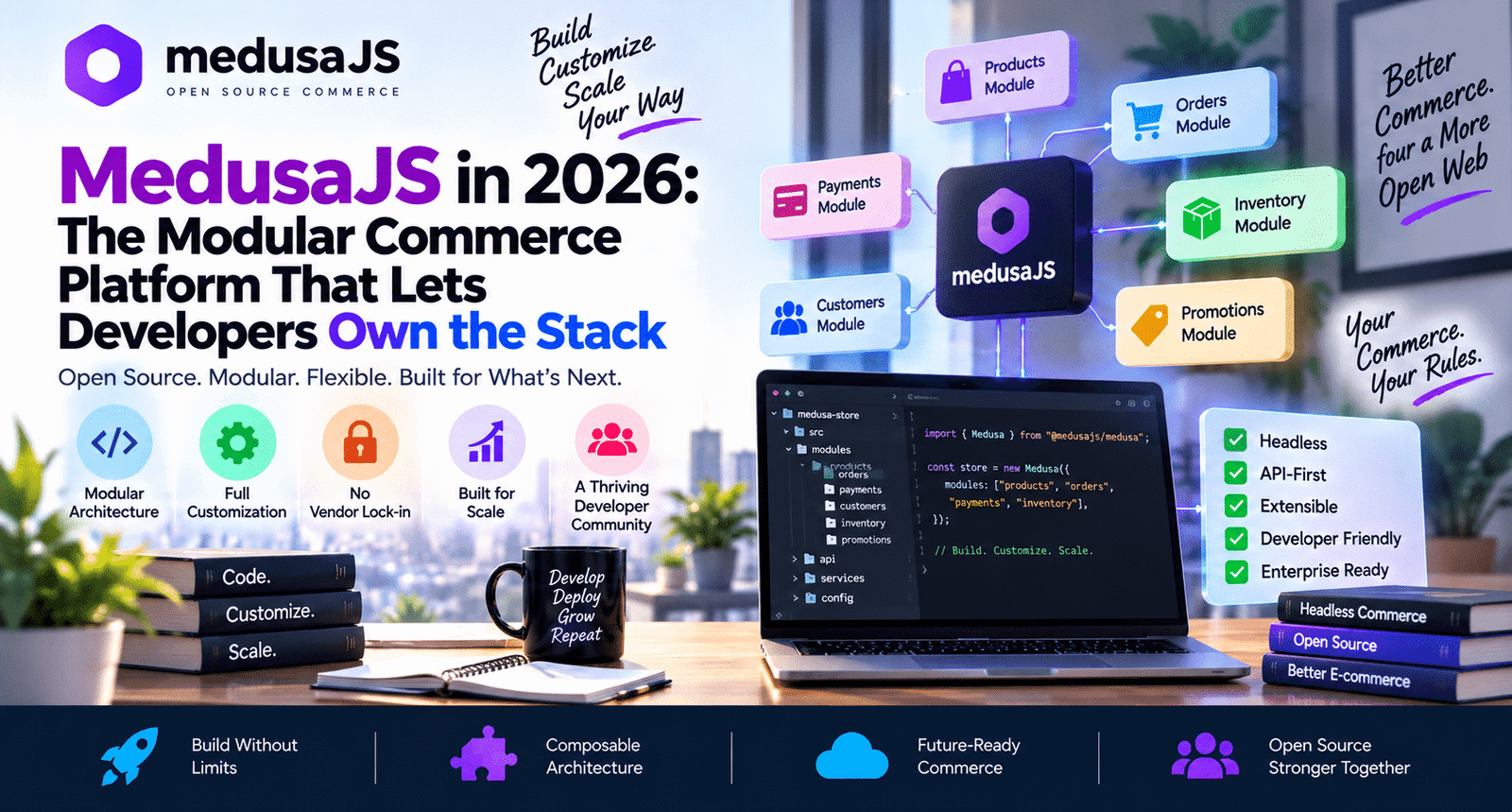
MedusaJS is an open-source, modular commerce platform built with Node.js that gives developers complete control over their e-commerce stack. In 2026, it has emerged as one of the most powerful alternatives to platforms like Shopify and commercetools — offering a headless, API-first architecture where every commerce function (payments, inventory, orders, promotions) exists as an independent, swappable module. Unlike traditional monolithic platforms, MedusaJS lets development teams build exactly what they need without vendor lock-in, hidden costs, or architectural limitations. It is ideal for developers and businesses that prioritize flexibility, scalability, and true ownership of their commerce infrastructure.
Introduction
The e-commerce landscape in 2026 looks dramatically different from what it did just a few years ago.
Businesses are no longer willing to accept the one-size-fits-all philosophy that dominated the early days of online retail. The era of plugging into a rigid SaaS platform, paying escalating transaction fees, and begging for features through a vendor's roadmap is ending — fast.
Developers, engineering teams, and forward-thinking brands are demanding something radically different: commerce infrastructure they actually own.
Enter MedusaJS.
What started as a scrappy open-source alternative to Shopify has evolved into something far more significant. In 2026, MedusaJS is not just a platform — it is a philosophy. A declaration that commerce logic should be composable, extensible, and entirely under the developer's control.
This blog is your comprehensive guide to understanding MedusaJS in 2026: what it is, how it works, why it is gaining massive traction across startups and enterprise organizations alike, and whether it is the right choice for your next commerce project.
Whether you are a developer evaluating headless commerce options, a CTO weighing build-vs-buy decisions, or a digital agency looking for a platform that can grow with your clients — this is the guide you have been searching for.
Let us get into it.
What Is MedusaJS and Why Does It Matter in 2026?
A Brief Origin Story
MedusaJS was created by Sebastian Rindom and Nicklas Gellner, who launched the project in 2021 as a response to the frustrations developers were experiencing with Shopify's closed architecture and the prohibitive costs of enterprise platforms like Salesforce Commerce Cloud.
The initial vision was simple but powerful: build an open-source commerce engine that developers would actually enjoy working with.
The project gained significant traction on GitHub, attracting thousands of stars and a growing community of contributors. By 2023, Medusa had raised venture funding and began building a more structured ecosystem around its open core.
By 2026, MedusaJS has matured into a production-grade commerce platform used by hundreds of businesses globally — from direct-to-consumer brands running millions of dollars in monthly revenue to enterprise organizations building complex multi-vendor marketplaces.
The Core Philosophy: Developer Ownership
What sets MedusaJS apart from every other commerce platform is not a single feature — it is an underlying philosophy.
MedusaJS believes that commerce logic is too important to outsource to a black box.
Every business has unique commerce requirements. The way a luxury fashion brand manages product variants is fundamentally different from how a B2B wholesale distributor handles pricing tiers. The checkout flow for a subscription box service looks nothing like the order management system of a digital goods marketplace.
Traditional platforms force developers to compromise — to bend their business logic around the platform's limitations. MedusaJS flips this equation entirely. The platform bends around your business logic.
What MedusaJS Actually Is (Technically Speaking)
At its technical core, MedusaJS is:
- A Node.js backend commerce engine
- Built with TypeScript for type safety and developer experience
- Powered by a PostgreSQL database
- Designed around a modular, service-based architecture
- Delivered as a set of independent NPM packages
- Exposing everything through a REST API and GraphQL layer
- Complemented by an optional Next.js storefront starter
- Managed through a customizable Admin dashboard
In 2026, the platform has expanded to include native support for edge computing deployments, improved multi-tenancy capabilities, and a significantly enhanced plugin marketplace that covers virtually every commerce use case imaginable.
The Modular Architecture That Changes Everything
Understanding Commerce Modules
The single most important concept in MedusaJS is modularity.
In a traditional monolithic commerce platform, every function — products, inventory, orders, customers, payments, shipping — is tightly coupled together. Change one thing and you risk breaking another. Scale one component and you have to scale everything. Swap out a payment provider and you are at the mercy of the platform's native integrations.
MedusaJS decouples all of this.
Every commerce function in MedusaJS exists as an independent module with:
- Its own data models
- Its own service layer
- Its own API endpoints
- Its own configuration
- The ability to be swapped, extended, or replaced
Here is a visualization of what the core modules look like in 2026:
┌─────────────────────────────────────────────────┐
│              MedusaJS Core Framework             │
├──────────┬──────────┬───────────┬───────────────┤
│ Product  │  Order   │ Inventory │   Customer    │
│ Module   │  Module  │  Module   │   Module      │
├──────────┼──────────┼───────────┼───────────────┤
│ Payment  │ Shipping │ Promotion │   Pricing     │
│ Module   │  Module  │  Module   │   Module      │
├──────────┼──────────┼───────────┼───────────────┤
│   Cart   │   Auth   │   Tax     │  Analytics    │
│  Module  │  Module  │  Module   │   Module      │
└──────────┴──────────┴───────────┴───────────────┘
         ↕ All connected via Medusa's Link Layer ↕
The Link Layer: The Secret Sauce
One of the most innovative architectural decisions in MedusaJS is the Link Layer — a system that allows modules to connect and share data without creating hard dependencies between them.
For example, the Product module does not need to know anything about the Inventory module. Yet through the Link Layer, you can associate a product variant with an inventory item in a completely decoupled way. This means:
- You can replace the Inventory module with a custom one without touching your Product module
- You can build entirely new modules and link them to existing ones
- You can scale modules independently based on load requirements
In 2026, this architecture has proven itself in production environments handling millions of SKUs and thousands of concurrent transactions.
Workflows: Commerce Logic as Code
Another architectural innovation that MedusaJS introduced is the concept of Workflows — a way to define complex, multi-step business processes as composable, observable, and rollback-capable code.
Instead of a rigid, hardcoded checkout flow, you define a workflow like this (simplified):
import { createWorkflow, transform } from "@medusajs/workflows-sdk"
import {
  validateCartStep,
  reserveInventoryStep,
  createPaymentSessionStep,
  placeOrderStep,
  sendOrderConfirmationStep,
} from "./steps"

export const placeOrderWorkflow = createWorkflow(
  "place-order",
  function (input) {
    const cart = validateCartStep(input.cartId)
    const reservation = reserveInventoryStep(cart)
    const payment = createPaymentSessionStep(cart)
    const order = placeOrderStep({ cart, payment, reservation })
    sendOrderConfirmationStep(order)

    return order
  }
)
What makes this powerful:
- Each step is independently testable
- If a step fails, the workflow can roll back automatically
- Steps can be added, removed, or reordered without rewriting the entire flow
- Workflows are observable — you can see exactly where a process succeeded or failed
This is a game-changer for teams that need to maintain complex business logic over time without accumulating technical debt.
Key Features of MedusaJS in 2026
True Multi-Tenancy Support
In 2026, MedusaJS offers robust multi-tenancy capabilities that allow a single Medusa installation to power multiple storefronts, brands, or even separate merchant accounts on a marketplace. This is particularly valuable for:
- Digital agencies managing multiple client stores
- Enterprise brands running regional or sub-brand storefronts
- Marketplace operators managing multiple vendors
Advanced Pricing Engine
The pricing module in Medusa has evolved into one of the most sophisticated open-source pricing engines available. It supports:
- Customer group-based pricing
- Volume/quantity-based pricing tiers
- Time-based promotional pricing
- Currency and region-specific price lists
- B2B negotiated pricing
- Rule-based dynamic pricing
All without touching a single line of the core platform code.
Native B2B Commerce Support
One area where MedusaJS has made enormous strides by 2026 is B2B commerce. Features now include:
- Company account management with multiple buyers under a single organization
- Purchase order (PO) workflows
- Credit limit management
- Approval workflows for large orders
- Custom catalog visibility by customer group
- Quote request management
This makes Medusa a serious contender in the B2B commerce space — an area traditionally dominated by expensive enterprise platforms.
Headless by Default, Flexible by Design
MedusaJS is headless by default, meaning the backend commerce logic is completely decoupled from any frontend presentation layer. In 2026, this means you can power:
- Next.js storefronts
- Nuxt.js or SvelteKit applications
- Mobile apps (React Native, Flutter)
- Voice commerce interfaces
- AR/VR shopping experiences
- IoT-connected retail devices
The storefront is truly your choice — Medusa does not care what renders the UI.
Enhanced Admin Dashboard
While the admin dashboard was a weak point in earlier versions, the 2026 iteration is a comprehensive, customizable React application that includes:
- Full order management with returns, refunds, and exchanges
- Drag-and-drop product organization
- Real-time inventory tracking across multiple locations
- Promotion and discount management
- Customer relationship management tools
- Extensible UI components — add custom pages and widgets without forking the admin
Edge-Ready Deployment
In 2026, MedusaJS modules can be deployed to edge computing environments, dramatically reducing latency for global commerce operations. Cart calculations, pricing lookups, and product availability checks can happen closer to the customer — resulting in faster storefronts and better conversion rates.
Built-in Event System and Webhooks
MedusaJS ships with a powerful event bus that enables:
- Real-time notifications (order placed, shipment created, payment failed)
- Integration with external systems via webhooks
- Event-driven automation workflows
- Support for Redis, RabbitMQ, and other message brokers
Comprehensive Search Integration
Out of the box, Medusa integrates with:
- Algolia
- MeiliSearch
- Elasticsearch / OpenSearch
- Typesense
Each integration is implemented as a swappable module — you can migrate between search providers without rewriting your product indexing logic.
MedusaJS vs The Competition
Let us put Medusa head-to-head against the most common alternatives developers and businesses consider in 2026.
MedusaJS vs Shopify / Shopify Plus
| Feature | MedusaJS | Shopify Plus |
| Open Source | Yes | No |
| Transaction Fees | None | Up to 0.6% |
| Custom Business Logic | Unlimited | Limited |
| Self-Hosting | Yes | No |
| Multi-Tenant | Native | Limited |
| B2B Features | Native | Add-on required |
| Developer Experience | Excellent | Liquid templating |
| App Ecosystem | Growing | Massive |
| Non-Technical User Friendly | Moderate | Excellent |
| Enterprise Pricing | No vendor lock-in | Expensive |
Bottom Line: Shopify remains the king for non-technical merchants who want a plug-and-play solution. MedusaJS wins decisively when a development team needs flexibility, custom logic, or wants to avoid Shopify's fee structure at scale.
MedusaJS vs commercetools
| Feature | MedusaJS | Commercetools |
| Open Source | Yes | No |
| Modular Architecture | Yes | Yes |
| Cost | Open core, affordable hosting | Very expensive |
| Developer Experience | Excellent | Steep learning curve |
| B2B Support | Native | Yes |
| Enterprise Features | Growing | Mature |
| Community Support | Active open-source | Vendor-dependent |
| Time to First Deployment | Hours | Weeks/months |
Bottom Line: commercetools pioneered MACH architecture but comes with enterprise pricing that puts it out of reach for most teams. MedusaJS delivers comparable architectural principles at a fraction of the cost with a far better developer experience.
MedusaJS vs WooCommerce
| Feature | MedusaJS | WooCommerce |
| Tech Stack | Node.js / TypeScript | PHP / WordPress |
| Performance at Scale | Excellent | Requires heavy optimization |
| Developer Experience | Modern | Legacy PHP patterns |
| Headless Ready | Native | Possible but complex |
| Plugin Ecosystem | Growing | Massive |
| Non-Technical Friendly | Moderate | Excellent |
| Security | Modern practices | Constant patching required |
Bottom Line: WooCommerce still holds an enormous market share due to WordPress's ubiquity, but for new projects, MedusaJS offers a dramatically better foundation for modern commerce.
MedusaJS vs Saleor
| Feature | MedusaJS | Saleor |
| Language | TypeScript / Node.js | Python / Django |
| API | REST + GraphQL | GraphQL-first |
| Modularity | Superior | Less modular |
| Community Size | Larger | Smaller |
| Frontend Agnostic | Yes | Yes |
| B2B Features | Stronger | Basic |
Bottom Line: If your team is Python-native, Saleor is worth evaluating. For JavaScript/TypeScript teams — and this represents the vast majority of modern frontend developers — MedusaJS is the natural choice.
Who Should Use MedusaJS?
MedusaJS Is a Great Fit For:
- Development Teams and Digital Agencies: Teams that build custom commerce experiences for clients will appreciate Medusa's flexibility. The ability to extend every part of the platform means you are never blocked by platform limitations when a client has a unique requirement.
- Startups Building at Scale: Early-stage companies with technical founders who want to avoid paying escalating fees to SaaS platforms as they grow. Starting on Medusa means you own your stack from day one.
- Mid-Market Brands with Complex Requirements: Companies that have outgrown Shopify or WooCommerce — dealing with custom pricing logic, complex inventory scenarios, or unique fulfillment workflows — find that Medusa's architecture maps naturally to their operational complexity.
- B2B Commerce Operators: The native B2B features in MedusaJS 2026 make it a compelling choice for wholesale distributors, manufacturers selling direct, and hybrid B2B/B2C operations.
- Marketplace Builders: Multi-vendor marketplace operators benefit enormously from Medusa's multi-tenancy capabilities and flexible order routing logic.
- Enterprise Teams Seeking MACH Architecture: Organizations that want MACH (Microservices, API-first, Cloud-native, Headless) principles without commercetools pricing.
MedusaJS May Not Be the Best Fit For:
- Non-Technical Business Owners: If you do not have access to a developer — or do not plan to have ongoing technical support — Medusa requires developer involvement to set up and maintain. Shopify or Squarespace commerce would be a better choice.
- Businesses Needing Immediate Deployment: Medusa's flexibility comes at the cost of setup time. If you need a functioning store in 48 hours with no technical resources, a managed SaaS platform will serve you better in the short term.
- Teams Requiring Extensive Ready-Made Integrations: While Medusa's plugin ecosystem has grown significantly by 2026, Shopify's App Store still dwarfs it in breadth. If you rely on very specific third-party tools with no API, verify Medusa compatibility before committing.
How to Get Started with MedusaJS in 2026
Prerequisites
Before diving into MedusaJS, ensure you have the following:
- Node.js 20+ installed
- PostgreSQL database (local or cloud-hosted)
- Git for version control
- Familiarity with TypeScript (strongly recommended)
- A package manager (npm, yarn, or pnpm)
- Basic understanding of REST APIs
Step 1: Create a New Medusa Project
{} Bash

npx create-medusa-app@latest my-medusa-store
This CLI command scaffolds a complete Medusa project including:
- The backend commerce engine
- A Next.js storefront starter
- The admin dashboard
Step 2: Configure Your Database
In your .env file:
{} Bash

DATABASE_URL=postgres://username:password@localhost:5432/medusa_db
REDIS_URL=redis://localhost:6379
JWT_SECRET=your-super-secret-jwt-key
COOKIE_SECRET=your-super-secret-cookie-key
Step 3: Run Database Migrations
{} Bash

cd my-medusa-store
npx medusa db:migrate
Step 4: Seed Sample Data (Optional)
{} Bash

cd my-medusa-store
npx medusa db:migrate
Step 5: Start the Development Server
Your Medusa backend will be running at http://localhost:9000 and the admin dashboard at http://localhost:9000/app.
{} Bash

Your Medusa backend will be running at http://localhost:9000 and the admin dashboard at http://localhost:9000/app.
Step 6: Connect Your Storefront
Navigate to your Next.js storefront directory and start it:
{} Bash

cd storefront
npm run dev
Your storefront will be live at http://localhost:8000.
Step 7: Build Your First Custom Module
Here is a simple example of a custom loyalty points module:
{} TypeScript

// src/modules/loyalty/index.ts
import { Module } from "@medusajs/utils"
import LoyaltyModuleService from "./service"

export const LOYALTY_MODULE = "loyaltyModuleService"

export default Module(LOYALTY_MODULE, {
  service: LoyaltyModuleService,
})
{} TypeScript
// src/modules/loyalty/service.ts
import { MedusaService } from "@medusajs/utils"
import { LoyaltyPoints } from "./models/loyalty-points"
class LoyaltyModuleService extends MedusaService({
LoyaltyPoints,
}) {
async awardPoints(customerId: string, points: number) {
// Your custom logic here
return await this.createLoyaltyPoints({
customer_id: customerId,
points: points,
awarded_at: new Date(),
})
}
async getCustomerBalance(customerId: string) {
const records = await this.listLoyaltyPoints({
customer_id: customerId,
})
return records.reduce((sum, record) => sum + record.points, 0)
}
}
export default LoyaltyModuleServiceThis is the power of MedusaJS — extending the platform with custom business logic in clean, typed, maintainable TypeScript code.
Real-World Use Cases and Success Stories
Use Case 1: Luxury Fashion D2C Brand
A European luxury fashion brand migrated from Shopify Plus to MedusaJS in late 2025 after hitting the ceiling of what Shopify's APIs could support. Their requirements included:
- Virtual try-on integration via a custom AR module
- White-glove concierge ordering for high-value customers
- Regional pricing with dynamic currency adjustment
- Custom loyalty program tied to lifetime purchase value
On MedusaJS, the development team built all of this within the core platform without a single third-party app subscription. Annual savings on platform fees exceeded €180,000.
Use Case 2: B2B Industrial Distributor
A B2B industrial parts distributor with 50,000+ SKUs and 2,000+ business customer accounts deployed MedusaJS to replace a legacy SAP-based e-commerce layer. The Medusa implementation included:
- Customer-specific negotiated pricing loaded from ERP
- Purchase order workflow with multi-level approval
- Real-time inventory sync with warehouse management system
- Sales rep portal with the ability to place orders on behalf of customers
Total implementation time: 14 weeks. Comparable implementation on commercetools had been quoted at 9 months.
Use Case 3: Multi-Brand Retail Group
A retail holding company operating eight distinct consumer brands used MedusaJS's multi-tenancy architecture to consolidate eight separate Shopify stores into a single Medusa installation. Benefits included:
- Shared inventory pool across brands
- Unified customer database with brand-level segmentation
- Centralized order management and fulfillment routing
- Significant reduction in third-party app licensing costs
Use Case 4: Digital Products Marketplace
A digital goods marketplace — selling software licenses, templates, and educational content — built entirely on MedusaJS by extending the product and fulfillment modules to handle:
- Instant digital delivery on purchase
- License key generation and management
- Subscription-based access to content libraries
- Affiliate commission tracking and payout management
The MedusaJS Ecosystem in 2026
The Plugin Marketplace
By 2026, the Medusa plugin ecosystem has grown substantially, with official and community plugins covering:
Payment Providers:
- Stripe (official)
- PayPal (official)
- Klarna
- Adyen
- Braintree
- Razorpay
- Mollie
- Square
Shipping Integrations:
- ShipBob
- EasyPost
- ShipStation
- DHL Express
- UPS
- FedEx
- Royal Mail
Search Providers:
- Algolia (official)
- MeiliSearch (official)
- Typesense
- Elasticsearch
CMS Integrations:
- Contentful
- Sanity.io
- Strapi
- Storyblok
- Prismic
Analytics and Reporting:
- Segment
- PostHog
- Google Analytics 4
- Mixpanel
ERP and Business Systems:
- Netsuite
- SAP (via middleware)
- QuickBooks
- Xero
The Community
The MedusaJS community has grown into one of the most active in the headless commerce space:
- GitHub: 30,000+ stars
- Discord: 25,000+ active members
- Weekly contributors: 200+
- Community plugins: 500+
- Official documentation pages: 1,000+
Medusa Cloud
For teams that want the power of MedusaJS without managing infrastructure, Medusa Cloud has emerged as a managed hosting option offering:
- One-click deployment
- Automatic database management and backups
- Built-in CDN and edge distribution
- Monitoring and alerting
- Dedicated support
This removes the primary barrier for teams who loved Medusa's architecture but needed someone else to manage the ops.
Challenges and Considerations
Being genuinely useful means being honest. MedusaJS is not perfect, and there are real challenges to consider before committing.
Requires Developer Expertise
This is not a platform for non-technical users. Setting up, customizing, and maintaining a Medusa instance requires solid Node.js/TypeScript knowledge. For businesses without in-house developers or a reliable agency partner, this is a significant barrier.
Mitigation: Use Medusa Cloud for managed hosting. Engage a certified Medusa partner agency for implementation.
Ecosystem Is Smaller Than Shopify
Despite significant growth, Medusa's plugin ecosystem is nowhere near the scale of Shopify's App Store. If you rely on very niche integrations, you may need to build custom connectors.
Mitigation: Check the plugin marketplace and community plugins before committing. Most major integrations exist. For custom needs, Medusa's open architecture makes building integrations far easier than other platforms.
Documentation Gaps
While Medusa's documentation has improved enormously, there are still areas — particularly around advanced multi-tenancy configurations and complex workflow orchestration — where community Discord discussions remain more useful than official docs.
Mitigation: Lean on the active Discord community. This is one of the most helpful open-source communities in the commerce space.
Self-Hosting Operational Overhead
Running your own Medusa instance means managing PostgreSQL, Redis, file storage, and potentially a message broker. This is real infrastructure that requires DevOps attention.
Mitigation: Use managed cloud services (Railway, Render, Supabase, AWS RDS) to reduce operational burden. Or opt for Medusa Cloud.
Admin Dashboard UX Is Not Shopify-Level (Yet)
While significantly improved in 2026, the Medusa admin dashboard is still not as polished as Shopify's interface for non-technical merchandising users. Merchants managing large product catalogs may find it less intuitive.
Mitigation: Medusa's admin is extensible. Custom UI components can be built to improve the experience for your specific team.
The Future of MedusaJS Beyond 2026
Looking ahead, several trends suggest MedusaJS will continue its trajectory of growth and adoption:
AI-Powered Commerce Logic
The MedusaJS team is actively exploring AI integration points within workflows — enabling things like AI-driven inventory forecasting, intelligent pricing optimization, and automated customer segmentation. The modular architecture makes adding AI-powered modules natural and non-disruptive.
Deeper Edge Computing Integration
As edge computing becomes mainstream, expect Medusa to push more commerce logic to the edge — enabling sub-50ms response times for product and pricing data globally.
Visual Workflow Builder
A low-code workflow builder for non-technical administrators is on the roadmap — allowing business users to customize commerce flows without writing code while keeping developers in control of the underlying infrastructure.
Expanded Enterprise Certifications
As enterprise adoption grows, expect MedusaJS to pursue SOC 2, PCI DSS Level 1, and other compliance certifications that make it easier for large organizations to deploy confidently.
The MACH Ecosystem Position
MedusaJS is positioning itself as the go-to open-source member of the MACH (Microservices, API-first, Cloud-native, Headless) ecosystem — sitting alongside best-of-breed CMS, search, and analytics tools in composable commerce stacks that were previously only accessible to enterprise organizations with massive budgets.
Conclusion
MedusaJS in 2026 represents something genuinely meaningful in the commerce technology landscape: proof that developers do not have to choose between power and ownership.
For too long, the e-commerce market forced a false choice. You could have an easy-to-use platform with limitations, or you could build entirely from scratch with maximum control but massive overhead. There was no middle ground that combined the structural foundation of a mature commerce engine with the freedom to build anything on top of it.
MedusaJS is that middle ground — and then some.
The modular architecture means your codebase reflects your business, not the other way around. The open-source core means you are never locked into a vendor's pricing or roadmap decisions. The TypeScript foundation means your team builds with confidence, catching errors before they reach production. The growing ecosystem means most of the integrations you need already exist. And the philosophy — that commerce logic is too important to outsource to a black box — resonates with every developer who has ever hit the ceiling of what a SaaS platform allows.
Is MedusaJS the right choice for every project? No. If you need a store running this week with no developers involved, Shopify will serve you well. But if you are building something that needs to last, scale, evolve, and remain entirely under your control — MedusaJS in 2026 is one of the most compelling choices in the market.
The era of developer-owned commerce infrastructure is here. MedusaJS is leading it.
FAQ
Is MedusaJS completely free to use?
Yes, MedusaJS is open-source and free to use under the MIT license. You can download, self-host, and customize it without paying any licensing fees. The costs associated with running Medusa come from your hosting infrastructure (servers, database, storage) and any development time required. Medusa also offers a managed cloud hosting option (Medusa Cloud) for teams that prefer not to manage their own infrastructure, which has associated costs. There are no transaction fees, revenue sharing arrangements, or per-seat pricing for the core platform.
How does MedusaJS compare to Shopify for a growing e-commerce brand?
The comparison depends heavily on your team's technical capabilities and business complexity. Shopify is the better choice if you are non-technical, need a store running immediately, and have straightforward commerce needs. MedusaJS becomes the superior choice when your business grows to the point where Shopify's limitations become painful — custom pricing logic, unique checkout flows, complex inventory scenarios, or when Shopify's transaction and app fees begin taking a significant cut of your revenue. Many brands make the migration from Shopify to MedusaJS once they cross $1–2M in annual revenue and begin feeling the platform's constraints. With MedusaJS, you trade ease of initial setup for unlimited long-term flexibility.
What technical skills do I need to work with MedusaJS?
At minimum, you need solid JavaScript/TypeScript proficiency and a basic understanding of Node.js backend development. Familiarity with PostgreSQL (or at least relational databases in general) is important since Medusa uses it as its primary datastore. Experience with REST APIs is essential since you will be consuming and extending Medusa's API layer. For frontend work, React knowledge is valuable both for building storefronts (if using Next.js) and for extending the admin dashboard. DevOps skills — or access to managed hosting services — are also important for production deployments. Teams that thrive with MedusaJS are typically those with full-stack JavaScript developers who are comfortable reading documentation and working through architectural decisions.
Can MedusaJS handle enterprise-level traffic and scale?
Yes, MedusaJS is designed to scale to enterprise workloads — but scaling requires thoughtful infrastructure architecture, just as it does with any self-hosted platform. The modular architecture means you can scale individual services independently based on load patterns. For example, during a flash sale, you can scale your cart and checkout services without over-provisioning your product catalog service. Real-world deployments in 2026 include stores processing hundreds of thousands of orders per month. Using a managed PostgreSQL service (like Amazon RDS or Supabase), Redis for caching and queuing, and deploying on Kubernetes or a comparable orchestration system, MedusaJS can handle substantial traffic. The edge-computing capabilities introduced in recent versions further enhance performance for global storefronts.
How long does it take to build a production-ready store with MedusaJS?
The timeline varies significantly based on project complexity, but here are realistic benchmarks:
- Simple D2C storefront (standard product catalog, Stripe payments, basic shipping): 2–6 weeks for an experienced developer
- Mid-complexity store (custom checkout flow, loyalty program, multi-currency): 6–12 weeks for a small team
- Complex implementation (marketplace, advanced B2B features, ERP integration): 3–6 months for a dedicated team
Factors that accelerate development include using the Next.js storefront starter as a foundation, leveraging existing plugins for payments and shipping, and having a clear requirements specification before beginning. Working with a MedusaJS-experienced agency can significantly reduce timelines compared to a team learning the platform from scratch.