

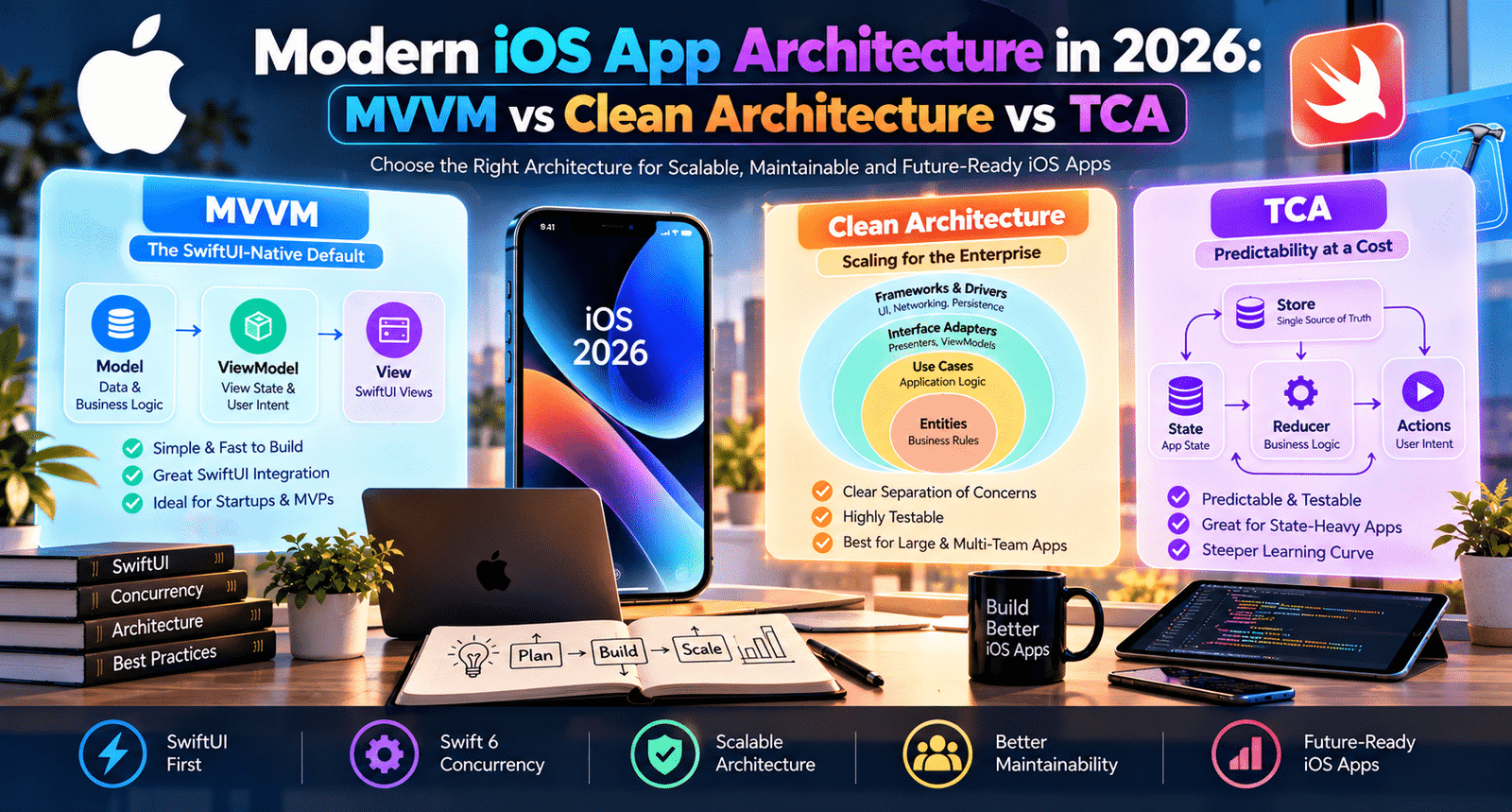
Quick Answer
For most new iOS apps in 2026, MVVM remains the practical default thanks to native SwiftUI integration and low onboarding friction. Clean Architecture is best for large, multi-team enterprise apps needing strict separation of concerns and testability. TCA shines in state-heavy, highly interactive apps where predictability and time-travel debugging outweigh its steeper learning curve and boilerplate. The right choice depends on team size, app complexity, and long-term maintenance goals — not hype.
Introduction
iOS app architecture in 2026 looks very different from the UIKit-dominated world of just a few years ago. With SwiftUI now the default UI framework, Swift Concurrency fully mature, and Swift 6's strict concurrency checking reshaping how we think about state and data flow, developers are re-evaluating their architectural choices from the ground up.
Three patterns dominate the conversation: MVVM (Model-View-ViewModel), Clean Architecture, and TCA (The Composable Architecture). Each solves real problems — but each also introduces trade-offs in complexity, testability, team scalability, and development speed.
Choosing the wrong architecture can mean slower feature delivery, painful refactors, and onboarding nightmares for new engineers. Choosing the right one means your codebase scales gracefully as your app — and team — grows.
This guide breaks down all three architectures with 2026-relevant context: SwiftUI's Observation framework, Swift 6 concurrency, and real-world team scenarios — so you can make an informed decision for your next project.
Why Architecture Choice Matters More Than Ever in 2026
Several shifts have changed the architecture conversation:
- SwiftUI is the standard UI layer, and its declarative, state-driven nature naturally pairs with certain architectures over others.
- The Observation framework (@Observable) has simplified MVVM significantly, removing much of the Combine-related boilerplate.
- Swift 6's strict concurrency model forces teams to think carefully about where mutable state lives and how it's isolated — a core concern in all three architectures.
- Remote and distributed teams need architectures with clear contracts and strong testability, pushing some toward Clean Architecture or TCA.
- App complexity has grown — more apps now handle offline sync, complex navigation, and multi-module codebases than ever before.
With that context, let's break down each architecture.
MVVM: The SwiftUI-Native Default
MVVM splits responsibilities into:
- Model – data and business logic
- View – SwiftUI views, purely declarative
- ViewModel – transforms model data into view state and handles user intent
Why It Still Works in 2026
SwiftUI was practically designed with MVVM in mind. With @Observable (replacing much of ObservableObject and @Published), ViewModels are leaner and faster to write than ever.
Pros:
- Minimal boilerplate, especially with @Observable
- Easy for new hires and junior developers to grasp
- Excellent Apple ecosystem and tooling support
- Fast to prototype and iterate
Cons:
- ViewModels can become bloated ("Massive ViewModel" problem) in large apps
- No enforced separation between business logic and application logic
- Testability depends heavily on developer discipline
Best for: Startups, small-to-mid teams, MVPs, and apps with moderate complexity.
Clean Architecture: Scaling for the Enterprise
Clean Architecture (popularized by Robert C. Martin) organizes code into concentric layers:
- Entities – core business rules
- Use Cases – application-specific logic
- Interface Adapters – presenters, controllers, ViewModels
- Frameworks & Drivers – UI, networking, persistence
The core rule: dependencies point inward. Outer layers depend on inner layers, never the reverse.
Why Teams Still Choose It in 2026
Large organizations with multiple squads working on the same codebase need strict boundaries. Clean Architecture enforces this through protocols and dependency inversion, making it easier to swap implementations (e.g., mock networking for tests) without touching business logic.
Pros:
- Excellent testability and separation of concerns
- Framework-agnostic business logic (survives SwiftUI/UIKit migrations)
- Scales well across large, multi-team codebases
- Pairs well with modular Swift Package architecture
Cons:
- Significant boilerplate and upfront design effort
- Overkill for small apps or solo developers
- Steeper learning curve for junior engineers
Best for: Enterprise apps, fintech/healthcare apps with compliance needs, large teams, long-lived codebases (5+ years).
TCA (The Composable Architecture): Predictability at a Cost
Developed by Point-Free, TCA brings a Redux-like, unidirectional data flow to Swift using:
- State – a single source of truth
- Action – events that can occur
- Reducer – pure functions that mutate state based on actions
- Store – runtime that drives the feature
TCA in 2026 has matured significantly, with better Swift 6 concurrency support, reduced boilerplate via macros, and improved performance in deeply nested feature trees.
Why Teams Adopt It
TCA's predictability makes it ideal for apps with complex state interactions — think multi-step checkout flows, real-time collaborative features, or apps with heavy undo/redo requirements. Its testing story is arguably the strongest of the three, with exhaustive state assertions built in.
Pros:
- Highly predictable, testable, and debuggable (time-travel debugging)
- Excellent for complex, interconnected state
- Strong community support and active development
- Composability makes large features manageable
Cons:
- Steep learning curve, especially for teams new to functional patterns
- More boilerplate than MVVM despite macro improvements
- Can feel like overengineering for simple screens
- Dependency on a third-party library (not Apple-maintained)
Best for: Complex, state-heavy apps; teams already bought into functional programming; apps prioritizing testability above dev speed.
Side-by-Side Comparison Table
| Criteria | MVVM | Clean Architecture | TCA |
| Learning curve | Low | Medium-High | High |
| Boilerplate | Low | High | Medium-High |
| Testability | Medium | High | Very High |
| SwiftUI integration | Native | Good (with adapters) | Good (via Store) |
| Team size fit | Small-Medium | Medium-Large | Small-Medium (specialized) |
| Best for | MVPs, startups | Enterprise, long-lived apps | Complex state, predictability |
| Maintenance cost | Low-Medium | Medium-High | Medium-High |
| Apple-supported | Yes (implicitly) | N/A (pattern, not framework) | No (third-party) |
Which Architecture Should You Choose?
- Building an MVP or small app with 1–3 developers? → MVVM. Ship fast, iterate, refactor later if needed.
- Building a large app with multiple teams, long lifespan, or compliance needs? → Clean Architecture. The upfront investment pays off over years.
- Building a complex, state-heavy app (finance, collaborative tools, multi-step flows)? → TCA. The testability and predictability are worth the learning curve.
Many teams in 2026 also adopt hybrid approaches — using Clean Architecture's layering principles with MVVM as the presentation layer, or using TCA only for the most complex features while keeping simpler screens in plain SwiftUI + @Observable. Architecture isn't all-or-nothing.
Conclusion
There's no single "best" iOS architecture in 2026 — only the best architecture for your specific context. MVVM offers speed and simplicity for most apps. Clean Architecture provides the rigor and scalability enterprise teams need. TCA delivers unmatched predictability for complex, state-driven features.
The smartest teams aren't dogmatic — they evaluate app complexity, team size, and long-term goals, then choose (or combine) architectures accordingly. Start simple, scale deliberately, and let your app's actual needs — not trends — guide your architectural decisions.
FAQs
Is MVVM still relevant for SwiftUI apps in 2026?
Yes. MVVM remains highly relevant, especially with the @Observable macro simplifying ViewModel implementation. It's the path of least resistance for most SwiftUI apps and is well-supported by Apple's own frameworks and documentation.
Is TCA worth learning in 2026?
If you're working on complex, state-heavy apps or want the strongest testing guarantees in Swift, yes. TCA has matured with better concurrency support and reduced boilerplate. However, for simple CRUD apps, it may introduce unnecessary complexity.
Can I combine Clean Architecture with MVVM?
Absolutely — and many teams do. Clean Architecture defines the layering (entities, use cases, interface adapters), while MVVM can serve as the presentation layer pattern within the "Interface Adapters" layer. This hybrid is common in enterprise iOS apps.
Does Swift 6's strict concurrency affect architecture choice?
Yes. Swift 6's actor isolation and sendability requirements make state management more explicit across all three architectures. TCA has adapted well with its Store's built-in concurrency handling, while MVVM and Clean Architecture implementations now lean heavily on actors and @MainActor isolation for ViewModels and use cases.
Which architecture is best for a solo indie developer?
MVVM is almost always the best choice for solo developers. It offers a good balance of structure and speed without the overhead of Clean Architecture's layering or TCA's learning curve.
Do I need to pick one architecture for my entire app?
No. A growing trend in 2026 is modular architecture, where different modules or features use different patterns based on their complexity. Simple settings screens might use MVVM, while a complex checkout flow uses TCA — all within the same app.