

Key Takeaways
- Most enterprise agent deployments still run one agent against one task, and that design caps how much complex work it can carry.
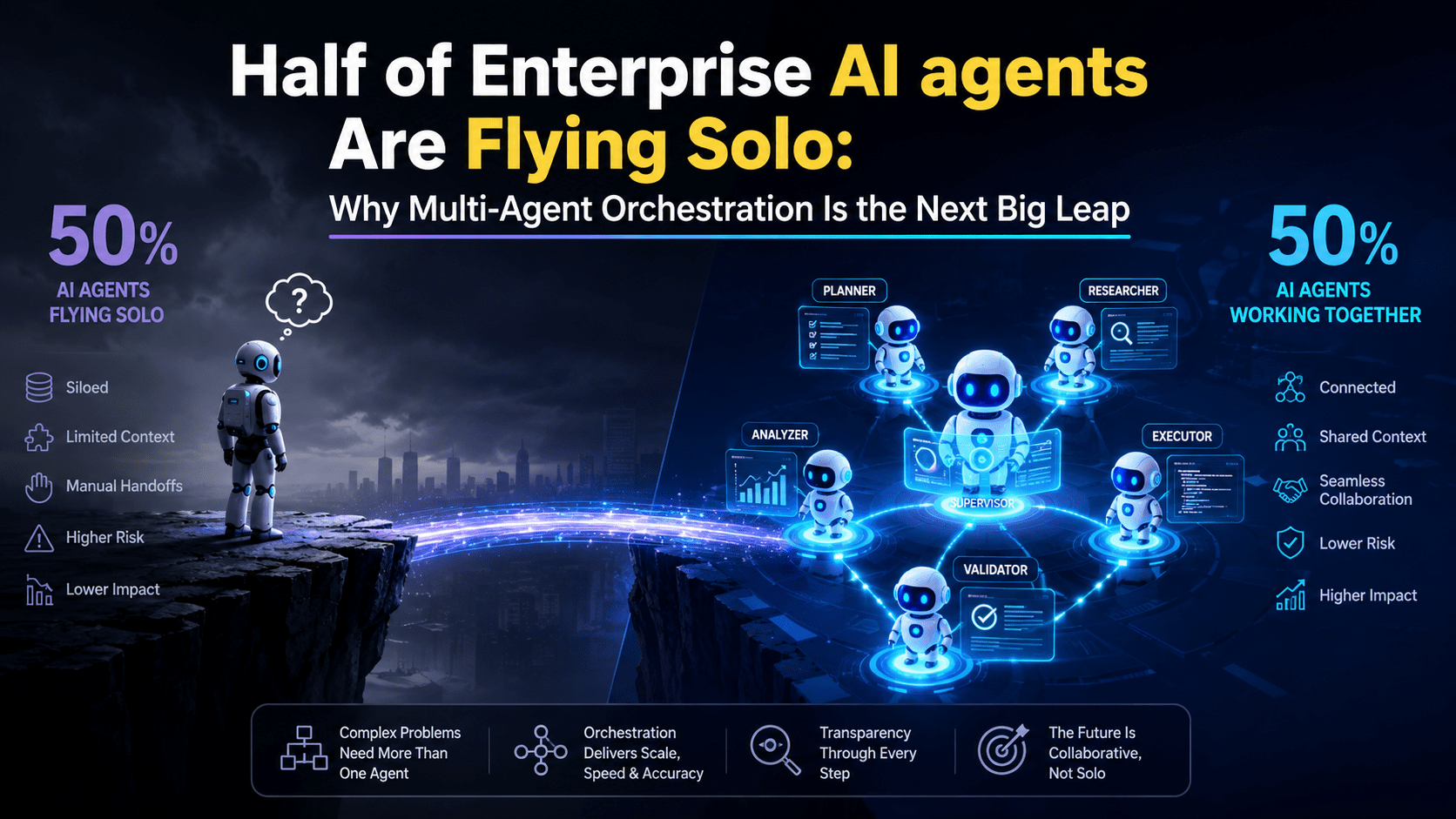
- Multi-agent orchestration splits work across planner, worker, and critic agents that hand off, share memory, and answer to a supervisor.
- Gartner expects 40% of enterprise apps to embed task-specific agents by the end of 2026, so the single-agent baseline is spreading fast.
- More than 40% of agentic projects face cancellation by 2027, usually over cost, unclear value, or weak governance rather than model quality.
- Teams investing in AI agent development services and orchestration frameworks now will run multi-step workflows that one agent cannot finish.
A lone agent works right up until the task gets interesting. It answers a question, drafts a reply, or pulls a record, then stalls the moment the job needs planning, checking, and a second opinion. Gartner projects that 40% of enterprise apps will feature task-specific AI agents by the end of 2026, up from less than 5% in 2025. That surge is real, and almost all of it is single agents doing single jobs. The ceiling arrives quietly: context runs short, one model owns every step, and no second component questions the output.
This is the gap that AI agent development services now have to close. A single agent handles a narrow slice well, yet enterprise work rarely stays narrow. Multi-agent orchestration answers by dividing labor across specialized agents that coordinate toward one goal. Companies still tuning a solo agent are optimizing the wrong unit. The next leap belongs to teams that treat orchestration, not the individual agent, as the product.
Where a Single Agent Quietly Hits Its Ceiling
Three constraints bound any solo agent, and they compound as tasks grow.
The first is context. One agent holds a finite window, and a long workflow fills it with instructions, tool outputs, and intermediate reasoning until earlier detail drops off. The second is reliability. A single model owns planning, execution, and self-review at once, so an early mistake propagates with nothing to catch it. The third is breadth. Real processes span retrieval, calculation, drafting, and validation, and one prompt tuned for all of them does none of them cleanly.
McKinsey's 2025 survey puts numbers to the stall. Twenty-three percent of organizations report scaling an agentic system somewhere in the business, yet no more than 10% are scaling agents inside any single function. Adoption is wide and shallow. Most teams have one agent working in one or two places, which is exactly the pattern that runs out of room once the work turns multi-step. The fix is not a bigger prompt. It is more agents, each doing less, coordinated well.
How Orchestrated Agents Divide the Work
Orchestration borrows from how capable teams operate: split the goal, assign specialists, and check each other. Several patterns recur across production systems.
- Planner and worker: a planner agent breaks a goal into ordered subtasks, then dispatches each to a worker agent built for that step. The planner never executes; the workers never decide scope.
- Critic and reviewer: a critic agent inspects a worker's output against the original request, flags gaps, and sends the work back for a revision before anything reaches a user.
- Supervisor routing: a supervisor agent sits above the group, decides which agent handles a request next, and resolves conflicts when two agents disagree.
- Shared memory: every agent reads and writes to a common store, so a decision one agent makes stays visible to the rest instead of dying inside a private context window.
Handoffs are the connective tissue. When a planner passes a subtask to a worker, it sends a compact instruction plus the relevant slice of shared memory, not the whole conversation. That keeps each agent's context lean and its output sharp. The design reads less like one brilliant model and more like a small, disciplined crew.
AI Agent Development Solutions for Complex Enterprise Workflows
Orchestration earns its keep on work that a solo agent cannot finish in one pass.
Consider a procurement request that must be validated against policy, priced across suppliers, checked for budget, and routed for approval. A planner agent maps those stages, worker agents handle sourcing and pricing, a critic agent confirms the quote matches the request, and a supervisor pushes the packet to the right approver. Research workflows follow the same shape: one agent gathers sources, another extracts claims, a third cross-checks them, and a synthesizer writes the brief. Operations teams use orchestration for incident triage, where agents in parallel pull logs, correlate alerts, and draft a remediation plan while a supervisor keeps them from stepping on each other.
The common thread is decomposition. Each of these jobs has natural seams, and AI development companies build AI agent development solutions around orchestration to cut along those seams instead of forcing one agent to hold the entire task in its head. That structure also makes results auditable because each agent's contribution is logged, reviewable, and traceable to a specific step. A single agent gives one opaque answer. An orchestrated system shows its work.
What AI agent Development Services Deliver Once Agents Coordinate
Dividing labor changes what a system produces, not just how it runs.
Accuracy improves because a critic agent catches errors before they reach a user, turning self-review into a separate, accountable step. Reach expands because specialized agents cover retrieval, math, drafting, and validation without a single prompt trying to be good at all four. Throughput rises because independent subtasks run in parallel rather than queuing behind one agent. Governance gets easier because every handoff and decision leaves a record, which matters when an auditor or a regulator asks how a conclusion was reached.
None of this requires a frontier model no one else has. It requires structure. The teams pulling ahead are the ones treating coordination as an engineering problem with real design decisions behind it: who plans, who executes, who checks, and who has the final say.
Building an Orchestrated System Without Overbuilding It
A workable approach starts small and adds agents only where a seam demands one.
- Map the workflow end to end and mark the natural seams: planning, retrieval, execution, validation, and approval.
- Assign one agent per seam, giving each a narrow role and a focused prompt rather than a general mandate.
- Define the handoff contract: what each agent receives, what it returns, and which slice of shared memory it touches.
- Add a supervisor to route work and settle disagreements once more than two agents are in play.
- Instrument every step with logging and evaluation, so a failing agent is identifiable rather than hidden inside a black box.
The discipline is restraint. Adding agents adds coordination cost, so each new agent should earn its place by owning a seam a single agent handled poorly. Many strong systems run three or four agents, not thirty. A custom AI agent development company that has shipped orchestration before will push back on complexity the design does not need, which is often the difference between a demo and a system that survives production.
Sequencing matters as much as headcount. A team that wires all five agents at once has no baseline to debug against, so a safer path ships the planner and one worker first, confirms the handoff contract holds, then layers in the critic and supervisor. Custom AI agent development services tend to start there, proving one seam in production before opening the next. That order also exposes cost early, while the workflow is cheap to change, rather than after a five-agent system is running against live traffic. Each added agent should clear the same bar: does it fix a failure the current design cannot, and is its share of the token bill worth the accuracy it buys?
The Frameworks and Protocols Doing the Coordinating
The tooling for orchestration matured quickly through 2025, and a few categories now anchor most builds.
Orchestration frameworks handle the plumbing: agent definitions, message passing, state, and control flow. Libraries such as LangGraph, CrewAI, and Microsoft's AutoGen give teams graph-based or role-based ways to wire planners, workers, and critics together without hand-building the coordination layer. Alongside them, interoperability protocols standardize how agents and tools talk. The Model Context Protocol (MCP) gives agents a consistent way to reach external tools and data, and emerging agent-to-agent standards aim to let agents from different vendors coordinate directly.
Shared memory and vector stores hold the common context agents read from, while evaluation and observability tools trace which agent did what. The stack is young and consolidating, so a design that isolates orchestration logic from any one framework stays portable as the market settles. Betting the architecture on a single vendor's coordination layer is the kind of decision that looks fine in a pilot and expensive a year later.
Coordination, Cost, and Governance: The Real Challenges
More agents mean more moving parts, and the difficulties are honest ones.
Coordination is the first. Agents can loop, deadlock, or contradict each other, and a supervisor has to resolve those cases without stalling the workflow. Cost is the second, and it is the one that kills projects. Every agent call is a model call, so a five-agent workflow can cost several times a single-agent version, and those costs balloon two to three times beyond estimates when nobody budgets for the coordination overhead. Debugging is the third. A wrong answer now has several possible authors, which is why per-agent logging is not optional. Governance is the fourth, and the sharpest: an autonomous system that acts across functions needs clear boundaries on what each agent may do and where a human signs off.
Gartner expects 40% of agentic projects to be canceled by the end of 2027, driven by escalating costs, unclear business value, and inadequate risk controls. The models are rarely the problem. Scope, budget, and governance are. An orchestration effort that names its business outcome, caps its agent count, and defines its human checkpoints avoids the failure pattern that claims the rest.
Governance deserves its own design pass, not a policy bolted on at the end. Each agent should carry an explicit permission boundary: what data it reads, what actions it may take, and which decisions it must escalate to a person. A worker agent that drafts a purchase order should not also approve it, and a supervisor that routes tasks should not silently overwrite a human's rejection. Writing those limits into the handoff contract keeps an autonomous system inside guardrails even as it acts across functions, and it gives auditors a clear map of who did what.
Where Orchestration Goes Next
The near-term trajectory points toward agents that coordinate across systems, not just within one workflow.
Gartner projects that 33% of enterprise software will include agentic AI by 2028, and that agent ecosystems will let networks of specialized agents collaborate across multiple applications and business functions. The direction is clear: standardized handoffs between agents built by different vendors, supervisor agents that manage other supervisors, and shared memory that persists across sessions rather than resetting each run. Governance tooling will mature alongside, because autonomous coordination at that scale demands audit trails and guardrails by default. The single-agent era was a starting point. Orchestration is where the work that matters gets done, and the architecture decisions made this year will decide who is ready for it.
Single agents solved the easy half of enterprise work, and multi-agent orchestration is how the hard half gets automated. Teams that keep polishing one agent will find themselves out-planned by systems that split the job across planners, workers, and critics. Investing in AI agent development services now, with a design that adds agents only where a seam demands one, positions an organization for the coordinated systems arriving through 2028. Damco helps enterprises build orchestrated agents through its AI agent development services, pairing planner-worker-critic patterns with the governance that keeps projects out of the cancellation column. The agent flying solo had its moment. The next leap belongs to the ones that coordinate.