

Quick Answer:
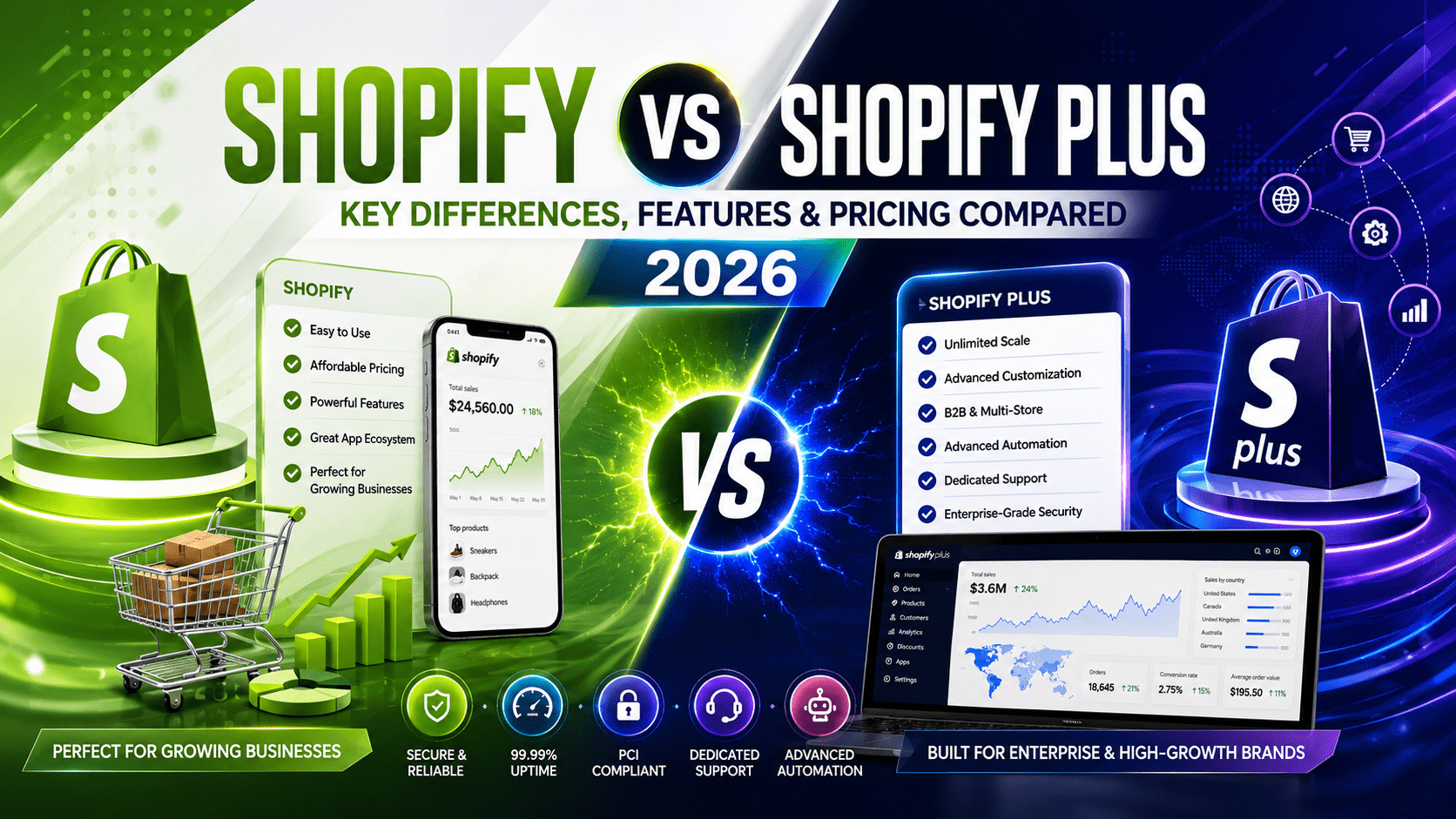
Shopify vs. Shopify Plus depends on your business size, revenue, and operational complexity. Standard Shopify is ideal for startups and SMBs under $1M annual revenue, offering affordability and essential eCommerce tools. Shopify Plus suits high-volume and enterprise brands needing advanced checkout customization, automation, B2B features, multi-store management, enhanced APIs, and dedicated support. Practical guide: Choose Shopify for growth and value; choose Plus for scale and enterprise control.
Introduction
Choosing the right eCommerce platform can make or break your online business. Whether you are a budding entrepreneur launching your first store or an enterprise brand processing millions of dollars in annual revenue, Shopify has a plan designed for you.
But here is the big question that thousands of store owners ask every single year:
Should I go with Shopify or Shopify Plus?
The two platforms share the same DNA, but they serve very different business needs. In 2026, both plans have evolved significantly with new features, updated pricing structures, and enhanced capabilities that make this comparison more important than ever.
In this in-depth guide, we will break down everything you need to know about Shopify vs. Shopify Plus, including features, pricing, scalability, support, and who each plan is truly built for, so you can make a confident, data-driven decision for your business.
What Is Shopify?
Shopify is one of the world's most popular eCommerce platforms, powering over 2 million active stores globally as of 2026. It offers a comprehensive suite of tools that enables anyone, regardless of technical expertise, to build, launch, and manage an online store.
Shopify comes in three main standard plans:
- Basic Shopify
- Shopify (Standard)
- Advanced Shopify
Each plan offers a range of features such as a customizable online storefront, secure payment processing, inventory management, shipping tools, and access to the Shopify App Store.
Shopify is primarily designed for small to mid-sized businesses (SMBs) that are growing steadily and need a reliable, affordable, and easy-to-use platform to sell products online.
Who Typically Uses Shopify?
- Independent online retailers
- Dropshipping businesses
- Small boutique brands
- Service-based product sellers
- New entrepreneurs entering eCommerce
What Is Shopify Plus?
Shopify Plus is the enterprise-grade tier of Shopify, designed specifically for high-volume merchants, fast-scaling brands, and large-scale B2B and B2C operations.
Launched in 2014, Shopify Plus has grown to power some of the world's most recognizable brands, including Gymshark, Heinz, Kylie Cosmetics, Allbirds, and Red Bull.
Shopify Plus is not just a more expensive version of Shopify. It is a fundamentally different offering that includes:
- Dedicated account management
- Greater customization capabilities
- Advanced automation tools
- Unlimited staff accounts
- Multi-store management
- B2B commerce features
- Enterprise-level security and compliance
As of 2026, Shopify Plus continues to be the go-to choice for brands generating $1 million or more in annual revenue and those with complex operational requirements.
Shopify vs. Shopify Plus: Pricing in 2026
Pricing is often the first factor businesses consider, and rightly so. Here is how the two platforms compare in 2026.
Standard Shopify Plans (2026 Pricing)
| Plan | Monthly Price (Annual Billing) | Transaction Fee (Non-Shopify Payments) |
| Basic Shopify | $29/month | 2% |
| Shopify | $79/month | 1% |
| Advanced Shopify | $299/month | 0.5% |
Note: Prices reflect annual billing. Monthly billing rates are approximately 25% higher.
Shopify Plus Pricing (2026)
Shopify Plus pricing operates on a variable model based on your business's monthly revenue:
- Starting price: $2,500/month (flat rate for stores with revenue under a set threshold)
- Revenue-based model: For high-volume merchants, pricing scales to approximately 0.25% of monthly platform revenue, capped at a maximum monthly fee (typically around $40,000/month)
- Contract term: Usually a 1 to 3 year contract
Important: Shopify Plus pricing is negotiable, and the exact cost depends on your business size, requirements, and negotiated terms. It is always recommended to speak directly with a Shopify Plus sales representative to get a custom quote.
Is Shopify Plus Worth the Price?
For businesses generating over $1 million to $2 million annually, the ROI on Shopify Plus often makes the investment worthwhile due to:
- Lower transaction fees
- Advanced automation reducing operational costs
- Dedicated support minimizing downtime
- Multi-store management eliminating the need for multiple subscriptions
Key Feature Differences
Let us dive into the most significant feature differences between Shopify and Shopify Plus in 2026.
Staff Accounts
| Feature | Shopify (Advanced) | Shopify Plus |
| Staff Accounts | Up to 15 | Unlimited |
| Custom Permissions | Limited | Advanced Role-Based Permissions |
Shopify Plus allows unlimited staff accounts with granular permission controls, which is essential for large teams and enterprise organizations.
Checkout Customization
This is one of the most critical differences between the two platforms.
- Standard Shopify: Limited checkout customization. You can adjust colors, logos, and basic fields, but deep customization is restricted.
- Shopify Plus: Full access to checkout.liquid (for legacy builds) and the more modern Checkout Extensibility, allowing brands to build highly customized checkout experiences with upsells, custom fields, trust badges, loyalty program integrations, and more.
A customized checkout experience can significantly improve conversion rates, often by 15% to 30%, making this feature alone a compelling reason to upgrade for high-volume stores.
Transaction Fees
| Plan | Transaction Fee (Third-Party Payment) |
| Basic Shopify | 2.0% |
| Shopify Standard | 1.0% |
| Advanced Shopify | 0.5% |
| Shopify Plus | 0.15% (or custom negotiated rate) |
For stores processing millions of dollars in revenue, the difference in transaction fees between Advanced Shopify and Shopify Plus can result in tens of thousands of dollars in savings annually.
Shopify Flow (Automation)
- Standard Shopify: Basic access to Shopify Flow for workflow automation
- Shopify Plus: Full access to advanced Shopify Flow automation, including custom triggers, complex multi-step workflows, and integration with third-party apps
With Shopify Plus, merchants can automate tasks like:
- Fraud detection and order holds
- Inventory alerts and restocking
- Customer segmentation and tagging
- Loyalty reward triggers
- Wholesale pricing rules
Launchpad
Launchpad is an exclusive Shopify Plus feature that allows merchants to schedule and automate product launches, flash sales, and promotional campaigns.
With Launchpad, you can:
- Schedule price changes in advance
- Automate theme changes for sale events
- Coordinate product visibility across channels
- Monitor real-time performance during launches
This tool is invaluable for brands running high-stakes product drops or seasonal campaigns.
Script Editor and Functions
- Standard Shopify: No access to Script Editor
- Shopify Plus: Access to Shopify Scripts (being transitioned to Shopify Functions), enabling merchants to write custom logic for:
- Line item discounts
- Shipping rules
- Payment customizations
Shopify Functions, the modern evolution of Scripts, allows developers to build custom server-side logic without worrying about infrastructure, giving Plus merchants unprecedented flexibility in how they manage promotions and checkout logic.
Customization and Flexibility
Theme Customization
Both Shopify and Shopify Plus offer access to the Shopify Theme Store, with free and premium themes. However:
- Standard Shopify: Theme customization is available through the drag-and-drop editor and some Liquid code access
- Shopify Plus: Full Liquid code access, enhanced theme controls, and the ability to build completely bespoke storefronts
Headless Commerce
Shopify Plus supports headless commerce through its Storefront API and Hydrogen framework, allowing brands to decouple the front-end experience from the back-end commerce engine. This unlocks:
- Custom-built storefronts using React, Next.js, or other frameworks
- Ultra-fast page load speeds
- Fully unique shopping experiences not possible with standard themes
Standard Shopify also offers headless capabilities, but Shopify Plus provides better support, documentation, and dedicated resources for headless builds.
Apps, Integrations, and Automation
Both platforms have access to the Shopify App Store, which hosts over 10,000 apps covering everything from email marketing to inventory management, reviews, and loyalty programs.
However, Shopify Plus merchants benefit from:
- Priority access to exclusive enterprise apps and integrations
- Better API rate limits, allowing for faster and more complex integrations with ERP systems, CRM platforms, and third-party logistics providers
- Native integrations with enterprise tools like Salesforce, SAP, NetSuite, and Oracle
- Access to Shopify Plus Certified App Partners, a curated group of apps specifically vetted for enterprise use
For businesses running complex tech stacks, these enhanced API limits and certified integrations are often non-negotiable.
Multi-Store and International Selling
Shopify Markets
Both Shopify and Shopify Plus have access to Shopify Markets, the platform's built-in tool for international selling, which allows merchants to:
- Sell in multiple currencies
- Display localized languages
- Offer region-specific pricing and domains
- Manage local duties and taxes
Shopify Plus: Expansion Stores
Where Shopify Plus truly shines for global brands is through Expansion Stores. Shopify Plus merchants get up to 9 expansion stores included in their plan (for a total of 10 stores), which can be used for:
- Region-specific storefronts (US, EU, Asia, etc.)
- Separate B2B and B2C stores
- Brand-specific stores under a parent company
- Wholesale-only storefronts
All expansion stores are managed from a single unified Organization Admin, making multi-store management significantly easier.
Standard Shopify users must pay for each additional store as a completely separate subscription.
Reporting and Analytics
Standard Shopify
All standard Shopify plans offer reporting dashboards covering:
- Sales and revenue
- Traffic and visitor behavior
- Product performance
- Customer data
- Marketing attribution
The depth of reporting increases with each plan tier, with Advanced Shopify offering the most comprehensive reports within the standard tier.
Shopify Plus
Shopify Plus includes all Advanced Shopify reports plus:
- Custom report builder for tailored insights
- Enhanced analytics dashboards
- Integration with enterprise BI tools like Tableau and Looker
- Multi-store reporting across all expansion stores from a single dashboard
- Priority access to beta analytics features
For data-driven enterprise teams, the custom reporting capabilities of Shopify Plus provide actionable insights that are simply not available on standard plans.
Customer Support
Support quality can be a major differentiator, especially when your store processes thousands of orders daily and downtime equals lost revenue.
| Support Feature | Standard Shopify | Shopify Plus |
| 24/7 Chat & Email Support | Yes | Yes |
| Phone Support | Limited | Yes (Priority) |
| Dedicated Account Manager | No | Yes |
| Launch Engineer | No | Yes |
| Merchant Success Program | No | Yes |
| SLA (Uptime Guarantee) | Standard | 99.99% Enterprise SLA |
Dedicated Merchant Success Manager
Every Shopify Plus merchant is assigned a Merchant Success Manager (MSM), a dedicated point of contact who helps with:
- Onboarding and platform setup
- Strategic growth advice
- Feature adoption and best practices
- Problem resolution and escalations
This level of white-glove support is a significant advantage for enterprise businesses that require more than just a help desk.
Who Should Choose Shopify?
Standard Shopify plans are an excellent choice if you:
- Are launching your first eCommerce store
- Are a small to mid-sized business with under $1 million in annual revenue
- Need an affordable, easy-to-use platform without complex technical requirements
- Have a relatively simple product catalog and operational needs
- Are testing the market before scaling
- Run a dropshipping or print-on-demand business
- Do not require advanced B2B features or multi-store management
For most growing businesses, the Advanced Shopify plan at $299/month offers an excellent balance of features and cost before making the jump to Plus.
Who Should Choose Shopify Plus?
Shopify Plus is the right choice if you:
- Generate $1 million or more in annual revenue (or are rapidly approaching that threshold)
- Need a customized checkout experience to maximize conversions
- Run high-volume flash sales or product launches that require automation
- Sell both B2B and B2C and need separate, tailored storefronts
- Operate in multiple countries or regions and need multi-store management
- Require advanced API access for complex ERP, CRM, or 3PL integrations
- Have a large team requiring unlimited staff accounts with custom permissions
- Need enterprise-level security, compliance, and SLA guarantees
- Want dedicated account management and strategic support from Shopify's team
Side-by-Side Comparison Summary
| Feature | Shopify (Advanced) | Shopify Plus |
| Monthly Price | $299/month | From $2,500/month |
| Transaction Fee | 0.5% | 0.15% |
| Staff Accounts | 15 | Unlimited |
| Checkout Customization | Limited | Full (Checkout Extensibility) |
| Shopify Flow Automation | Basic | Advanced |
| Launchpad | No | Yes |
| Shopify Scripts / Functions | No | Yes |
| Multi-Store Management | No | Up to 10 Stores |
| B2B Features | Basic | Advanced |
| Custom Reporting | Limited | Yes |
| Dedicated Account Manager | No | Yes |
| Headless Commerce | Limited Support | Full Support |
| API Rate Limits | Standard | Enhanced |
| 99.99% Uptime SLA | No | Yes |
Final Verdict: Shopify vs. Shopify Plus in 2026
The choice between Shopify and Shopify Plus ultimately comes down to where your business is today and where it is headed.
If you are building, growing, or running a store doing less than $1 million in annual revenue, standard Shopify gives you everything you need at a fraction of the cost. The platform is robust, reliable, and packed with powerful features for businesses at every stage of growth.
However, if your business is scaling rapidly, processing high order volumes, operating across multiple markets, or requiring enterprise-grade tools, automations, and support, Shopify Plus is not just a luxury, it is an investment that pays for itself.
The enhanced checkout capabilities, reduced transaction fees, advanced automation, dedicated support, and multi-store management features of Shopify Plus are specifically engineered to help enterprise brands sell more, operate more efficiently, and grow with confidence.
The bottom line:
- Choose Shopify if you are growing toward $1 million in revenue
- Choose Shopify Plus if you are at or beyond $1 million and need enterprise capabilities
Conclusion
Whether you are a growing entrepreneur or an established enterprise brand, understanding the differences between Shopify and Shopify Plus is essential to making the right platform decision in 2026.
Shopify continues to be one of the most powerful and accessible eCommerce platforms in the world, and the Plus tier takes that power to an entirely new level for businesses ready to operate at scale.
Take the time to assess your current revenue, operational complexity, team size, and growth trajectory. From there, the right choice becomes clear.
Ready to take the next step? Explore Shopify's plans, request a Shopify Plus demo, or consult with a certified Shopify Partner to find the perfect solution for your business.
FAQs
Can I upgrade from Shopify to Shopify Plus?
Yes, you can upgrade at any time. Most merchants upgrade when they reach consistent revenue of $1 million or more annually or when they hit the limitations of the standard plans.
Is Shopify Plus worth it for small businesses?
Generally, no. The starting price of $2,500/month makes Shopify Plus cost-prohibitive for most small businesses. Standard Shopify plans are more cost-effective for smaller operations.
Does Shopify Plus include a free trial?
Shopify Plus typically does not offer a free trial like standard plans. However, Shopify sales representatives can provide demos and custom onboarding experiences.
How long are Shopify Plus contracts?
Shopify Plus agreements are typically 12-month or 36-month contracts. Longer contracts often come with better pricing.
Can Shopify Plus handle large product catalogs?
Yes. Shopify Plus is built to handle large inventories, complex product variants, and high SKU counts, making it ideal for enterprise retailers with extensive catalogs.
What is the difference between Shopify Plus and Shopify Advanced?
The key differences include checkout customization, automation tools (Launchpad and advanced Flow), multi-store management, transaction fees, dedicated support, and API rate limits. Shopify Plus offers all of these at an enterprise level, while Advanced Shopify is the top standard tier.