

Quick Answer:
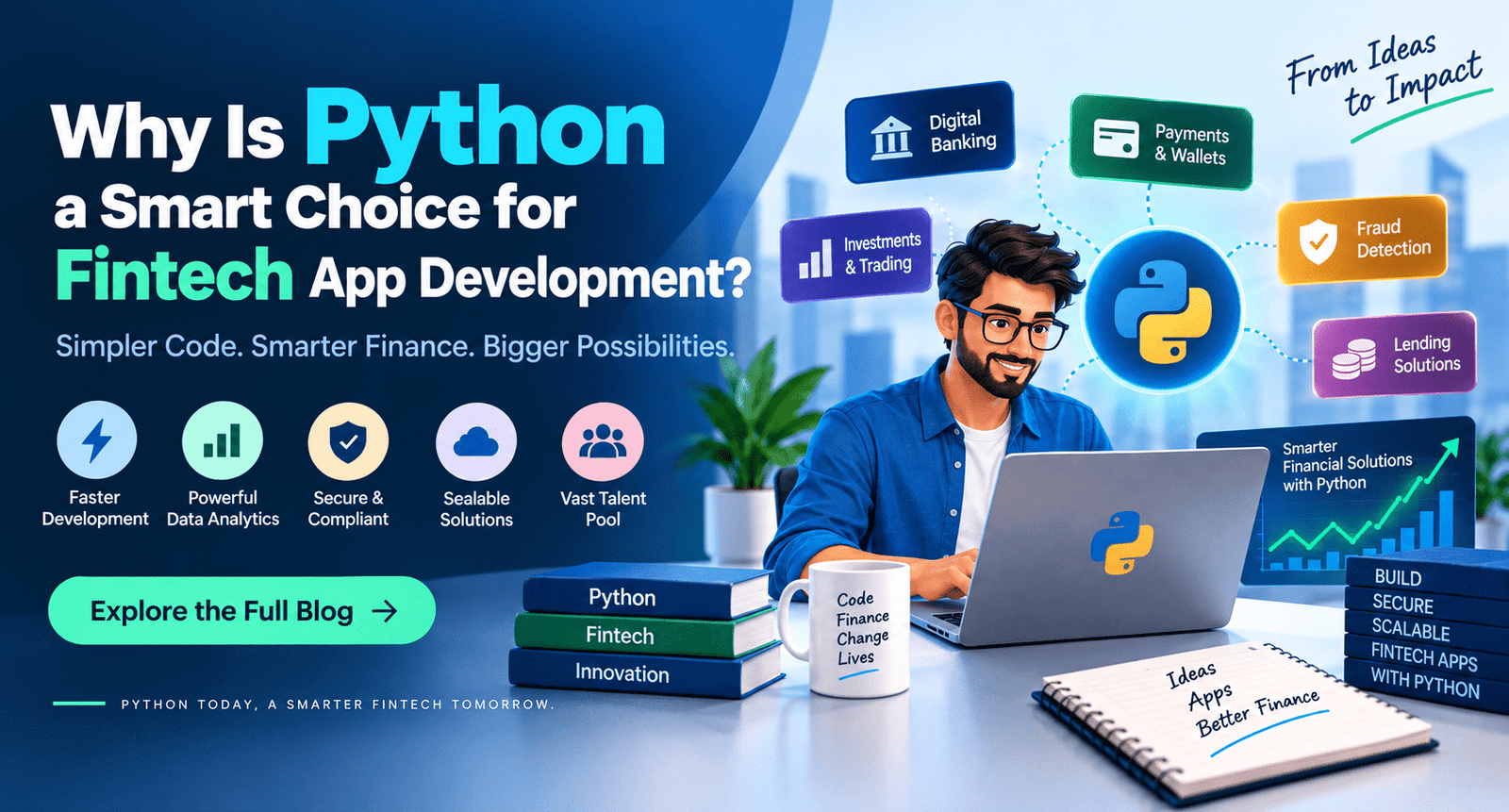
The article explains why Python is a smart choice for fintech app development, highlighting its rapid development, strong data science and machine-learning capabilities, security support, scalability, rich ecosystem, and cost efficiency. It covers popular frameworks such as Django and FastAPI and use cases including payments, fraud detection, trading, personal finance, blockchain, and compliance. It also discusses performance limitations and compares Python with Java, C++, and Node.js.
Introduction
Fintech app development is one of the fastest-growing areas in software engineering. Digital banks, payment platforms, robo-advisors, lending apps, and cryptocurrency exchanges all need reliable, secure, and scalable software. When choosing a programming language, many teams ask: Why is Python a smart choice for fintech app development?
Python has become a go-to language for financial technology because it combines simplicity, power, and a massive ecosystem of libraries. It helps developers build everything from payment gateways to fraud-detection models. In this guide, you’ll learn why Python is a smart choice for fintech app development, the frameworks and libraries that make it possible, its real-world use cases, and answers to common questions.
Why Python Is a Smart Choice for Fintech
Python’s rise in financial technology is no accident. The language was designed for readability and productivity. For fintech teams, that means fewer bugs, faster code reviews, and easier maintenance, all critical in a highly regulated industry.
But there is more to it. Python is also at the center of the data science and machine learning revolution. Since financial services are data-driven, Python can handle everything from transaction processing to predictive analytics. It also integrates well with external APIs, payment systems, databases, and cloud services, making it a flexible choice for modern fintech apps.
Key Benefits of Python for Fintech App Development
1. Rapid Development and Faster Time-to-Market
Python’s syntax is clear and concise. Developers can write more code in fewer lines compared to languages like Java or C++. For fintech startups, this speed is invaluable. You can launch an MVP quickly, test it with users, and iterate based on feedback. Faster development also reduces overall project cost.
2. Strong Data Science and ML Capabilities
Fintech apps rely on data, user transactions, credit scores, market trends, and risk factors. Python has some of the best tools for data analysis and machine learning. With Pandas, NumPy, and scikit-learn, teams can process large financial datasets, build recommendation engines, and train models for credit scoring or fraud detection.
3. Security and Compliance Support
Security is non-negotiable in fintech. Python offers secure frameworks like Django and FastAPI that include built-in protections against common web vulnerabilities such as SQL injection, cross-site scripting (XSS), and cross-site request forgery (CSRF). For encryption, Python provides libraries like cryptography and PyCryptodome, which help safeguard sensitive data and meet compliance standards like PCI DSS and GDPR.
4. Scalability and Asynchronous Processing
Python can power applications that handle millions of users. With frameworks like FastAPI, plus asynchronous programming with asyncio, Python can process many requests at once. For background jobs and complex workflows, tools like Celery and Apache Airflow help manage tasks such as payment reconciliation, report generation, and data pipelines. When performance-critical components are needed, Python can be combined with lower-level languages or optimized using Cython, PyPy, and multiprocessing.
5. Rich Ecosystem of Open-Source Libraries
Python’s ecosystem is one of its biggest advantages. Whether you need a web framework, an API client for a payment gateway, or a machine learning model, someone has likely built a Python library for it. This open-source culture reduces development time and allows fintech teams to focus on business logic rather than reinventing the wheel.
6. Accessible Talent Pool and Lower Costs
Python is one of the most popular programming languages in the world. That means it is easier to hire developers, data scientists, and DevOps engineers with fintech experience. The language is also beginner-friendly, so new team members can become productive quickly. Combined with free, open-source tools, Python offers an excellent cost-to-value ratio for fintech app development.
Popular Python Libraries and Frameworks for Fintech
| Category | Library/Framework | Common Use |
| Web Development | Django | Full-featured web applications with built-in admin and security |
| Web Development | Flask | Lightweight microservices and custom APIs |
| Web Development | FastAPI | High-performance, async APIs with automatic docs |
| Data Analysis | Pandas | Data cleaning, transformation, and financial analysis |
| Data Analysis | NumPy | Numerical computing and high-performance arrays |
| Machine Learning | scikit-learn | Fraud detection, credit scoring, predictions |
| Machine Learning | TensorFlow / PyTorch | Deep learning for NLP, computer vision, and risk models |
| Automation & Workflow | Celery | Background tasks and asynchronous job queues |
| Automation & Workflow | Apache Airflow | Data pipeline orchestration and scheduled jobs |
| Blockchain | Web3.py | Interacting with Ethereum and smart contracts |
| Security | cryptography / PyCryptodome | Encryption, hashing, and secure data handling |
| Testing | pytest | Unit and integration testing for reliable code |
These libraries are just a sample of Python’s capabilities. In Python fintech app development, teams often combine several libraries to build complete, robust systems.
Real-World Use Cases of Python in Fintech
Digital Payment Platforms
Python is used to build payment processing systems that connect to payment providers such as Stripe and PayPal, plus banking APIs like Plaid. APIs built with FastAPI or Django can handle payment validation, currency conversion, and transaction history.
Fraud Detection and Risk Management
Machine learning models in Python can analyze transaction patterns in real time. They flag suspicious activity, detect anomalies, and reduce false positives. Python’s data processing tools make it easier to train and deploy these models quickly.
Algorithmic Trading and Quantitative Finance
Python is a favorite among quantitative analysts. With NumPy and Pandas, developers can backtest trading strategies against historical data. Libraries like PyTorch and TensorFlow help create predictive models for market movements.
Personal Finance Apps
Budgeting apps, expense trackers, and investment tools rely on Python for data aggregation and categorization. Natural language processing (NLP) libraries can even parse transaction descriptions to auto-categorize spending.
Blockchain and DeFi Applications
Python supports blockchain development through libraries such as Web3.py and Brownie. Developers can interact with smart contracts, build decentralized finance (DeFi) dashboards, and analyze on-chain data.
Regulatory Compliance and Reporting
Fintech companies must comply with complex regulations. Python automates KYC/AML checks, generates compliance reports, and maintains audit trails. Automation reduces the risk of human error and helps teams respond to regulatory changes faster.
Challenges and How to Overcome Them
No technology is perfect. Python has a few challenges, especially in high-performance fintech environments.
Performance Constraints
Python is slower than compiled languages like C++ or Java in CPU-intensive tasks. However, you can mitigate this with:
- Using optimized libraries like NumPy, which are written in C.
- Running critical components in Cython, C++, or Rust.
- Using asynchronous programming and multiprocessing.
- Scaling horizontally with microservices and cloud infrastructure.
The Global Interpreter Lock (GIL)
The GIL can limit Python’s ability to run multiple CPU-bound threads at the same time. But for fintech apps, the bottleneck is often I/O, not CPU. Async frameworks, worker queues, and multiprocessing solve most concurrency needs.
Security Risks from Dependencies
Using many third-party packages can introduce vulnerabilities. To mitigate this, fintech teams should:
- Regularly scan dependencies with tools like pip-audit and Snyk.
- Use virtual environments to isolate dependencies.
- Follow secure coding guidelines and conduct regular penetration testing.
Compliance Complexity
Financial regulations are constantly changing. Python can help automate compliance, but teams still need a clear architecture for logging, data encryption, and audit trails. Building compliance into the development lifecycle from day one is essential.
Python vs Other Languages for Fintech
Python vs Java
Java is widely used in legacy banking systems and offers strong performance and scalability. Python, on the other hand, is more productive for data science, machine learning, and rapid prototyping. Many modern fintech companies use a hybrid approach: Java or Kotlin for core banking services, Python for analytics and AI.
Python vs C++
C++ provides ultra-low-latency execution, which is critical for high-frequency trading. But C++ is more complex and slower to develop. Python is often used for strategy development, backtesting, and risk analysis, while C++ handles the execution engine.
Python vs Node.js
Node.js is excellent for event-driven applications and real-time communication. Python is stronger in data analysis, financial modeling, and AI. Both can build APIs, but Python’s ecosystem makes it the more natural fit for data-heavy fintech products.
In short, Python is a smart choice for most fintech app development because it offers the best balance of developer productivity, data capabilities, and ecosystem support.
Conclusion
Why is Python a smart choice for fintech app development? Because it helps fintech teams solve the industry’s biggest challenges—speed, security, data, and compliance—without sacrificing agility. Python’s clean syntax, powerful libraries, and supportive community make it an excellent language for building financial software that can grow with your business.
Whether you are creating a digital wallet, a fraud detection system, or a trading platform, Python gives you the tools to build secure, scalable, and intelligent solutions. For any fintech roadmap, Python deserves a place at the table.
FAQs
Is Python secure enough for fintech app development?
Yes. Python offers robust security features through frameworks like Django and FastAPI, which protect against common attacks such as SQL injection and XSS. With encryption libraries like cryptography, developers can secure sensitive financial data. Security ultimately depends on coding practices, regular audits, and proper dependency management.
Can Python handle high-frequency trading and large financial datasets?
Python is excellent for processing large datasets and backtesting trading strategies. For ultra-low-latency execution, however, many companies implement performance-critical components in C++ or Rust and use Python for strategy, risk, and analytics. Python can also handle large data volumes with tools like Dask and distributed computing frameworks.
Which Python frameworks are best for fintech apps?
Django is ideal for full-featured web applications with an admin panel. FastAPI is great for high-performance asynchronous APIs. Flask is perfect for lightweight microservices. For data and machine learning, combine these with Pandas, NumPy, and scikit-learn. The best choice depends on your specific fintech use case.
How does Python compare to Java or C++ for fintech?
Python offers faster development and stronger data science/machine learning capabilities. Java and C++ provide better raw performance and are often used in core banking and low-latency systems. Many fintech companies use a polyglot architecture, leveraging Python where speed of development and data intelligence matter most.
Is Python suitable for blockchain and cryptocurrency apps?
Yes. Web3.py and Brownie are popular Python libraries for interacting with Ethereum, deploying smart contracts, and building DeFi applications. Python also supports crypto analytics, real-time pricing dashboards, and blockchain data analysis.
How much does it cost to build a fintech app with Python?
The cost varies depending on app complexity, features, regulatory requirements, and team location. A basic MVP may start around $30,000–$60,000, while a full-scale fintech platform can exceed $250,000. Python can reduce costs by speeding up development and leveraging free open-source libraries, but security and compliance still require a solid budget.