

Quick Answer
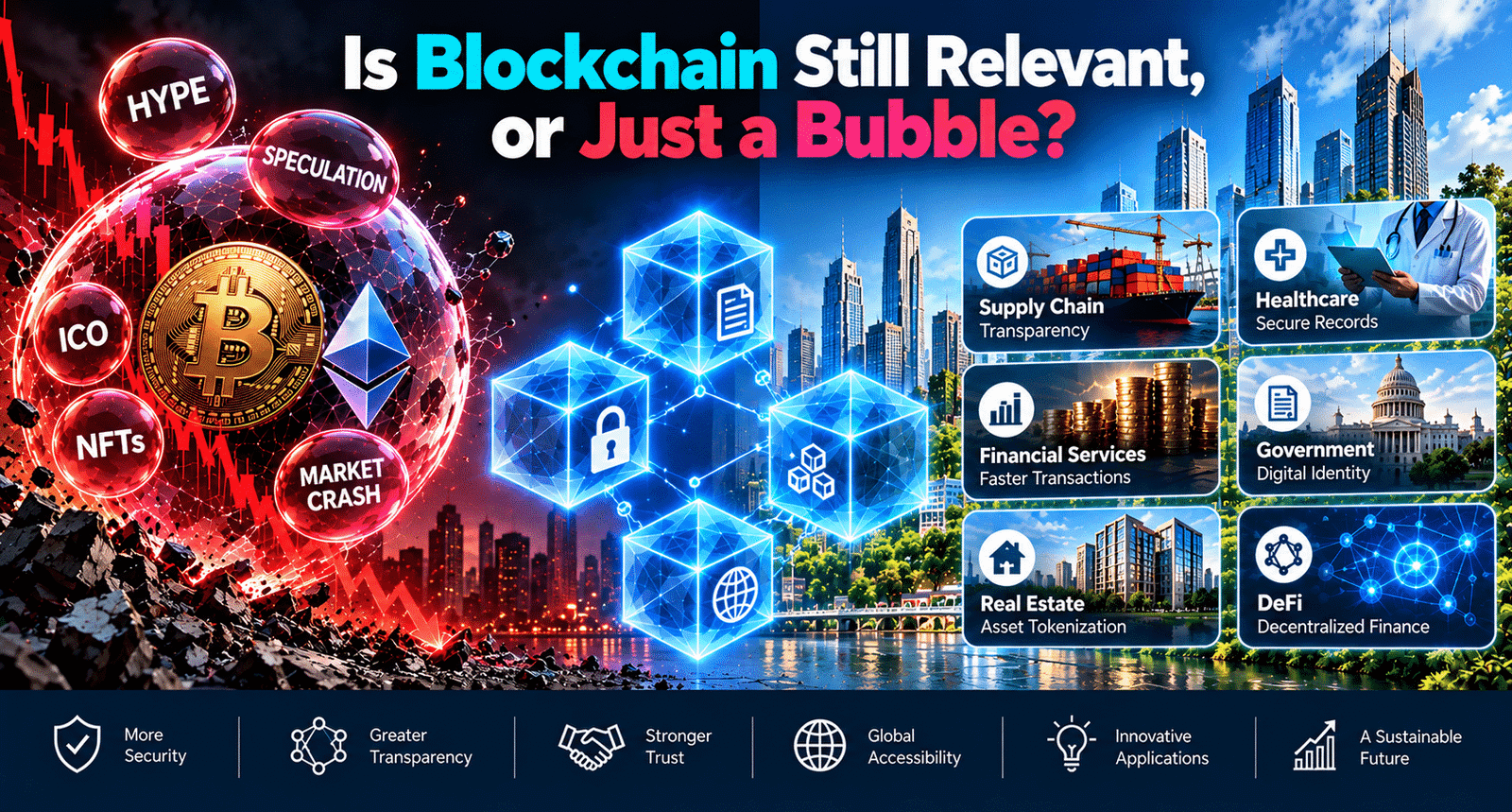
Is blockchain still relevant? Yes — but with important nuances. Blockchain is no longer the silver-bullet buzzword it was during the 2017–2021 hype peak, but it remains a genuinely transformative technology in specific industries. From supply chain management and healthcare to decentralized finance (DeFi) and digital identity, blockchain continues to solve real problems that traditional databases simply cannot. The bubble that burst was largely around speculation — not around the technology itself.
Introduction
Remember when blockchain was going to change everything?
Between 2017 and 2021, you couldn't open a business magazine, attend a tech conference, or scroll through LinkedIn without someone declaring that blockchain would revolutionize finance, healthcare, government, real estate, and probably your morning coffee routine too.
Then the crypto market crashed. NFT prices collapsed. Crypto exchanges imploded. And suddenly, the same people who had been shouting about blockchain from the rooftops went very, very quiet.
So here we are in 2024, and the obvious question is begging to be asked:
Was blockchain ever real, or was it just the most sophisticated hype cycle of the digital age?
The answer — like most things worth knowing — is more complicated than either the enthusiasts or the skeptics want to admit.
In this blog, we're going to cut through the noise. We'll look at where blockchain actually stands today, where it's genuinely delivering value, where it has failed to live up to expectations, and whether it has a real future beyond the world of cryptocurrency speculation.
Whether you're a business owner trying to figure out if blockchain is worth your investment, a tech professional navigating your career, or simply a curious person who wants the truth — this guide is for you.
Let's get into it.
What Is Blockchain, Really? (Beyond the Buzzword)
Before we can answer whether blockchain is still relevant, we need to strip away the jargon and be clear about what blockchain actually is — because a staggering number of people who talked about it the most understood it the least.
At its core, a blockchain is:
- A distributed ledger — a database that is shared and synchronized across multiple computers or nodes
- Immutable — once data is written to the chain, it is extremely difficult to alter or delete
- Decentralized — no single authority controls the entire database
- Transparent — transactions are visible to all participants (depending on the type of blockchain)
- Secured by cryptography — each block of data is linked to the previous one using a cryptographic hash
Think of it like a Google Doc that thousands of people can see simultaneously, but nobody — not even Google — can go back and secretly edit what was written last week. Every entry is permanent, timestamped, and verified by the network.
There are three primary types of blockchain:
| Type | Description | Example |
| Public Blockchain | Open to anyone, fully decentralized | Bitcoin, Ethereum |
| Private Blockchain | Restricted access, controlled by one organization | Hyperledger Fabric |
| Consortium Blockchain | Semi-decentralized, controlled by a group of organizations | R3, Energy Web Chain |
Understanding this distinction is critical — because a huge portion of the "blockchain is dead" narrative is really just the story of public cryptocurrency speculation collapsing. Private and consortium blockchains have been quietly building real infrastructure for years.
The Rise and Fall of the Blockchain Hype Cycle
To understand where blockchain stands today, you need to understand where it came from — and the trajectory it has traveled.
The Timeline at a Glance
- 2008 — The Genesis: Satoshi Nakamoto publishes the Bitcoin whitepaper, introducing blockchain as the underlying technology for a peer-to-peer electronic cash system. Almost nobody notices.
- 2013–2015 — Early Adopters and Ethereum: Ethereum launches, introducing smart contracts and expanding blockchain beyond currency. Developers start experimenting. The wider world still isn't paying much attention.
- 2017 — The First Mania: Bitcoin surges to nearly $20,000. ICOs (Initial Coin Offerings) raise billions. Every startup slaps "blockchain" into its pitch deck. Gartner's Hype Cycle places blockchain at the "Peak of Inflated Expectations." The bubble grows enormous.
- 2018 — The First Crash: Bitcoin crashes more than 80%. Most ICO tokens become worthless. Regulatory scrutiny increases globally. The word "blockchain" starts to carry a slight embarrassment in polite company.
- 2020–2021 — The Second Wave: DeFi explodes. NFTs go mainstream. Bitcoin hits $69,000. Institutional investors arrive. Blockchain is back — bigger and louder than ever.
- 2022 — The Great Reckoning: Terra/Luna collapses, wiping out $60 billion in weeks. FTX implodes spectacularly. The crypto winter arrives. NFT trading volumes drop by over 95%. Critics declare blockchain officially dead.
- 2023–2024 — The Maturation Phase: The noise fades. But underneath the surface, enterprise blockchain adoption continues growing. Bitcoin ETFs get approved. Real-world use cases emerge across industries. The technology quietly evolves while the speculators move on.
What Does This Tell Us?
It tells us something important: the hype cycle and the technology cycle are not the same thing.
Almost every transformative technology goes through this pattern — from the internet (dot-com bubble) to AI (multiple AI winters) to mobile apps. The speculation always outpaces the reality. Then reality catches up — and the technology that survives the crash is often the one that changes the world.
The question is whether blockchain is the internet of 2003 (temporarily unfashionable but fundamentally sound) or the flying car of the 1960s (genuinely exciting but ultimately impractical).
The evidence is increasingly pointing toward the former.
Where Blockchain Is Actually Being Used Right Now
Here's what the "blockchain is dead" crowd consistently ignores: active, real-world deployment across dozens of industries.
Let's look at where blockchain is delivering genuine, measurable value right now.
Financial Services and Banking
This is blockchain's most mature use case — and it goes far beyond Bitcoin.
- Cross-border payments: Ripple (XRP) and Stellar are being used by banks and financial institutions to settle international transfers in seconds rather than days, at a fraction of traditional fees.
- Trade finance: JPMorgan's Onyx platform processes billions in repo transactions daily using blockchain.
- Central Bank Digital Currencies (CBDCs): Over 130 countries are actively exploring or piloting CBDCs — all built on blockchain or distributed ledger technology. China's digital yuan has already processed over $250 billion in transactions.
- Settlement systems: The Australian Securities Exchange (ASX), DTCC in the US, and others are modernizing their settlement infrastructure using blockchain-based systems.
Bottom line: Traditional finance isn't rejecting blockchain. It's quietly adopting it at an infrastructure level — just without the fanfare.
Supply Chain Management
This may be blockchain's most compelling real-world use case outside of finance.
Supply chains are notoriously opaque, fragmented, and vulnerable to fraud, counterfeiting, and inefficiency. Blockchain addresses all three.
- Walmart uses IBM Food Trust (built on Hyperledger Fabric) to trace leafy greens from farm to store shelf. What used to take 7 days to trace now takes 2.2 seconds.
- Maersk (the world's largest shipping company) partnered with IBM to build TradeLens, a blockchain platform for global trade documentation. While TradeLens was later discontinued due to adoption challenges, it demonstrated the concept's viability and led to successor solutions.
- De Beers uses Tracr to track diamonds from mine to retailer, reducing the circulation of conflict diamonds.
- Pharmaceutical companies use blockchain for drug traceability, fighting the global counterfeit medicine crisis that kills an estimated 1 million people annually.
Healthcare
Healthcare is one of the most data-sensitive industries in the world — and blockchain's properties of immutability, security, and interoperability make it a natural fit.
- Medical record management: MedRec, developed by MIT, uses blockchain to give patients control over their medical records while ensuring providers can access accurate, up-to-date information.
- Clinical trials: Blockchain creates tamper-proof records of trial data, addressing the serious problem of selective publication and data manipulation in research.
- Drug supply chain: The US FDA's Drug Supply Chain Security Act (DSCSA) has driven pharmaceutical companies to adopt blockchain for end-to-end drug traceability.
- Health data exchange: Estonia — often cited as the world's most digitally advanced nation — uses blockchain-based health records for its entire population.
Government and Public Records
Governments are notoriously slow adopters of new technology, which makes the following examples all the more significant.
- Land registries: Georgia (the country), Sweden, and Honduras have piloted or implemented blockchain-based land registries to reduce fraud and corruption in property ownership records.
- Voting systems: Sierra Leone conducted a blockchain-verified election in 2018. Multiple US states have piloted blockchain-based voting for overseas military voters.
- Digital identity: The EU's European Blockchain Services Infrastructure (EBSI) is developing cross-border digital identity solutions for citizens.
- Benefits distribution: The UN World Food Programme uses blockchain (Building Blocks) to distribute food assistance to refugees in Jordan, reducing administrative costs by 98%.
Decentralized Finance (DeFi)
Despite the crashes and scandals, DeFi remains one of blockchain's most innovative frontiers.
As of 2024, the total value locked (TVL) in DeFi protocols — while down from its 2021 peak — still represents tens of billions of dollars. More importantly, DeFi is demonstrating that it's possible to build financial services (lending, borrowing, trading, insurance) without traditional intermediaries.
For the 1.4 billion adults globally who remain unbanked, this isn't just interesting technology — it's potentially life-changing.
NFTs and Digital Ownership
Yes, the NFT bubble burst spectacularly. But NFTs as a concept — using blockchain to establish verifiable digital ownership — hasn't disappeared. It has matured.
- Gaming: In-game assets as NFTs are gaining traction in serious gaming ecosystems.
- Music: Artists like Kings of Leon have used NFTs to release albums and offer fans unique experiences.
- Ticketing: Ticketmaster and other platforms are exploring NFT-based tickets to reduce scalping and fraud.
- Real-world asset tokenization: Tokenizing real assets (real estate, art, commodities) on blockchain is emerging as one of the most promising applications — with BlackRock, Franklin Templeton, and others launching tokenized funds.
Is Blockchain Just a Crypto Story?
One of the most persistent and damaging misconceptions about blockchain is that it is cryptocurrency. It isn't.
Cryptocurrency is one application of blockchain technology.
Blockchain is the infrastructure. Cryptocurrency is one of many things you can build on that infrastructure.
Confusing blockchain with crypto is like confusing the internet with email. Email was one of the first major applications of the internet — just as Bitcoin was one of the first major applications of blockchain. But the internet became so much more than email, and blockchain is becoming much more than cryptocurrency.
This distinction matters enormously when evaluating blockchain's relevance, because:
- Enterprise blockchain deployments are largely not cryptocurrency-based
- The companies building on blockchain (IBM, Microsoft, Amazon, Oracle) are targeting business efficiency, not financial speculation
- Regulatory frameworks that restrict or ban certain crypto activities often have no bearing on enterprise blockchain use cases
When someone says "blockchain is dead" because crypto crashed, they're making the equivalent of saying "the internet is dead" because Pets.com went bankrupt in 2001.
The Real Challenges Blockchain Still Faces
Intellectual honesty requires acknowledging that blockchain has genuine, serious challenges that prevent it from being the universal solution some claimed it would be.
Scalability
Public blockchains still struggle with transaction throughput. Bitcoin processes approximately 7 transactions per second. Visa processes about 24,000. While Layer 2 solutions (like the Lightning Network for Bitcoin and Polygon for Ethereum) are addressing this, scalability remains an ongoing engineering challenge.
Energy Consumption
Proof-of-Work blockchains (like Bitcoin) consume enormous amounts of energy. Bitcoin's annual energy consumption is comparable to that of some medium-sized countries. This is a legitimate environmental concern — though Ethereum's move to Proof-of-Stake in 2022 reduced its energy consumption by approximately 99.95%.
Complexity and User Experience
Blockchain-based applications are still notoriously difficult for non-technical users. Managing private keys, understanding wallets, and navigating decentralized applications presents a user experience nightmare compared to conventional apps. Mass adoption requires dramatically simplified interfaces.
Regulatory Uncertainty
The regulatory landscape for blockchain — especially crypto-adjacent applications — remains unclear in many jurisdictions. This uncertainty slows enterprise adoption, as companies are reluctant to build on infrastructure that might be restricted or banned.
The "Oracle Problem"
Blockchain is brilliant at securing data once it's on the chain. But it has no way to verify that the data entered into the chain is accurate. If someone enters false information about a product's origin, the blockchain will immutably store that false information. Solutions like Chainlink's decentralized oracle networks are working on this problem, but it remains a fundamental limitation.
Interoperability
There are hundreds of different blockchain networks that largely cannot communicate with each other. This fragmentation reduces efficiency and creates silos — exactly the problem blockchain was supposed to solve. Cross-chain protocols are emerging, but interoperability remains a work in progress.
Talent and Implementation Costs
Blockchain expertise is still relatively rare and expensive. Enterprise implementations can cost millions of dollars and take years to deploy. For many organizations, the ROI calculation simply doesn't justify the investment — especially when a well-designed traditional database might serve the same purpose.
What Experts and Industry Leaders Are Saying
Rather than relying on either the hype or the backlash, let's look at what credible voices are actually saying.
Gartner — which coined the "Hype Cycle" that blockchain famously rode — now positions blockchain in the "Slope of Enlightenment" phase. This means the technology has survived the "Trough of Disillusionment" and is moving toward productive deployment. Gartner predicts blockchain will generate $3.1 trillion in business value by 2030.
McKinsey Global Institute identifies blockchain as one of twelve potentially transformative technologies and estimates that blockchain's potential economic impact could reach $5.2 trillion in the next decade — though they also caution that realizing this potential depends heavily on solving current technical and adoption challenges.
The World Economic Forum has consistently listed blockchain as one of the top emerging technologies and predicts that 10% of global GDP will be stored on blockchain technology by 2027.
Larry Fink, CEO of BlackRock — the world's largest asset manager — called tokenization (using blockchain to represent real-world assets) "the next generation for markets" and launched BlackRock's own tokenized fund on Ethereum in 2024.
These aren't crypto speculators or blockchain evangelists. These are establishment institutions and executives betting serious money and reputation on blockchain's future.
Blockchain vs. Traditional Databases — When Does It Make Sense?
Here's something the blockchain enthusiasts of 2017 didn't want to admit: blockchain is not always the right solution.
A traditional centralized database is:
- Faster
- Cheaper
- Easier to build and maintain
- More than adequate for most use cases
Blockchain makes sense specifically when you need:
- Multiple parties who don't fully trust each other to share data
- Immutability — a tamper-proof record that nobody can alter retroactively
- No central authority — you need to remove the middleman
- Transparency — all participants need to verify the same data independently
- Automation through smart contracts — self-executing agreements without human intermediaries
If your use case doesn't require most of these features, a traditional database will serve you better, faster, and cheaper.
The fact that many "blockchain projects" of 2017–2020 failed isn't evidence that blockchain doesn't work — it's evidence that those projects were using blockchain to solve problems that didn't require blockchain. The solution was never the problem. The problem selection was.
The Future of Blockchain: Dead, Dormant, or Disrupting?
So where does all of this leave us?
The honest answer is: blockchain is neither dead nor the revolutionary force it was hyped to be — it's settling into something far more interesting: a foundational technology.
Here's what the next few years likely hold:
Real-World Asset Tokenization Will Grow Significantly
The tokenization of real-world assets — real estate, bonds, commodities, private equity — is potentially the biggest blockchain opportunity of the decade. Boston Consulting Group estimates this market could reach $16 trillion by 2030. Major financial institutions are already positioning themselves.
CBDCs Will Bring Blockchain to Billions
Whether or not people realize it, Central Bank Digital Currencies will bring distributed ledger technology to billions of people who have never owned a cryptocurrency. This represents a quiet but enormous expansion of blockchain infrastructure.
Enterprise Adoption Will Continue Quietly
Away from the headlines, enterprise blockchain deployment will continue growing — particularly in supply chain, healthcare, and financial services. It won't be exciting. It won't trend on social media. But it will deliver real value.
AI + Blockchain Integration
The combination of AI and blockchain is emerging as a powerful pairing. Blockchain can provide the transparent, auditable record-keeping that AI systems need for accountability and trust. Expect this integration to accelerate.
Regulatory Clarity Will Accelerate Adoption
As governments around the world develop clearer regulatory frameworks for both crypto and enterprise blockchain, adoption will accelerate. The uncertainty that has slowed many organizations from committing to blockchain implementations will diminish.
The Speculation Layer Will Persist — But Mature
Cryptocurrency and speculative blockchain assets aren't going away — but the wild west era is likely over. Institutional involvement, regulatory oversight, and market maturity will create a more stable (if less exciting) environment.
Conclusion
Let's return to the question we started with: Is blockchain still relevant, or was it just a bubble?
The bubble was real. The speculation was excessive. The promises were overblown. The frauds were genuine. The crashes were painful. The disappointments were significant.
And blockchain is still relevant.
These two things are not contradictions. They are both true simultaneously — because the bubble was about speculation, and the relevance is about technology.
The blockchain story in 2024 is not the story of a technology that failed to deliver. It's the story of a technology that is doing what all genuinely transformative technologies do: surviving the hype cycle, maturing through the disillusionment phase, and emerging — quieter, more focused, and more genuinely useful — on the other side.
The internet survived the dot-com crash. AI survived multiple winters. Mobile computing survived the failed predictions of the early 2000s.
Blockchain will survive its own reckoning — because underneath all the noise, there are real problems it solves better than any alternative currently available.
The question was never really whether blockchain is relevant. The question is whether the people deploying it are asking the right questions, solving the right problems, and building with the discipline that transformative technology demands.
The enthusiasts who declared blockchain would change everything were wrong about the timeline and the scope.
The skeptics who declared blockchain dead after the crash were wrong about the technology.
The truth — as it so often does — lives somewhere in the practical, unglamorous, genuinely interesting middle.
FAQ
Is blockchain technology actually still being used in 2024?
Yes, absolutely. Despite the dramatic decline in cryptocurrency prices and NFT trading volumes, blockchain technology is actively being used across multiple industries. Major corporations including Walmart, JPMorgan, IBM, Maersk, and De Beers use blockchain in their operations. Over 130 governments worldwide are developing Central Bank Digital Currencies based on distributed ledger technology. Enterprise blockchain spending continues to grow — according to IDC, global spending on blockchain solutions reached over $19 billion in 2024, with projections showing continued growth through the decade. The misconception that blockchain is "dead" often comes from conflating the collapse of speculative crypto markets with the broader state of blockchain technology itself.
What is the difference between blockchain and cryptocurrency? Aren't they the same thing?
No — they are fundamentally different, though related. Blockchain is a type of distributed database technology — a way of recording and storing information. Cryptocurrency is one application of blockchain technology, using it to create digital currencies. The relationship is similar to the internet and email — email is one application of internet infrastructure, but the internet is much more than email. Bitcoin was the first and most famous application of blockchain, which is why the two terms became conflated in popular culture. However, most enterprise blockchain implementations have nothing to do with cryptocurrency. Companies using blockchain for supply chain tracking, medical records, or legal contracts are using the underlying technology without any cryptocurrency involvement.
Why did so many blockchain projects fail if the technology is genuinely valuable?
Most blockchain projects failed for the same reasons most startups fail — poor planning, inadequate market fit, and misaligned incentives — not because the underlying technology is flawed. Specifically, the blockchain boom of 2017–2020 produced several categories of failures: projects that used blockchain to solve problems that didn't require blockchain (a traditional database would have worked better and cheaper), fraudulent projects that used blockchain as a buzzword to attract investment without any genuine use case, genuinely innovative projects that were ahead of the infrastructure and regulatory environment needed to support them, and projects that were technically sound but failed to achieve the multi-party adoption that blockchain requires to function. The failure of many individual blockchain projects tells us that blockchain isn't magic — it requires the same rigorous business planning as any technology. It does not tell us that blockchain itself is invalid.
Is blockchain environmentally sustainable? What about Bitcoin's energy use?
This is a legitimate concern, and the answer depends heavily on which blockchain you're discussing. Bitcoin, which uses a "Proof of Work" consensus mechanism, is energy-intensive by design. The computational "mining" process requires significant electricity, and Bitcoin's total energy consumption is indeed comparable to some medium-sized countries. This is a valid environmental criticism. However, it's important to note that not all blockchains work this way. Ethereum, the second-largest blockchain, switched from Proof of Work to "Proof of Stake" in September 2022 (an event called "The Merge"), reducing its energy consumption by approximately 99.95% overnight. Most enterprise blockchain platforms (Hyperledger Fabric, Quorum, etc.) use consensus mechanisms that consume a tiny fraction of Bitcoin's energy. The environmental question for blockchain is nuanced — the answer depends entirely on which blockchain, which consensus mechanism, and what energy sources are powering the network.
Should my business invest in blockchain technology right now?
It depends entirely on your specific situation and needs. Blockchain makes business sense when you need to share data across multiple organizations that don't fully trust each other, when you need a tamper-proof, auditable record that multiple parties can independently verify, when you want to automate multi-party agreements through smart contracts, or when eliminating intermediaries (and their costs) would provide clear business value. Blockchain likely doesn't make sense if you're just managing data within your own organization, if speed and cost are primary concerns (traditional databases are faster and cheaper), if you don't have the budget for complex implementation (enterprise blockchain can cost millions), or if none of your key use cases require the specific properties blockchain provides. Our recommendation: don't adopt blockchain because it sounds innovative. Adopt it if you have a specific problem that blockchain solves better than available alternatives. Start with a proof-of-concept, validate the business case, and scale carefully.
What is the future of blockchain? Will it eventually go mainstream?
Blockchain is already entering mainstream adoption — just not in the flashy, consumer-facing way that was predicted. The mainstream adoption of blockchain is happening at an infrastructure level, much like TCP/IP (the protocol that runs the internet) operates invisibly beneath every website you visit. Here's what mainstream blockchain adoption likely looks like over the next 5-10 years: Central Bank Digital Currencies will bring distributed ledger technology to billions of people who will use it without necessarily knowing it's blockchain-powered. Tokenized assets — representing stocks, bonds, real estate, and commodities on blockchain — will become a significant feature of global financial markets. Supply chain traceability will increasingly be powered by blockchain, improving food safety, reducing counterfeiting, and enabling ethical sourcing verification. Digital identity solutions built on blockchain will give individuals more control over their personal data. The technology that will "go mainstream" may not look anything like the cryptocurrency-centric vision of 2021. But blockchain's core properties — immutability, transparency, and decentralized trust — will quietly power significant portions of global commerce, finance, and governance.