
Quick Answer
What are the top programming trends to watch in 2026?
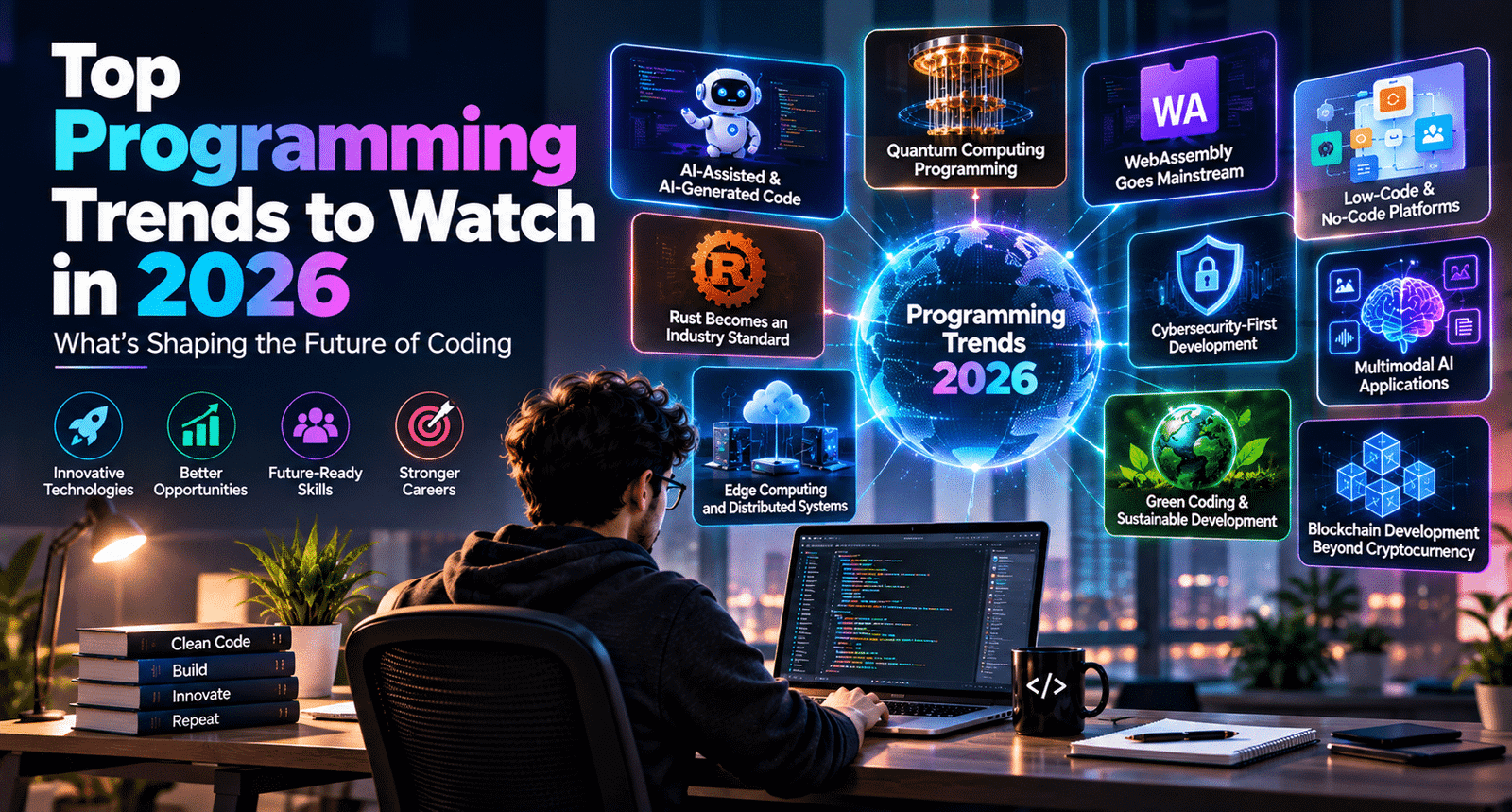
The top programming trends in 2026 include AI-assisted coding tools, quantum computing development, the mainstream adoption of WebAssembly, the growth of low-code/no-code platforms, the rise of Rust as a systems programming language, edge computing, cybersecurity-first development practices, and sustainable green coding. These trends are reshaping how developers write code, build applications, and deliver software solutions across industries.
Introduction
The world of programming never stands still. Every year, new technologies, languages, frameworks, and methodologies emerge that fundamentally change the way developers think, build, and ship software. But 2026 is shaping up to be one of the most transformative years in the history of software development.
From artificial intelligence writing entire blocks of functional code to quantum computers solving problems that traditional hardware never could, the programming landscape of 2026 is as exciting as it is challenging. Whether you are a seasoned software engineer, a beginner just learning your first programming language, or a business leader trying to stay ahead of the digital curve, understanding these trends is no longer optional — it is essential.
In this comprehensive guide, we break down the top programming trends to watch in 2026, explaining what each trend means, why it matters, and how you can position yourself or your organization to take full advantage of the opportunities they present.
Let us dive in.
AI-Assisted and AI-Generated Code
What Is It?
Artificial intelligence has already begun revolutionizing programming, but in 2026, AI-assisted coding is no longer a novelty — it is a fundamental part of the developer workflow. Tools like GitHub Copilot, Amazon CodeWhisperer, Google Gemini Code Assist, and a growing ecosystem of AI coding assistants are now capable of generating, reviewing, debugging, and optimizing code with remarkable accuracy.
Why It Matters in 2026
In 2026, we are seeing a shift from AI as a suggestion engine to AI as an active co-developer. Developers are increasingly working alongside AI models that can:
- Write entire functions and modules based on natural language prompts
- Automatically detect and fix security vulnerabilities in real-time
- Translate code from one programming language to another
- Generate unit tests, documentation, and API specifications autonomously
- Predict and optimize application performance bottlenecks
According to industry research, developers who use AI coding assistants are completing tasks up to 55% faster than those who do not, and this productivity gap is expected to widen through 2026 and beyond.
What This Means for Developers
Rather than replacing programmers, AI is reshaping the role. The most sought-after developers in 2026 are those who know how to:
- Prompt engineer effectively — crafting precise instructions that get the best output from AI tools
- Review and validate AI-generated code — because AI still makes mistakes that human oversight can catch
- Integrate AI workflows into the broader software development lifecycle (SDLC)
The developers who resist AI adoption risk falling behind. Those who embrace it are becoming significantly more productive and valuable in the job market.
Key Takeaway
AI-assisted coding is the single most impactful programming trend of 2026. Learn it, master it, and integrate it into your daily development workflow.
The Rise of Quantum Computing Programming
What Is It?
Quantum computing has been a buzzword for nearly a decade, but 2026 marks a significant turning point. Major players including IBM, Google, Microsoft, and a wave of well-funded startups are delivering quantum computing platforms that are increasingly accessible to enterprise developers and researchers.
Why It Matters in 2026
Traditional computers process information in bits — either 0 or 1. Quantum computers use qubits, which can represent 0, 1, or both simultaneously thanks to a phenomenon called superposition. This allows quantum computers to solve certain types of problems exponentially faster than classical computers.
In 2026, quantum computing is being actively applied to:
- Cryptography and cybersecurity — both breaking existing encryption and developing quantum-resistant algorithms
- Drug discovery and genomics — simulating molecular interactions that classical computers cannot handle
- Financial modeling — running complex risk analysis and portfolio optimization simulations
- Supply chain optimization — solving logistical challenges with thousands of variables
- Climate modeling — processing vast datasets to improve prediction accuracy
Programming Languages for Quantum Computing
Developers interested in quantum computing should explore:
- Qiskit (IBM's open-source quantum computing framework, Python-based)
- Microsoft Q# (a domain-specific language designed for quantum algorithms)
- Cirq (Google's Python library for quantum circuits)
- PennyLane (used for quantum machine learning applications)
What This Means for Developers
Quantum programming is still a specialized field requiring knowledge of quantum mechanics and linear algebra. However, demand for quantum-ready developers is skyrocketing, and those who build expertise now will find themselves in an extremely advantageous position as the technology matures.
Key Takeaway
You do not need to become a quantum physicist, but understanding the basics of quantum computing and experimenting with platforms like Qiskit will put you ahead of most developers in the field.
WebAssembly Goes Mainstream
What Is It?
WebAssembly (often abbreviated as Wasm) is a binary instruction format that allows code written in languages like C, C++, Rust, and Go to run in web browsers at near-native speed. While it has been around since 2017, 2026 is the year WebAssembly truly goes mainstream.
Why It Matters in 2026
WebAssembly is breaking down the barriers that once made JavaScript the exclusive language of the web. In 2026:
- High-performance web applications — video editing, 3D rendering, and complex data visualization are running entirely in the browser via Wasm
- Server-side WebAssembly — with runtimes like Wasmtime and WASMEdge, WebAssembly is being used in server environments as a lightweight and secure alternative to Docker containers
- Cross-platform development — developers write code once and deploy it on web browsers, servers, edge devices, and even IoT hardware
- Plugin ecosystems — major platforms are using Wasm to build safe, sandboxed plugin systems that third-party developers can contribute to without security risk
Real-World Applications in 2026
- Figma and Photoshop-like web tools are running complex computations using WebAssembly
- Cloudflare Workers and similar edge platforms are leveraging Wasm for ultra-fast, globally distributed code execution
- Database engines are being compiled to WebAssembly for browser-embedded use cases
Key Takeaway
If you are a backend developer who knows C++, Rust, or Go, WebAssembly opens up an entirely new frontier in web development. Understanding Wasm is becoming an increasingly valuable skill in 2026.
Low-Code and No-Code Platforms Evolve
What Is It?
Low-code and no-code development platforms allow users to build applications through visual interfaces and pre-built components rather than writing traditional code. In 2026, these platforms are more powerful, more intelligent, and more integrated with AI than ever before.
Why It Matters in 2026
The global demand for software outpaces the supply of skilled developers by a significant margin. Low-code and no-code platforms address this gap by enabling:
- Business analysts, marketers, and operations teams to build functional applications without developer involvement
- Citizen developers to create workflow automation, data dashboards, and internal tools independently
- Professional developers to accelerate delivery of standard functionality, reserving their expertise for complex, custom logic
In 2026, platforms like Salesforce Lightning, Microsoft Power Platform, OutSystems, Bubble, Webflow, and AppSmith are incorporating generative AI features that allow users to describe their desired application in plain English and have the platform generate a working prototype in minutes.
The Impact on Professional Developers
Rather than making developers obsolete, low-code platforms are:
- Freeing developers from repetitive, boilerplate work
- Creating new specialization opportunities — "Low-Code Architects" who configure, extend, and govern these platforms are in high demand
- Shifting developer focus toward integration, security, scalability, and governance
Key Takeaway
Low-code and no-code are not threats to professional developers — they are tools that amplify productivity. Developers who learn to work with these platforms will become multipliers of value in their organizations.
Rust Becomes an Industry Standard
What Is It?
Rust is a systems programming language that offers the performance of C and C++ while eliminating an entire category of bugs related to memory safety. In 2026, Rust's adoption has moved well beyond early enthusiasts — it is now being mandated by major organizations and government agencies as a preferred language for safe, performant systems programming.
Why It Matters in 2026
- The White House and CISA have issued guidance recommending memory-safe programming languages — and Rust is leading the list
- The Linux Kernel now includes Rust code alongside C, opening doors for systems-level Rust development
- Microsoft, Google, Meta, Amazon, and Cloudflare are all actively expanding their use of Rust in production systems
- Android and Chrome contain significant amounts of Rust code, with memory safety vulnerabilities dropping dramatically as a result
What Makes Rust Special
Rust's ownership model guarantees:
- No null pointer exceptions
- No buffer overflows
- No data races in concurrent code
- Zero-cost abstractions — you get high-level programming convenience without sacrificing runtime performance
Career Opportunity
Rust developers are among the highest-paid programmers in the world in 2026. The language consistently tops developer satisfaction surveys (Rust has been the "most loved language" in the Stack Overflow survey for many consecutive years) and demand for Rust expertise is significantly outpacing supply.
Key Takeaway
Learning Rust in 2026 is one of the best investments a programmer can make. Start with the official Rust Book (available free online) and build small systems-level projects to gain practical experience.
Edge Computing and Distributed Programming
What Is It?
Edge computing refers to processing data closer to where it is generated — on devices, local servers, or regional data centers — rather than sending everything to a centralized cloud. In 2026, edge computing is enabling a new paradigm of distributed, low-latency application development.
Why It Matters in 2026
The explosion of IoT devices, autonomous vehicles, smart manufacturing systems, and real-time AI applications means that cloud-only architectures are no longer sufficient. The latency introduced by sending data to a remote cloud server and waiting for a response is unacceptable for:
- Self-driving vehicles making split-second decisions
- Industrial robots responding to sensor inputs in milliseconds
- Augmented reality experiences that require real-time visual processing
- Healthcare monitoring devices that need immediate anomaly detection
Programming for the Edge in 2026
Developing for edge environments requires a different mindset:
- Working with constrained resources — edge devices have limited CPU, memory, and storage
- Designing for intermittent connectivity — applications must function offline and sync intelligently
- Distributed state management — maintaining consistency across dozens or hundreds of edge nodes
- Security at the edge — ensuring that distributed endpoints do not become attack vectors
Frameworks and platforms gaining traction include Cloudflare Workers, AWS Greengrass, Azure IoT Edge, and WASM-based edge runtimes.
Key Takeaway
Edge computing demands a combination of embedded systems knowledge, cloud architecture understanding, and distributed systems expertise. Developers who can bridge these worlds are exceptionally valuable in 2026.
Cybersecurity-First Development
What Is It?
DevSecOps — the integration of security practices directly into the software development lifecycle — is no longer a best practice suggestion in 2026. It is a non-negotiable industry standard. Security is being "shifted left," meaning it is addressed at the earliest stages of development rather than bolted on after the fact.
Why It Matters in 2026
The cost and frequency of cyberattacks continue to accelerate. High-profile breaches, ransomware attacks, and supply chain vulnerabilities have forced organizations to treat security as a core engineering concern rather than a compliance checkbox.
In 2026, DevSecOps practices include:
- Automated security scanning integrated directly into CI/CD pipelines
- Software Composition Analysis (SCA) — automatically identifying and flagging vulnerabilities in third-party dependencies
- AI-powered threat detection — real-time analysis of code for security anti-patterns
- Zero Trust Architecture — never trusting, always verifying, even within internal networks
- SBOM (Software Bill of Materials) — mandatory transparency about what components make up a software product
The Developer's Security Responsibility
In 2026, security knowledge is part of the baseline expectation for developers:
- Understanding OWASP Top 10 vulnerabilities
- Writing secure APIs with proper authentication and authorization
- Implementing data encryption at rest and in transit
- Conducting threat modeling during system design
Key Takeaway
Cybersecurity knowledge is no longer just for security specialists. Every developer in 2026 is expected to write secure code by default. Invest in security education — it dramatically increases your value as a developer.
The Growth of Multimodal AI Applications
What Is It?
Multimodal AI refers to artificial intelligence systems that can process and generate multiple types of data — text, images, audio, video, and code — simultaneously. In 2026, building applications that leverage multimodal AI capabilities has become one of the hottest areas of software development.
Why It Matters in 2026
Models like GPT-4o, Google Gemini Ultra, and Anthropic Claude have demonstrated the ability to:
- Understand and generate text, images, and code in a single interaction
- Process audio inputs and return intelligent, context-aware responses
- Analyze video content and extract meaningful insights
- Power real-time, human-like conversational AI experiences
Developers in 2026 are building:
- Intelligent document processing systems that read, understand, and act on invoices, contracts, and forms
- Multimodal customer service agents that can see what a user is looking at and provide contextual help
- AI-powered creative tools that generate images, video, and music from text descriptions
- Accessibility applications that describe visual content to visually impaired users in real-time
Programming Skills for Multimodal AI
- Proficiency with LLM APIs (OpenAI, Anthropic, Google, Cohere)
- Understanding of vector databases (Pinecone, Weaviate, Chroma)
- Knowledge of RAG (Retrieval-Augmented Generation) architectures
- Familiarity with LangChain, LlamaIndex, and similar orchestration frameworks
Key Takeaway
The ability to integrate multimodal AI into applications is one of the most marketable skills a developer can have in 2026. Start experimenting with AI APIs today — the barrier to entry is lower than ever.
Green Coding and Sustainable Software Development
What Is It?
Green coding — also called sustainable software development — is the practice of writing code and designing systems in ways that minimize energy consumption and environmental impact. In 2026, this movement has gained significant momentum driven by regulatory pressure, corporate sustainability commitments, and developer community advocacy.
Why It Matters in 2026
Data centers currently account for approximately 1-2% of global electricity consumption, a figure that is rising rapidly as AI workloads, video streaming, and cloud services expand. The carbon footprint of software is real and measurable, and organizations are being held increasingly accountable.
Green Coding Practices in 2026
- Algorithm optimization — more efficient code uses less CPU time and therefore less energy
- Efficient data storage and retrieval — reducing unnecessary database queries and caching intelligently
- Serverless and event-driven architectures — running code only when needed rather than keeping servers perpetually active
- Carbon-aware computing — scheduling workloads to run when and where renewable energy is most available
- Measuring software carbon intensity using tools like the Green Software Foundation's Carbon Aware SDK
Organizations Driving the Movement
The Green Software Foundation — backed by Microsoft, Google, Accenture, and GitHub — is developing standards, tools, and best practices for measuring and reducing software's environmental impact.
Key Takeaway
Green coding is both an ethical responsibility and a growing professional differentiator. Understanding how to measure and optimize your software's energy footprint is a skill that will be increasingly valued by employers in 2026 and beyond.
Blockchain Development Beyond Cryptocurrency
What Is It?
While cryptocurrency markets have had their volatility, the underlying blockchain technology has continued to mature and find real-world utility far beyond digital currencies. In 2026, blockchain development is being applied to a diverse range of industries and use cases.
Why It Matters in 2026
Enterprise blockchain adoption has moved from pilot projects to production deployments across:
- Supply chain transparency — tracking products from manufacturer to consumer with immutable records
- Healthcare data management — giving patients control over their medical records across providers
- Digital identity verification — decentralized identity systems that eliminate the need for centralized ID databases
- Smart contracts in legal and real estate — automating contract execution when predefined conditions are met
- Tokenization of real-world assets — representing physical assets like real estate, art, and commodities as digital tokens on a blockchain
Programming for Blockchain in 2026
Key technologies include:
- Solidity — still the dominant language for Ethereum-compatible smart contracts
- Rust — used for Solana blockchain development
- Move — a newer, safety-focused language used on Aptos and Sui blockchains
- Hyperledger Fabric — for enterprise-grade permissioned blockchain networks
- Chainlink — the leading oracle network connecting blockchains with real-world data
Key Takeaway
Blockchain development in 2026 is not about speculation — it is about solving real business problems with decentralized, tamper-proof systems. The developers who understand smart contracts and decentralized application architecture are finding strong enterprise demand for their skills.
How to Prepare for These Programming Trends
Knowing the trends is one thing. Positioning yourself to capitalize on them is another. Here is a practical roadmap for developers at every stage:
For Beginner Developers
- Start with Python — it remains the most versatile entry-point language and is central to AI/ML development
- Learn the fundamentals deeply — data structures, algorithms, and system design principles are timeless
- Experiment with AI tools — use GitHub Copilot or similar tools early and often to understand their capabilities and limitations
- Build projects — hands-on experience with cloud platforms (AWS, Azure, or Google Cloud free tiers) will serve you well
For Intermediate Developers
- Add Rust or Go to your toolkit — both languages are in high demand for systems and backend development
- Get comfortable with AI APIs — build a project using OpenAI or Anthropic APIs to develop practical AI integration experience
- Pursue a cloud or DevSecOps certification — credentials from AWS, Google, or Microsoft carry real weight in the job market
- Contribute to open-source projects — this builds portfolio evidence and professional network simultaneously
For Senior Developers and Architects
- Invest in quantum computing literacy — understanding the principles positions you ahead of the curve
- Lead DevSecOps adoption in your organization — security-integrated development pipelines require experienced champions
- Explore edge architecture design — distributed systems expertise is increasingly valuable as IoT and real-time applications proliferate
- Mentor and teach — the developer community is expanding rapidly, and those who share knowledge build significant professional capital
Conclusion
The programming world in 2026 is more dynamic, exciting, and consequential than at any previous point in history. The trends we have explored — from AI-assisted coding and quantum computing to green software practices and edge development — are not abstract future possibilities. They are happening right now, reshaping industries, creating new career opportunities, and redefining what it means to be a skilled software developer.
The developers who will thrive in 2026 and beyond are those who cultivate adaptability as a core professional skill. Technology will continue to evolve, new languages will emerge, new paradigms will challenge old assumptions, and the tools we use to write software will become exponentially more powerful. The ability to learn continuously — not just once — is what separates great developers from good ones.
At TechTalksToday, Whether your next step is learning Rust, exploring AI APIs, getting a cloud certification, or contributing to an open-source WebAssembly project, the most important thing is to take that step today. The landscape of 2026 rewards the curious, the proactive, and the persistent.
Start building. Keep learning. The future of programming belongs to those who shape it.
FAQs
What is the most important programming trend in 2026?
While every trend on this list carries significant weight, AI-assisted coding is arguably the most immediately impactful trend in 2026. Tools like GitHub Copilot, Amazon CodeWhisperer, and Google Gemini Code Assist are being adopted by individual developers and enterprise teams alike, delivering measurable productivity gains. The ability to work effectively alongside AI coding assistants — knowing how to prompt, review, and integrate AI-generated code — is the single most valuable skill a developer can develop right now. That said, trends like cybersecurity-first development and Rust adoption are also critically important for writing safe, production-grade software.
Which programming languages should I learn in 2026?
The best programming languages to learn in 2026 depend on your career goals, but here are the top recommendations:
- Python — Essential for AI/ML, data science, scripting, and rapid prototyping. Still the most universally useful language.
- Rust — For high-performance, memory-safe systems programming. In extremely high demand and very well compensated.
- TypeScript — The modern standard for JavaScript development, both frontend and backend (with Node.js).
- Go (Golang) — Excellent for cloud-native backend development, DevOps tooling, and microservices.
- Solidity — For smart contract and blockchain application development.
- SQL — Still foundational for data management and increasingly important as data-driven decision-making accelerates.
If you are starting from scratch, Python is the clear first choice. If you are an experienced developer looking to specialize, Rust offers the best combination of demand and premium compensation in 2026.
Will AI replace programmers by 2026?
No — AI will not replace programmers by 2026, and the evidence strongly suggests it will not in the near future. What AI is doing is transforming the nature of programming work rather than eliminating it. AI coding tools are excellent at generating boilerplate code, suggesting solutions, fixing syntax errors, and automating repetitive tasks. However, they still require human programmers to:
- Define the problem clearly and provide meaningful context
- Review, validate, and test AI-generated code for correctness and security
- Design system architecture and make high-level technical decisions
- Handle novel, complex problems that require creative thinking
- Ensure code meets ethical, legal, and business requirements
In fact, developer demand is projected to grow through 2026 and beyond, in part because AI tools are making software development more accessible and accelerating the creation of new applications, which in turn creates demand for more developers to build and maintain them. The developers most at risk are those who refuse to adapt — not those who embrace AI as a tool.
What is the salary outlook for programmers in 2026?
The salary outlook for skilled programmers in 2026 remains exceptionally strong, particularly in areas aligned with the trends covered in this article. Based on current trajectories:
- AI/ML Engineers — $130,000 to $350,000+ annually (particularly for those with production AI deployment experience)
- Rust Developers — $140,000 to $220,000+ (supply shortage driving premium compensation)
- Cloud Architects and DevSecOps Engineers — $120,000 to $200,000+
- Quantum Computing Specialists — $150,000 to $300,000+ (highly niche, very high demand)
- Blockchain/Web3 Developers — $100,000 to $200,000+ for enterprise blockchain roles
- Full-Stack Developers (TypeScript/React/Node) — $90,000 to $160,000+
Geographic location, industry, experience level, and company size all influence compensation. Remote work continues to normalize compensation somewhat globally, though significant disparities remain. Developers who specialize in high-demand areas like AI, cybersecurity, and cloud infrastructure consistently command above-average compensation in 2026.