

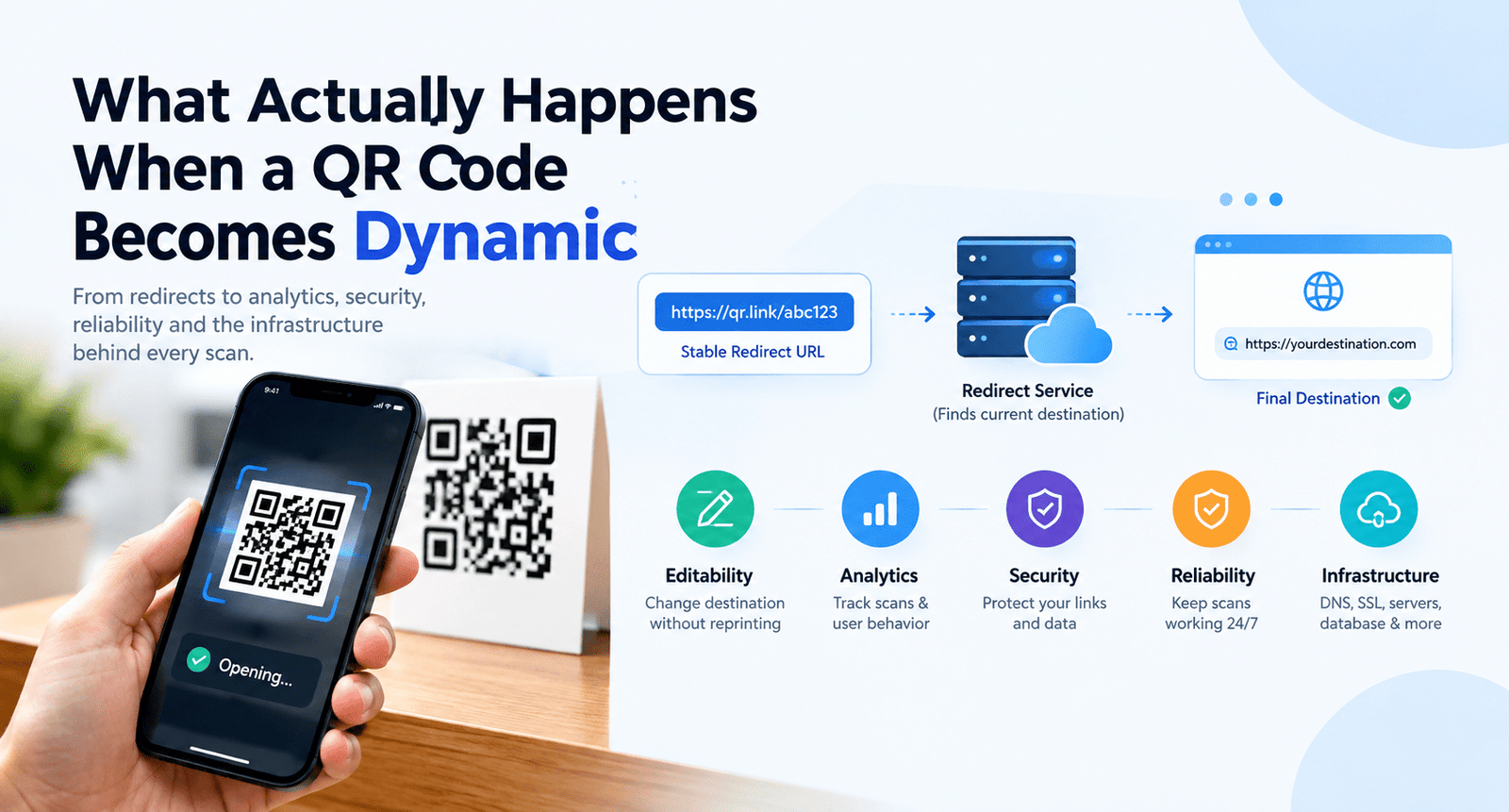
A printed QR code looks simple because the visible part is simple: a grid of black and white modules that encodes data. The complexity begins when the encoded data is not the final destination, but a stable web address that can redirect somewhere else. That extra layer is what makes a QR code dynamic in practice. It also introduces a small web infrastructure problem involving redirects, storage, analytics, reliability, and security.
Static and dynamic QR codes differ after the scan
A static QR code usually contains the final information directly. If it contains a URL, the scanner reads that URL and opens it. Once the code has been printed, changing the destination normally means generating and printing a new code.
A dynamic QR code normally encodes a stable redirect URL instead. The scanner opens that redirect URL, the server looks up the current destination, and the server sends the browser to it. The printed code does not need to change when the destination changes because the code points to the redirect service rather than directly to the final page.
This distinction matters because the QR image itself is not doing anything dynamic. The dynamic behavior lives in the web system behind the encoded URL.
The request flow is short but every step matters
A typical scan follows a simple chain. First, the phone decodes the QR symbol into a URL. Second, the browser requests that URL over HTTPS. Third, the redirect service identifies the code from a path or short identifier. Fourth, the service retrieves the current destination from storage. Finally, it returns an HTTP redirect and the browser requests the destination page.
That may take only a fraction of a second, but the user depends on several components: DNS, TLS, the redirect application, its data store, and the destination website. If any required component is unavailable, the scan can fail even though the printed QR symbol is perfectly readable.
This is the first important product lesson: once a QR code becomes dynamic, availability is no longer only a printing problem. It becomes an infrastructure responsibility.
Editability comes from indirection
The core technical idea is indirection. A database record might associate a short identifier such as abc123 with a destination such as a campaign page. When the owner changes the destination, the database record changes, not the QR image.
The redirect URL should therefore be treated as a durable public identifier. If the service changes its internal database structure, hosting provider, analytics pipeline, or application framework, previously printed codes should still resolve to the same stable redirect address.
This also means deleting or recycling identifiers carelessly can be dangerous. A QR code can remain on packaging, posters, documents, or signage for years. Reassigning an old identifier to a different user or destination can create confusing or even unsafe behavior.
Redirect design affects speed and reliability
The redirect endpoint should do as little work as possible. Its critical job is to validate the identifier, resolve the destination, apply essential safety checks, optionally record a lightweight event, and return the redirect. Heavy reporting work should not sit in the path of every scan.
For that reason, analytics are often better handled asynchronously. The redirect can emit a compact event and let another process aggregate counts, countries, devices, browsers, or time based statistics later. If analytics processing slows down, the redirect should ideally continue to work.
Caching can also help, but it needs care. Long caching periods improve performance while making destination changes slower to propagate. Very short caching keeps edits responsive but increases database traffic. The right choice depends on how frequently destinations change and how much traffic the service receives.
Analytics should be useful without becoming invasive
Dynamic QR systems can measure scans because the redirect server sees the request before sending the user onward. Useful metrics can include the time of the scan, an approximate country or region derived from network information, browser family, device category, and the QR identifier.
But a technically possible metric is not automatically a useful metric. Collecting more data increases privacy, compliance, storage, and security costs. For many products, aggregate statistics answer the practical questions without building detailed profiles of individual users.
A good rule is to decide the product question first and collect only the data required to answer it. If the goal is to know whether a poster campaign is being scanned and on which device classes, there is little reason to retain unnecessary identifiers or precise location data.
Security becomes part of the QR product
A redirect service can become a target because changing a destination can change where every existing scan goes. Account security therefore matters much more than it might appear from the simplicity of the QR interface.
At minimum, destination edits should require authenticated access, ownership checks should be enforced on every update, and identifiers should not expose predictable access to other users' records. Administrative actions should be logged so unexpected changes can be investigated.
Destination validation is also important. Systems should reject malformed URLs and should consider protections against destinations that create obvious abuse. Open redirect behavior, where arbitrary destinations can be supplied without ownership or policy checks, can make a service useful to phishing campaigns and can damage the reputation of the redirect domain.
The redirect domain itself is an asset. If browsers, email systems, or security vendors begin to distrust it because of abuse, legitimate QR codes can be affected. Abuse prevention is therefore not only a moderation concern; it is a reliability concern for every user of the service.
Failure modes are easier to manage when they are separated
A dynamic QR system can fail in several different ways. DNS can fail to resolve. TLS certificates can expire or be misconfigured. The redirect application can be unavailable. The database can be slow. A destination can be removed. An account can be compromised. The analytics system can fall behind.
Treating all of these as one generic outage makes debugging harder. Separating the redirect path from nonessential systems, monitoring each dependency, and returning clear error pages for invalid or disabled codes makes incidents easier to understand.
The most important path should also be the simplest path. A scan should not depend on a dashboard service, a report generator, an email system, or other features that have nothing to do with resolving the destination.
A practical architecture for a small service
A small dynamic QR platform does not need an elaborate architecture. A sensible starting point can be built from a few clearly separated responsibilities:
- A public redirect endpoint that resolves stable QR identifiers quickly.
- A database that stores ownership, destination, status, and creation information.
- An authenticated dashboard for creating codes and changing destinations.
- A lightweight event pipeline for scan analytics.
- Background aggregation for reports that do not need to run during the redirect.
- Monitoring for redirect errors, latency, certificate problems, and unusual traffic.
- Basic abuse controls and a way to disable malicious or compromised destinations.
The exact technology is less important than preserving these boundaries. A serverless function, a small application server, or an edge worker can all be reasonable choices if the redirect remains fast, observable, and independent from nonessential features.
Product decisions are technical decisions
Features that look like interface choices often create infrastructure consequences. Allowing users to pause a QR code requires a defined behavior for paused scans. Allowing destination history creates retention and access control questions. Allowing team workspaces requires permission checks on every change. Allowing custom domains introduces DNS and certificate management.
Even something as simple as showing a scan count raises a definition question. Does a refresh count as another scan? Are obvious bots filtered? Are repeated requests from the same device combined? A metric becomes meaningful only when its rules are consistent and understandable.
This is why the most useful design work happens before adding more features. The service needs clear invariants: a printed identifier should remain stable, a destination change should propagate predictably, unauthorized users should not be able to change it, and analytics should never be allowed to break the redirect itself.
A deployment checklist
- Keep the redirect URL stable across future application changes.
- Use HTTPS and monitor certificate renewal.
- Keep the redirect path minimal and fast.
- Separate analytics processing from the redirect when possible.
- Enforce ownership and authorization on every destination change.
- Do not recycle public identifiers casually.
- Validate destinations and plan for abuse reports.
- Monitor latency, error rates, and invalid identifiers.
- Define what each analytics metric actually means.
- Collect only the data the product genuinely needs.
The main lesson
Dynamic QR codes are a good example of how a small interface can hide a real distributed system. The QR symbol is only the entry point. The useful behavior comes from the redirect layer behind it, and that layer has to remain stable long after the code is printed.
The engineering challenge is not making the redirect complicated. It is keeping the critical path simple while still supporting editability, analytics, security, and long term reliability. A well designed system makes all of that invisible to the person scanning the code, which is exactly how it should feel.
About the author
David Mariscal Fernández is the creator of ProQR, a web tool for static and dynamic QR codes. https://useproqr.com
Want to Share Your Expertise?
Have valuable insights, industry knowledge, or an original technology article to share? You can also submit your content to TechTalksToday. We welcome well-written, original content that provides useful information and insights to our readers.
Submit your content today and get your ideas in front of a technology-focused audience. Contact us to learn more about our content submission opportunities.