

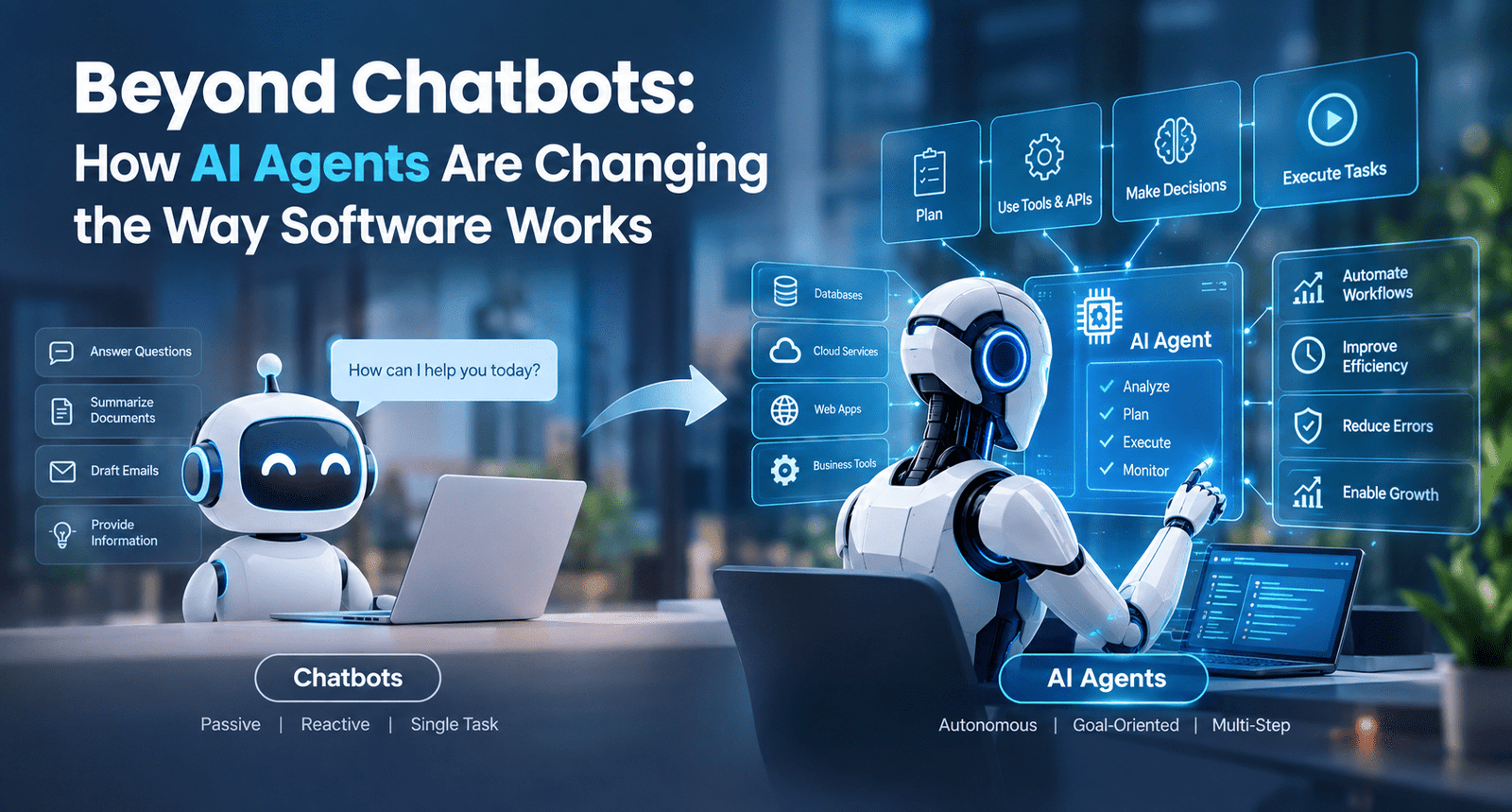
For years, our interaction with ai was a predictable script - you type a prompt, wait a few seconds, and get a neatly formatted block of text. Chatbots are digital sounding boards - useful for summarizing documents, drafting emails, or answering basic questions, but ultimately passive. They sit within a browser window waiting for human direction, unable to act on their own.
Such a paradigm is rapidly changing. We have moved from conversational UIs to advanced AI agent development, giving rise to autonomous, goal-oriented systems that execute complex workflows. Modern architectural frameworks not only propose solutions but also carry out multi-step processes, make context-based decisions, and interact with their external environment. Businesses looking to implement these technologies can explore AI Agent development companies to find organizations specializing in building and deploying AI-powered solutions.
In order to comprehend this transformation, it is necessary to examine the evolution of systems from basic chat windows to powerful orchestration engines and what this implies for the future of enterprise computing.
From Static Text Output to Autonomous Execution
The main restriction of conventional chatbots is their isolation. A standard language model knows how to generate credible text based on its training, but it cannot log into your CRM, verify inventory levels, or trigger an emergency system patch without heavy custom scripting.
Autonomous agents eliminate this boundary. Equipped with planning capabilities, long-term memory, and tool integration, an ai agents operates on high-level objectives rather than granular instructions. If you ask a conversational assistant to handle a customer return, it gives you a template email. If you assign the same objective to an agent, it cross-references the customer’s account history, evaluates the return policy against current inventory, initiates a refund via the payment gateway, and updates the warehouse management system - all without human intervention.
This move toward action-oriented architecture relies on three core capabilities-
- Tool Use & API Integration- Agents interact with external databases, execution environments, and web applications through standard protocols.
- Dynamic Planning- When faced with an unexpected error or missing data, an agent adjusts its approach, re-evaluating sub-goals on the fly.
- Reflection & Error Handling- Modern agent frameworks continuously evaluate their own outputs, running internal validation steps before finalizing a task.
The Rise of Multi-Agent Systems in Enterprise Software
Today we see automation of individual tasks with single-agent systems, but the real enterprise transformation happens when multiple specialized agents work together.
Instead of creating a monolithic software program that tries to handle each process from start to finish, engineering teams deploy coordinated networks of specialized units. For example, in a modern software development lifecycle, you could have one agent whose sole job is writing functional code, another that scans for security vulnerabilities, and a third that writes test suites and documentation.
Enterprise AI agents break complex business logic into modular roles to reduce hallucination risk and increase output speed. Each agent works within a defined scope and passes structured outputs to the next node in the pipeline.
Transforming the SaaS Paradigm
Over the years, Software-as-a-Service (SaaS) systems relied on people for every action. Dashboards, forms, dropdown menus, and manual data entries became the backbone of all productivity.
Now, with advances in agent frameworks, conventional GUI systems are being replaced with intent-driven interfaces. Users no longer have to spend countless hours navigating software menus to create reports or build pipelines. They simply state what they want done, and the AI agents handle the process.
This structural shift is reshaping software architecture in several distinct ways-
- Headless Execution- Software is increasingly built around agent-accessible APIs rather than human-facing visual dashboards.
- Predictive Task Management- Systems actively monitor data streams to trigger actions preemptively, rather than waiting for scheduled manual batch processing.
- Decentralized Decision-Making- Routine internal approvals and rule-based tasks move to background agents, allowing human teams to focus exclusively on edge cases and strategic exceptions.
Overcoming the Orchestration Challenge
Moving these systems from experimental pilots to production environments creates steep engineering challenges, even as the shift to agentic workflows promises clear efficiency gains.
Autonomous software decision-making comes with real risks around security, rate limits, and control. Without proper guardrails, an agent could get stuck in an endless loop trying to accomplish a failed task, execute dangerous system commands, or leak sensitive internal data between connected network nodes.
These operational risks shift professional AI agent development toward governance, control loops, and observability rather than just model performance. Engineering teams need to implement-
- Deterministic Guardrails- These are hard constraints that restrict what an agent can autonomously approve.
- Human-in-the-Loop (HITL) Triggers- Required human review checkpoints for high-risk operations, e.g., financial transactions or production database writes.
- State Management & Auditing- Full log tracking so you can see every decision step, providing clear visibility if an agent goes off track.
Deploying reliable AI agents requires custom workflows, isolated security sandboxes, and deep context from internal data, which is why businesses are turning to specialized AI agent development services to build secure, production-ready systems.
Concluding Thoughts
The evolution from simple chatbots to custom AI agent development marks a fundamental shift in how human teams interact with software. We are leaving behind the era where computers were purely passive tools waiting for precise manual commands.
As intelligent agents take over the heavy lifting of orchestration, data management, and operational execution, software becomes an active collaborator. Organizations that focus on building secure, well-governed agentic workflows today will define the operational benchmarks for tomorrow - turning static software tools into autonomous drivers of enterprise growth.